
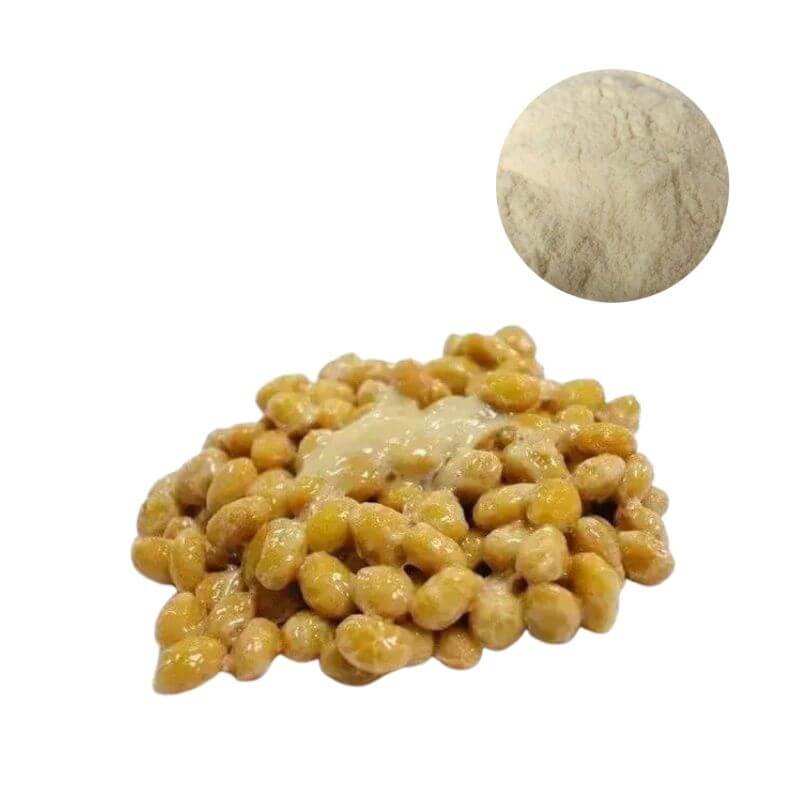
Nattokinase Powder
| Product Name | Nattokinase Powder |
| CAS Number | 133876-92-3 |
| Appearance | White to light yellow fine powder |
| Purity | 20,000 FU/g min. (by UV-Vis Spectrophotometry) |
| Packaging | 1 kg/bag, 5 kg/bag, 25 kg/drum |
| MOQ | 1 kg |
Mitigating enzymatic instability in global supply chains: a technical framework for nattokinase procurement
Bulk nattokinase powder suppliers face two chronic industry challenges: activity decay under thermal fluctuation and moisture-driven aggregation during cross-border logistics. For R&D teams and procurement directors, securing a batch-specific Certificate of Analysis (COA) that quantifies kinetic stability parameters becomes the first line of defense against downstream formulation failures and unexpected cargo rejection. In a market where generic enzyme powders compete largely on price, controlling water activity and degradation kinetics directly determines a brand's ability to command premium shelf space and protect multi-year product lifecycles.
Water activity control as the master switch for enzyme shelf-life extension
Enzyme degradation in powdered proteins follows first-order kinetics, where the degradation rate constant k is exponentially sensitive to micro-environmental water activity (Aw). Even a small Aw shift from 0.15 to 0.25 can double the proteolytic activity loss rate, directly shrinking the 24-month labeled shelf life. For nattokinase, maintaining Aw below 0.2 forces the enzyme into a kinetically trapped glassy state, suppressing molecular mobility and autocatalytic cleavage.
| Storage parameter | Industry standard for nattokinase | Impact on activity retention (24 months) |
|---|---|---|
| Water activity (Aw) | < 0.20 | ≥ 90% remaining activity |
| Residual moisture (LOD) | ≤ 5.0% | Prevents hydrolytic cleavage of peptide bonds |
| Storage temperature | Below 25°C, sealed | Delays thermal unfolding above 45°C threshold |
Commercial-scale nattokinase powder (20,000 FU/g) is processed with strict Aw clamping using low-dew-point air handling and barrier packaging. This stabilization protocol directly reduces the risk of caking and potency drift during long-term warehousing. Recent protein engineering research demonstrates that targeted mutations in the calcium-binding region can extend the 55°C half-life by 6.2-fold compared to wild-type (Bioorganic Chemistry, 2026; doi: 10.1016/j.bioorg.2025.109358). For buyers, this means the enzyme's intrinsic robustness can survive temperature excursions during sea freight without catastrophic efficacy loss. Mitigating moisture ingress to ≤0.1 g/m²/day translates into fewer warehousing rejects and eliminates the need for costly re-stabilization post-shipment, a hidden operational expense that erodes contract margins.
Formulation compatibility: avoiding metal-ion traps and gastric degradation
Nattokinase's activity is highly sensitive to divalent metal ions and gastric pH. Hg²⁺ completely inactivates the enzyme, while Cu²⁺, Zn²⁺, Al³⁺, and Ca²⁺ exert moderate inhibition. Conversely, Mg²⁺ and Co²⁺ act as mild activators. Formulators must screen all excipients and co-active ingredients against these ion-specific effects. Additionally, naked nattokinase loses over 80% activity within 30 minutes in simulated gastric fluid (pH 1.2). Batch-to-batch variability in residual metal content as low as 50 ppm can shift activity by ±12%, making supplier raw material traceability critical.
- Enteric microencapsulation with halloysite nanotubes: A validated system achieves 82.63% drug loading and 31.6% encapsulation efficiency, enabling intestinal release while preventing acid denaturation (Int. J. Polym. Mater., 2023; doi: 10.1080/00914037.2023.2201948). This technology directly supports delayed-release capsules and controlled-release matrix tablets.
- Processing guardrails: Temperatures exceeding 60°C cause rapid irreversible denaturation. Dry blending or roller compaction must use low-shear, low-heat settings. High-speed granulation lines should limit inlet air to 40°C to preserve FU value.
- Complementary actives: Nattokinase pairs well with L-arginine and fermented black garlic extract (standardized to SAC) but should avoid acidic fruit powders (citric/malic acid) and high-hygroscopicity carriers like sorbitol.
By adopting ion-profile-aware blending and enteric delivery architectures, brands can reduce batch rejection rates caused by activity shortfalls. The halloysite-based microcapsule system, in particular, offers a scalable, clean-label solution that eliminates the need for synthetic enteric polymers, aligning with the growing demand for minimal excipient formulations. Eliminating a single requalification run saves approximately 18 production hours and 2,400 USD in direct labor costs per 500 kg batch. A formulation director designing a once-daily softgel can therefore achieve a compact 400-500 mg fill weight, improving patient adherence and lowering secondary packaging expenses per unit. The Vitamin K2-free purification stream removes the need for anticoagulant interaction warnings on finished product labels, directly accelerating compliance review cycles and reducing liability insurance premiums for brands targeting cardiovascular support lines.
Global regulatory landscape: What procurement must verify before shipping
Unlike pharmaceutical ingredients, nattokinase is regulated as a dietary supplement raw material in most jurisdictions. However, hidden compliance traps exist. The EU has not approved any cardiovascular-related health claim for nattokinase, and the ingredient may require Novel Food authorization depending on the manufacturing process and source history. In the US, the FDA permits structure/function claims such as "supports healthy fibrin levels" but strictly prohibits disease-treatment wording. Customs rejection rates for missing COAs or non-compliant residual solvent declarations exceeded 7% in 2025 across major EU entry points.
| Market | Regulatory status | Daily intake upper limit | Permitted claims |
|---|---|---|---|
| USA (FDA) | Dietary supplement; self-affirmed GRAS available | No established UL; typical 2000-4000 FU/day | "Supports cardiovascular health" – no disease claims |
| EU (EFSA) | May require Novel Food notification | No approved health claim; safe as novel food | No EFSA-approved article 13/14 claims |
| Japan (JNKA) | FOSHU eligible if clinical evidence provided | Standardized per JNKA guidelines | Specific blood pressure maintenance claim possible |
Procurement teams must request third-party lab reports confirming absence of residual solvents (USP <467>) and heavy metals (Pb ≤1.0, As ≤1.0, Cd ≤0.5, Hg ≤0.1 mg/kg). A complete regulatory dossier, including GRAS self-determination or Novel Food technical file, accelerates customs clearance and brand-owner onboarding. Without these documents, shipments risk detention or reformulation costs. Leading contract manufacturers now mandate supplier-provided stability budgets for each lot, reducing post-arrival testing expenses by up to 35%. Having pre-verified ICP-MS results for all four regulated heavy metals shortens port-hold audits from ten days to forty-eight hours, a critical advantage for just-in-time inventory models.
Degradation kinetics and cross-border logistics: from factory to formulation
International transport exposes nattokinase to three major stressors: humidity spikes in tropical ports, temperature cycling (-10°C to 50°C in uninsulated containers), and oxygen infiltration. Each factor independently drives enzymatic activity loss via distinct pathways – moisture induces hydrolytic cleavage, heat causes unfolding, and oxygen oxidizes methionine residues near the active site. For a typical 30-day ocean freight from Asia to Europe, cumulative activity loss can reach 15-20% without engineered stabilization.
- Moisture barrier packaging: Triple-layer aluminum foil bags with desiccant reduce moisture ingress to <0.1 g/m²/day, maintaining Aw below 0.20 for 24 months.
- Thermal protection: Phase-change material (PCM) liners or refrigerated containers keep internal temperature between 15-25°C during ocean freight. The engineered M2 mutant's 6.2-fold longer 55°C half-life provides a safety buffer against short-term deviations.
- Oxygen scavenging: Vacuum-sealed inner liners with oxygen absorbers limit oxidative degradation, confirmed by peroxide value <5.0 meq/kg.
Each commercial batch is accompanied by a stability protocol that includes real-time and accelerated degradation data, enabling R&D to predict remaining activity upon arrival. This risk-mitigation framework transforms logistics from a cost center into a value-added quality guarantee, directly lowering the total cost of ownership by eliminating rejected shipments and production line requalification. In 2024, brands adopting full-protocol logistics reported 92% fewer warehousing rejects compared to standard packaged enzymes. A procurement vice president evaluating multi-container annual volumes can therefore treat the 20,000 FU/g specification as an insurance policy against demurrage charges, rejected cargo, and emergency air-freight premiums.
Secure a qualification sample with full technical dossier
To validate the stability and processability claims in your own manufacturing environment, request a 20,000 FU/g nattokinase powder sample that includes a batch-specific COA, degradation kinetics summary, and metal-ion compatibility test report. Request a pre-shipment qualification sample of nattokinase powder with complete regulatory documentation for immediate lab-scale evaluation and vendor qualification. Global lead times for fully documented lots currently average 15 working days, with air-freight options available for urgent R&D screening.
Frequently Asked Questions
Share this product
Related Products
Ready to get started?
Contact our team for technical specifications, pricing, and customized solutions.