
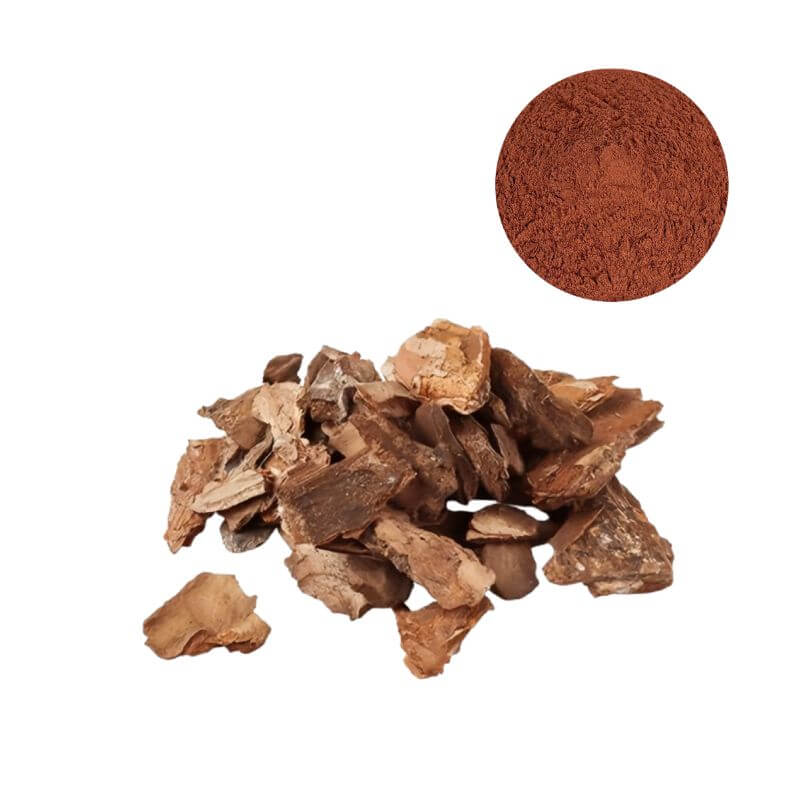
Pine Bark Extract Powder
| Product Name | Pine Bark Extract Powder |
| CAS Number | 133248-87-0 |
| Appearance | Reddish-brown fine powder |
| Purity | OPCs ≥ 70.0% (by HPLC) / Proanthocyanidins ≥ 95.0% (by UV) |
| Packaging | 1 kg/bag, 5 kg/bag, 25 kg/drum |
| MOQ | 1 kg |
Pine Bark Extract Powder (≥ 95% Proanthocyanidins): A Strategic Antioxidant Core for Metabolic & Cognitive Health Formulations
For supplement brands moving beyond generic antioxidant blends, the differentiation lies in clinically-quantifiable efficacy and clean-label provenance. Pine Bark Extract Powder, available as bulk pine bark extract standardized to OPCs ≥ 70% by HPLC or ≥ 95% proanthocyanidins by UV-Vis, has emerged as a foundational ingredient in this shift. Its potent oligomeric proanthocyanidins (OPCs) are directly linked to measurable outcomes in vascular function, glycemic control, and neuroprotection. However, capturing this value in a finished product requires more than a certificate of analysis—it demands a supplier who interprets those numbers as formulation intelligence. Bulk pine bark extract with batch-to-batch consistency turns a commodity into a competitive asset. For brand owners, this science-backed purity grade supports premium pricing and reduces reliance on generic claims.
Precision Through Proanthocyanidins: The Biochemical Rationale for Metabolic Support
Unlike single-molecule antioxidants, pine bark extract operates through a network pharmacology model. Its low-molecular-weight proanthocyanidins, primarily B-type oligomers, exhibit high affinity for vascular endothelial cells. Clinical evidence confirms that this interaction enhances nitric oxide (NO) bioavailability, directly improving endothelium-dependent vasodilation. A 2025 systematic review and meta-analysis of 27 randomized controlled trials (n=1,685) reported that pine bark extract supplementation significantly reduced systolic blood pressure (-2.26 mmHg), diastolic blood pressure (-2.62 mmHg), fasting blood glucose (-6.25 mg/dL), and HbA1c (-0.32%) (BMC Complement Med Ther, 2025; doi: 10.1186/s12906-025-04819-9). A 2022 randomized controlled trial in 62 adults using Pinus massoniana bark extract (1,322 mg/day, 12 weeks) reported SBP reduction of -3.29 mmHg (P=0.028), with -7.49 mmHg in the untreated high-normal BP subgroup (P=0.001) and DBP by -3.06 mmHg (P=0.011) (Complement Ther Med, 2022; doi: 10.1016/j.ctim.2022.102896). From a strategic formulation perspective, these quantifiable endpoints allow brands to transition from vague “antioxidant support” claims to specific cardiometabolic maintenance positioning—a critical differentiator in the saturated heart health category.
Key clinical outcomes validated by recent research:
- Blood pressure modulation – SBP reduction of 2-7 mmHg depending on baseline levels.
- Glycemic control – Fasting glucose decrease of ~6 mg/dL, comparable to mild lifestyle interventions.
- Lipid profile improvement – LDL cholesterol reduction of ~5 mg/dL without statin-like side effects.
For procurement teams, this directly translates to a risk-mitigated investment. The ingredient’s multi-target mechanism supports multiple product lines (cardiovascular, metabolic, cognitive) under one raw material SKU, simplifying inventory and reducing qualification overhead.
Quality Benchmarks That Preserve Biological Activity: Beyond Simple Purity
While a ≥ 95% proanthocyanidin specification is commercially standard, not all 95% extracts perform identically in vivo. The critical hidden variable is the oligomer-to-polymer ratio. Lower-molecular-weight oligomers (dimers to tetramers) are the primary absorbable and bioactive fractions. In premium pine bark extract powder, the OPC profile should be enriched in these bioactive units—a nuance rarely captured by a single UV total phenolics number. Reputable GMP pine bark extract suppliers provide HPLC fingerprinting that verifies this distribution, along with strict residual solvent limits (USP <467>) to guarantee safety in long-term use formulas.
| Quality Attribute | Specification Benchmark | Why It Matters for Formulators |
|---|---|---|
| Proanthocyanidin Oligomer Ratio | ≥ 40% oligomers (dimers to tetramers) | Higher bioavailability; directly influences NO production and antioxidant efficacy. |
| Loss on Drying | ≤ 5.0% (USP <731>) | Low moisture prevents caking and hydrolytic degradation during blending. |
| Heavy Metals (Pb, As, Cd, Hg) | Pb ≤ 3.0 mg/kg, As ≤ 1.0 mg/kg, Cd ≤ 1.0 mg/kg, Hg ≤ 0.1 mg/kg (ICP-MS) | Meets EU and US Prop 65 thresholds, enabling global distribution. |
For procurement teams, this directly translates to a simplified supplier qualification process. When a certified COA includes these detailed parameters, brands save weeks of independent lab testing and reduce the risk of non-compliance in regulated markets like the EU (Novel Food-compliant sources) and the US (GRAS affirmation). From a compliance standpoint, verifying the oligomer ratio and heavy metal profile upfront avoids costly reformulation or market rejection later—a direct contributor to total cost control.
Formulation in Practice: Stability, Synergy, and Dosage Architecture
Pine bark extract’s polyphenolic nature makes it susceptible to oxidation, photodegradation, and metal-ion chelation. Practical formulation requires an integrated strategy. For solid dosage forms (tablets, capsules), direct compression with dry binders (microcrystalline cellulose) and a humidity-controlled environment (<45% RH) effectively preserves activity. For gummies or liquid shots, encapsulation with cyclodextrins or liposomes significantly enhances stability—though at a higher cost. The ingredient is highly compatible with vitamin C (protects and regenerates proanthocyanidins) and medium-chain triglycerides (MCTs) for improved lymphatic absorption. However, avoid direct mixing with alkaline minerals (e.g., magnesium carbonate) in aqueous systems, as pH > 7 accelerates degradation.
Common formulation scenarios and recommended integration:
- Capsules (500 mg fill weight) – 100-150 mg pine bark extract + vitamin C (Ascorbic Acid) (50 mg) + microcrystalline cellulose. Ideal for cardiovascular and antioxidant formulas.
- Functional beverage powder (5 g stick pack) – 100 mg pine bark extract + acerola cherry extract + natural flavors. Requires microencapsulated form for shelf-life > 18 months.
- Sports nutrition tablet (2-tablet dose) – 150 mg pine bark extract + beetroot extract + taurine powder. Supports NO pathway synergy for endurance.
From a strategic formulation perspective, the 95% purity grade allows lower inclusion rates (100-200 mg daily) while achieving clinical efficacy observed in studies using 150-300 mg of less concentrated extracts. This reduces total formula cost and enables smaller tablet sizes—a significant consumer compliance advantage. The 2022 trial’s 1,322 mg/day reflects a supplement matrix, not a standardized extract. For R&D teams, this purity level means they can hit clinical-effective doses in two capsules instead of four, directly improving patient adherence and repeat purchase rates.
Supply Chain Integrity & Total Cost of Ownership for Bulk Sourcing
When evaluating bulk pine bark extract suppliers, price per kilogram is a misleading metric. The real differentiator is total cost of ownership (TCO), which includes stability testing, rework from out-of-spec batches, and market delays from insufficient documentation. High-quality pine bark extract powder is derived from controlled species (Pinus massoniana or Pinus pinaster), with extraction using purified water or ethanol-water mixtures. Massoniana extracts offer a favorable cost-to-OPC-content ratio, while premium French maritime pine extracts command a premium. For pine bark extract wholesale, key sourcing considerations include:
- Traceability – Does the supplier provide species identification via HPTLC or microscopy?
- Batch-specific COA – Are heavy metals, residual solvents, and microbials tested per USP/EP methods?
- Regulatory support – Can they supply Novel Food or GRAS dossier excerpts for EU/US filing?
For procurement teams, this directly translates to lower operational risk. A single out-of-spec heavy metal batch could trigger a product hold costing $50k+ in lost revenue and brand damage. Partnering with a certified pine bark extract exporter who provides full disclosure of these parameters turns a raw material purchase into a compliance asset. Applying a total-cost-of-ownership lens, the incremental investment in verified, GMP-certified material prevents catastrophic batch failures and regulatory rejections, safeguarding both brand reputation and launch timelines.
Next Steps: Accelerate Your Development Cycle with Verified Resources
Pine bark extract powder at ≥ 95% proanthocyanidins delivers clinically supported efficacy for cardiometabolic and cognitive health formulations. By choosing a pine bark extract supplier that provides full HPLC fingerprinting, stability protocols, and regulatory dossiers, you de-risk your product launch and shorten the R&D timeline. Start by requesting a complimentary sample and the complete technical dossier—including the batch-specific COA and suggested formulations for capsules, powders, and gummies. Request Your Complimentary Sample & Technical Dossier – available for qualified brands within 24 hours.
Frequently Asked Questions
Share this product
Related Products
Ready to get started?
Contact our team for technical specifications, pricing, and customized solutions.