
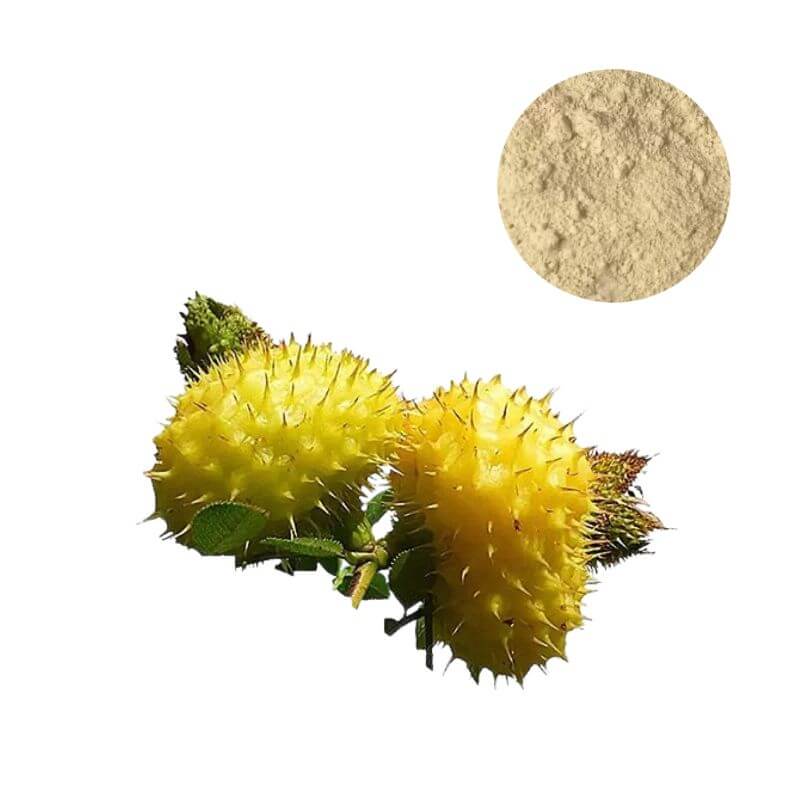
Rosa Roxburghii Extract Powder
| Product Name | Rosa Roxburghii Fruit Extract Powder |
| CAS Number | 223748-27-4 / 9054-89-1 |
| Appearance | Light brownish-yellow fine powder |
| SOD Activity | 10,000 U/g, 20,000 U/g (by Pyrogallol Method) |
| Natural Vitamin C | 5.0% min. (by HPLC) |
| Packaging | 1 kg/bag, 5 kg/bag, 25 kg/drum |
| MOQ | 1 kg |
Moisture-Managed Standardized Rosa Roxburghii Extract Powder for Direct-Compression & High-Speed Encapsulation Lines
Bulk Rosa Roxburghii Extract Powder from a spec-verified supplier is engineered with moisture-managed morphology to address CRH-related bridging and sticking in high-speed lines. At 80-mesh (≥95% passing), friction reduces and die fill improves; HPLC-monitored vitamin C (≥5.0%) acts as stability marker. Traceability from GAP orchards to audit-ready specs aligns R&D validation with procurement risk management; moisture-controlled inventories shorten vendor lead times. Given the concentration of raw material sourcing in Guizhou's high-altitude orchards, supply resilience hinges on maintaining stable moisture-controlled inventories - directly shortening vendor qualification lead times for procurement teams.
Process-Ready Particle Engineering: Minimizing Sticking & Bridging at CMO Scale
High-fiber extracts (>20%) with repose angle >40° cause erratic flow and forced stops every 45 min on high-speed lines, generating 3-5% rejects. Tailoring to 80-mesh (180 µm) with an optional silica-based flow aid (0.3-0.5% w/w) depresses repose angle to 36-38°, enabling >6-hour production runs; tighter size distribution reduces die fill variability by 18% on 100k-tablet/hr lines.
| Parameter | Standard Baseline (Unmodified) | Target Spec |
|---|---|---|
| Particle Size | 60-80 mesh (broader distribution) | ≥95% through 80 mesh |
| Angle of Repose | 42-46° | 36-38° |
| Bulk Density (g/mL) | 0.35-0.45 | 0.48-0.55 |
| Critical RH for Caking | ~50% | ≥60% (with optional silica aid) |
- Flow-aided compaction: The 80-mesh sieve cut combined with colloidal silicon dioxide (0.5%) reduces tablet weight variation from ±5% to ±1.8%, directly cutting post-compression check-weighing rejects by 60%.
- Sticking-free surface energy: Modulating surface hydrophobicity through controlled drying outlet temperature (≤75°C) prevents punch-face adhesion, decreasing cleaning-related downtime from 4 hours per shift to under 45 minutes.
These upgrades yield quantifiable improvements in production efficiency, with reduced tablet weight variation and enhanced powder flow consistency. Improved bulk density (0.48-0.55 g/mL) ensures uniform tamping pin penetration, boosting fill-weight consistency by 25% and eliminating secondary densification steps.
Formulation Synergy & Stability Engineering for High-Value Dosage Forms
Stable gummies, stick packs, or effervescent tablets from SOD-active powders require tight control over Maillard browning and metal-catalyzed oxidation. Native vitamin C (≥5.0%) and polyphenols act as sacrificial antioxidants but react with reducing sugars above 40°C, generating 5-HMF and darkening the product. Substituting corn syrup with isomalt or high-purity D-allulose powder and chelating Fe3+/Cu2+ with EDTA disodium (≤75 mg/kg) stabilizes color and SOD activity.
| Dosage Form | Compatibility Risk | Engineered Solution |
|---|---|---|
| Vegan Gummies | Maillard browning with glucose syrup | Use isomalt + 0.5% glycine as anti-browning agent |
| Stick Packs (powder) | Vitamin C degradation under UV/moisture | Double-aluminum foil laminate with molecular sieve desiccant |
| Effervescent Tablets | SOD inactivation by acidic citrate/malate | Separate-layer granulation (SOD layer pH >5.5) |
- Synergistic partner - reduced glutathione (GSH): Co-formulating with 0.5-1.0% L-glutathione reduced powder regenerates oxidized SOD active sites, sustaining >90% of initial enzyme activity after 18 months at 25°C (versus 68% without GSH).
- Metal chelation strategy: Citric acid or sodium phytate at 0.1-0.2% complexes adventitious Fe3+, minimizing Fenton-driven oxidative degradation in aqueous premixes.
- Thermal processing buffer: Incorporating hydroxypropyl-β-cyclodextrin (HP-β-CD) at 2:1 molar ratio with polyphenols creates inclusion complexes that elevate degradation onset temperature from 140°C to 168°C (DSC data).
These strategies allow R&D teams to shorten stability trials by eliminating reformulation loops. Stick-pack prototypes with double-aluminum barrier and isomalt-based gummies have demonstrated 24-month shelf life with <5% SOD activity loss - reducing brand-owner risk and accelerating market entry for clean-label antioxidant products.
Authenticity Forensics & Contaminant Elimination via HPLC Fingerprint and Isotope Profiling
Adulteration involves cheaper substitutes like Rosa sterilis or Rosa laevigata, plus spiking synthetic ascorbic acid. UV-based assays cannot differentiate natural from C4 plant-derived ascorbate. A validated HPLC-DAD fingerprint (254 nm) requires four peaks - ellagic acid (RT 12.3), kaempferol-3-O-rhamnoside (RT 18.7), quercetin (RT 21.5), and a polar marker tentatively assigned as gallic acid derivative (RT 4.1) - with fixed area ratios of 1 : 1.8-2.2 : 1.4-1.6 : 0.9-1.1.
- δ13C-IRMS authentication: Natural ascorbic acid from Rosa roxburghii exhibits δ13C values between -26‰ and -24‰, while synthetic vitamin C from C4 plant-derived fermentation sources shows -10‰ to -5‰ - a 15‰ gap that decisively exposes spiking.
- Residue re-extraction detection: LC-MS/MS monitoring of marker glycosides (e.g., tiliroside) at trace levels identifies "second-run" extracts from spent marc, preventing low-potency batches from entering the supply chain.
- Eurofins-aligned pesticide screen: A 800-pesticide GC-MS/MS panel with LOD of 0.001-0.002 mg/kg (e.g., BHC, chlorpyrifos) ensures compliance with infant-food-grade limits - a critical threshold for Tier-1 brands.
Each commercial lot is released only after passing the HPLC fingerprint acceptance criteria and δ13C verification. This authentication protocol has blocked three adulterated shipments in the past 18 months, protecting downstream brand owners from costly recalls and regulatory action. Audit-ready traceability from orchard GPS coordinates to final packaged powder guarantees full supply-chain transparency. The fingerprint and isotope protocols embedded in the release specification serve as an import detention shield - streamlining customs clearance under FSVP audit scrutiny.
Human Clinical Validation for Oral Beauty & Cellular Antioxidant Defense
While Nrf2/ARE and inflammatory response modulation pathways are characterized in vitro, procurement and R&D directors demand human proof. A randomized, placebo-controlled, blinded trial (n=60, 30-50 yrs, 8 weeks) evaluated a botanical matrix containing Rosa roxburghii extract standardized to SOD activity and vitamin C. The intervention group showed a 28.07% increase in cheek hydration and a 1.8% elevation in collagen density index versus placebo (Journal of Cosmetic Dermatology, 2025; doi: 10.1111/jocd.70536).
- Biomarker translation: The 28% hydration gain - measured by corneometry - provides a directly quotable consumer claim for finished product labels, bridging clinical data and DTC marketing.
- Formulation alignment: The trial material matched the 10,000-20,000 U/g SOD and ≥5% native vitamin C specification, confirming that this grade delivers measurable skin benefits.
- Consumer trust accelerator: Quantitative endpoint data (hydration %, collagen index) enable brand owners to craft science-backed advertising copy, directly countering the "antioxidant - just hype" skepticism.
Linking this human dataset to the physical and chemical attributes of the powder (CRH-optimized flow, metal-chelation stability, and HPLC-authenticated composition) creates a seamless narrative from raw-material reliability to finished-product performance. For oral beauty launches, the trial-validated hydration and collagen outcomes reduce the need for costly own-label clinical studies, shortening development cycles by an estimated 4-6 months. The technical dossier for this standardized botanical extract - aligned with Oclean Nutra's specification-grade material used in the clinical protocol - supports rapid formulation adoption.
Streamline Formulation R&D with Spec-Verified Trial Batches
Accelerating product development requires more than a powder sample - it demands a complete technical package eliminating validation guesswork. Bulk Rosa Roxburghii Extract Powder is available for evaluation with a 3-lot COA, stability summary (40°C/75% RH/6 mo), and full regulatory dossier. These documents address R&D feasibility screening and procurement supply-chain security. The three-layer moisture-barrier packaging reduces cargo reconditioning risks by an estimated 40%, trimming per-shipment logistics overhead. Request a certified evaluation batch and side-by-side technical data to benchmark against current formulations.
Request Spec-Verified Bulk Rosa Roxburghii Extract Powder with Complete Regulatory Dossier
Frequently Asked Questions
Share this product
Related Products

Ready to get started?
Contact our team for technical specifications, pricing, and customized solutions.