
Methylcobalamin vs. Cyanocobalamin: The R&D Guide to Bioavailability, Stability, and Cost-in-Use for Next-Gen Vitamin B12 Supplements
Compare methylcobalamin and cyanocobalamin across stability, cellular retention, and scale-up economics. Learn how 1% trituration solves micro-dose content uniformity issues to optimize your B12 supplement pipeline.
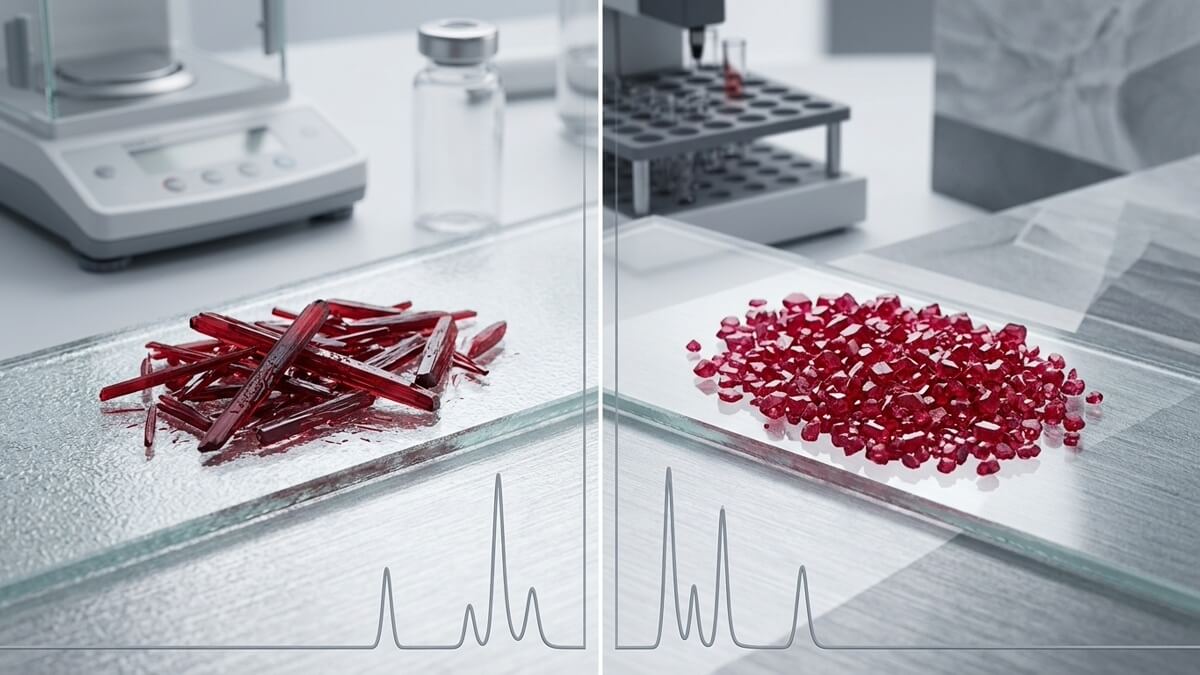
Many brands transitioning from standard B12 to a premium active form encounter a familiar setback: their chosen methylcobalamin powder fails to meet content uniformity targets, sticks to punches, or degrades faster than projected. These failures stem from overlooking structural, physicochemical, and pharmacokinetic differences between the two dominant B12 vitamers. This guide provides the hard data that R&D, QA, and procurement teams need to navigate that transition with confidence.
Structural Divergence and Immediate Processing Consequences
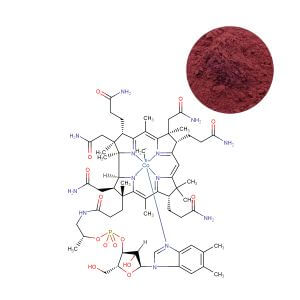
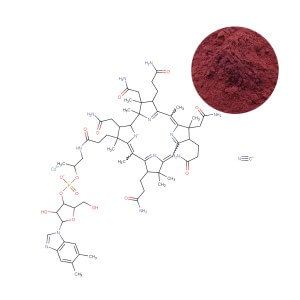
Methylcobalamin carries a methyl group (-CH3) at the cobalt center, while cyanocobalamin bears a cyano moiety (-CN). This substitution alters electron density and directly influences solubility, hygroscopicity, and photostability. The active form dissolves to only ~0.01 g/100mL in water (25°C), compared with ~1.25 g/100mL for the synthetic analogue. Its melting point (decomposes above 190°C) offers little processing advantage, but its pronounced hygroscopicity demands stringent humidity control during blending. Particle size distribution-for example, 90% passing through 200 mesh-directly affects blend homogeneity and necessitates extended mixing cycles for pure-grade powders.
When selecting Methylcobalamin Powder, formulators must decide between a 99% crystalline grade and a 1% trituration on DCP or mannitol. The pure form exhibits poor flow (Carr index >25, indicating poor flowability per industry classification) and high electrostatic charge, making it unsuitable for direct compression. The 1% pre-blend, by contrast, yields a free-flowing granulation (Carr index <15, consistent with good flowability per industry standards) that ensures content uniformity (RSD <3%) at microgram potencies. Smart procurement teams evaluate effective-dose cost rather than per-kilogram pricing, factoring in flow consistency and blend uniformity.
| Physical Property | Methylcobalamin | Cyanocobalamin | Scale-Up Impact |
|---|---|---|---|
| Aqueous solubility (25°C) | ~0.01 g/100mL | ~1.25 g/100mL | MeCbl requires solubilizers for liquid formats |
| Hygroscopicity (critical RH) | High (uptake >5% at 60% RH) | Low (<2% at 60% RH) | MeCbl needs dehumidified blending areas |
| Photodegradation t1/2 (1971 lux) | 0.99 hours | >50 hours (est.) | MeCbl demands opaque, light-protective packaging |
| Bulk density (g/mL) | Lower than cyanocobalamin | 0.45-0.60 | MeCbl increases blend volume per batch |
Cyanocobalamin bulk density data sourced from Sigma-Aldrich product specifications. MeCbl bulk density is qualitatively lower; precise values vary with crystalline form and particle size distribution. Carr index classifications based on industry-standard powder flowability criteria (Carr index >25: poor flow; <15: free-flowing). Photodegradation t1/2 data sourced from J. Sep. Sci. 2022; doi:10.1002/jssc.202200132.
Pharmacokinetic Divergence and Label-Relevant Differentiation
The absorption advantage of cyanocobalamin at very low doses (~49% vs ~44% for methylcobalamin at 1 mcg) is overshadowed by tissue retention. The synthetic form is excreted in urine at roughly three times the rate of the active form, and animal data show that methylcobalamin yields 13% higher hepatic cobalamin storage. These numbers translate into a clear label claim: "enhanced cellular retention" for methylcobalamin-based products. The underlying mechanism is straightforward-methylcobalamin acts directly as the cytosolic coenzyme for methionine synthase, bypassing the hepatic conversion step required by Cyanocobalamin Powder.
A comprehensive 2023 review of B12 stability profiles confirmed that degradation kinetics differ substantially between vitamers under thermal, photolytic, and pH stress (Molecules, 2023; doi: 10.3390/molecules28010240). For R&D leaders, this reinforces that choosing the active form not only alters pharmacokinetics but also imposes tighter stability controls. When formulating for neurological support or premium positioning, methylcobalamin offers a distinct mechanistic edge that cyanocobalamin cannot replicate without metabolic activation.
- Methylcobalamin: Direct entry into methylation cycle; higher tissue retention; supports neuronal health and homocysteine metabolism.
- Cyanocobalamin: Requires intracellular conversion; lower storage efficiency; suited for general maintenance but not targeted neuro claims.
From a commercial scale-up perspective, solubility and flow parameters directly impact hopper design, feeder speed, and compression force-determining high-throughput line viability.
Scale-Up Dynamics: Compression, Flow, and Stability Under Real-World Stress
In high-speed tableting, methylcobalamin's hygroscopicity and poor flow create tangible risks: sticking to punch faces, picking, and weight variation. At relative humidity above 60%, the powder rapidly absorbs moisture, losing crystalline integrity and causing binding in feed frames. Compressibility indices above 25% correlate with punch sticking rates exceeding 2% of tablet weight, necessitating lubrication adjustments for pure methylcobalamin. For 1% trituration on mannitol, compressibility drops below 18%, stabilizing high-speed punch performance. The 1% trituration on DCP or mannitol resolves most of these issues by providing a free-flowing bulk density that behaves predictably in rotary presses. For gummy production (90-105°C cooking), unprotected methylcobalamin degrades by 30-50% - a loss that can be mitigated with chelating agents or encapsulation systems.
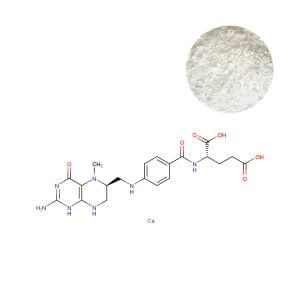
For liquid or semi-solid formats, pH stability becomes critical. Methylcobalamin retains optimal integrity between pH 5.0 and 6.0; below pH 4.0, degradation accelerates tenfold. Formulators should either adjust the finished product's pH or deploy microencapsulation to shield the molecule. Suppliers who understand these physical constraints and offer pre-stabilized grades-such as those meeting the technical specifications of Oclean Nutra-provide a clear advantage in de-risking scale-up. When designing a multi-vitamin stack, consider the synergistic role of 5-MTHF in the methylation cycle; a combined approach with 5-MTHF Ca Powder can amplify the neurological and cardiovascular benefits of active B12.
- Recommended carrier: 1% mannitol-based trituration for direct compression; 0.1% MCC blend for large premixes.
- Process controls: Blend at <40% RH; use opaque packaging; avoid co-processing with ascorbic acid or ferrous salts in the same granulation.
Analytical Auditing, Anti-Fraud Safeguards, and Cost-In-Use Reality
Procurement teams face a subtle fraud risk: some "99%" methylcobalamin batches contain elevated hydroxocobalamin - a direct marker of photodegradation during manufacture or storage. Standard HPLC (C18, 342 nm) achieves a limit of detection (LOD) of 4.4 ng for methylcobalamin, but many suppliers only report total impurities without specifying hydroxocobalamin content. QA departments should mandate a separate specification for hydroxocobalamin (≤0.5%) and request full chromatograms. Residual solvent limits (acetone <5000 ppm, ethanol <5000 ppm) and individual impurity thresholds (single <0.3%) further differentiate qualified suppliers from marginal ones.
| Grade | Purity (HPLC) | Critical Impurity Control | Best-Fit Application |
|---|---|---|---|
| 99% crystalline MeCbl | >99% | Hydroxocobalamin <0.5%; single impurity <0.3% | R&D trials, low-volume custom capsules |
| 1% MeCbl on DCP | 1% ±5% assay | Carrier-related impurities, flowability specs | High-speed tableting, capsule filling |
| 1% MeCbl on mannitol | 1% ±5% assay | Low hygroscopicity, superior compressibility | Direct compression, chewable tablets |
The cost-in-use calculation flips the FOB/kg comparison. Although methylcobalamin typically costs 2.5-3× more than cyanocobalamin per kilogram, the effective cost per bioavailable dose narrows when accounting for superior retention. The incremental ingredient cost of methylcobalamin per finished unit remains modest relative to the 20-30% retail uplift that the active form commands in the premium supplement segment. Procurement leaders should also audit vendors for HPLC methodology; UV-only testing misses hydroxocobalamin substitution entirely.
Decision Framework and Next Steps for Your Product Pipeline
The choice is strategic: market positioning determines the optimal B12 form. For cost-sensitive mass-market multivitamins, cyanocobalamin remains a reliable workhorse. For neuro-focused, premium, or science-driven brands, methylcobalamin's direct metabolic pathway and superior retention make it the only logical choice. Success with the active form, however, hinges on disciplined carrier selection, light-tight packaging, and rigorous process controls.
Request technical documentation including particle size distribution, bulk and tapped density, and a COA that explicitly quantifies hydroxocobalamin. These documents are your first line of defense against supply-chain risks. For tailored assistance in selecting the optimal B12 grade for your formulation, consult our technical advisory team to arrange a sample evaluation and stability trial.
Share this article
Found this helpful? Share it with others!
Related Products
Products mentioned in this article
Want to learn more?
Explore our products or contact our team for personalized solutions and expert advice.