
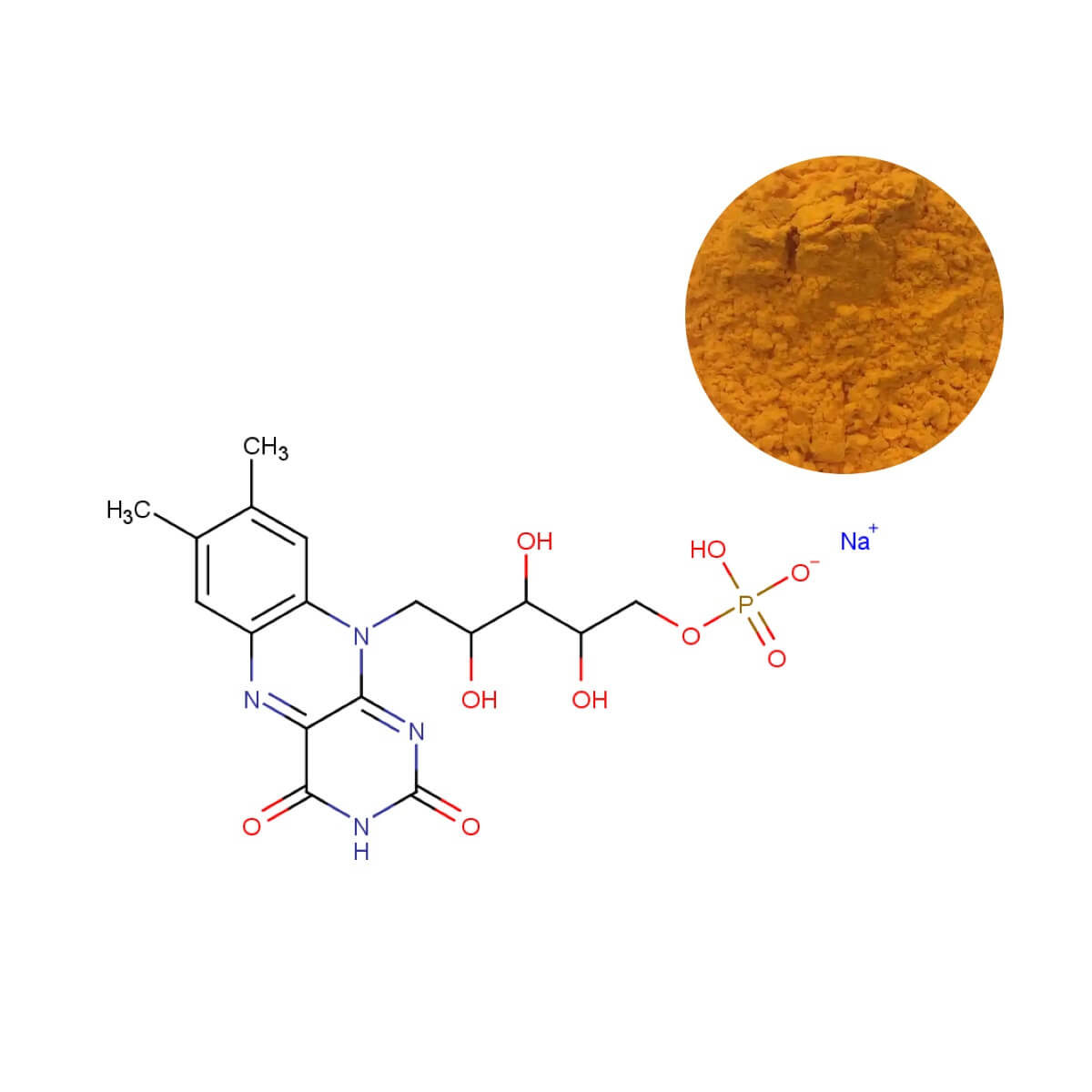
Riboflavin 5'-Phosphate Sodium Powder
| Product Name | Riboflavin 5'-Phosphate Sodium Powder |
| CAS Number | 6184-17-4 (Dihydrate) / 130-40-5 (Anhydrous) |
| Appearance | Yellow to orange-yellow crystalline powder |
| Purity | ≥ 95.0% (by HPLC) |
| Packaging | 1 kg/bag, 5 kg/bag, 25 kg/drum |
| MOQ | 1 kg |
Bioavailable Riboflavin 5'-Phosphate Powder for Premium Energy & Metabolic Support
Bulk Riboflavin 5'-Phosphate Sodium Powder delivered by spec-verified distributors provides a phosphorylated B2 form that is readily utilized in cellular energy metabolism without requiring hepatic flavokinase-mediated phosphorylation. Aqueous solubility exceeding 50 mg/mL unlocks clear liquid formats and high-load tablet innovations not feasible with standard riboflavin. Each commercial lot ships with complete audit-ready traceability and batch-specific COA documentation, bridging clinical-grade validation with procurement risk management while enabling consistent DTC energy-support claims that resonate with premium health-conscious consumers.
Clinical Rationale and Active B2 Bioavailability Fingerprint
Building on the immediate metabolic availability conferred by the phosphate ester, the quantitative USP specification anchors premium brand positioning against generic alternatives. Identity rests on three critical indices: assay (73.0%-79.0% calculated as riboflavin on dried basis), specific rotation (+37.0° to +42.0°), and loss on drying (≤7.5%). Tier-1 brand audits mandate these parameters, while related substances including free riboflavin are controlled to USP limits (≤6.0%). Bulk orders spanning 25 kg to 1 metric ton are routinely verified against USP reference standards, supporting consistent in-vitro performance across production batches for scalable contract manufacturing.
| Identity Parameter | USP Specification | Commercial Significance |
|---|---|---|
| Assay (as Riboflavin) | 73.0% - 79.0% (HPLC) | Verifies active potency for precise labeling |
| Specific Rotation | +37.0° to +42.0° | Fingerprint for batch-to-batch structural consistency |
| Loss on Drying | ≤ 7.5% | Prevents hygroscopic degradation during storage |
This USP-defined fingerprint validates exclusive DTC claims such as "active, coenzymated B2" and "ready-to-use energy support." Brands leveraging these metrics differentiate against inactive riboflavin variants, supporting a premium retail positioning within the energy metabolism segment. The quantitative assay provides clinical practitioners with scientific credibility, while optical rotation data serves as an anti-counterfeit shield against structural isomers, protecting brand equity in competitive markets.
Overcoming Formulation Barriers in Gummies and RTD Liquids
While the clinical profile secures premium pricing potential, the compound's extraordinary water solubility—approximately 500 times higher than free riboflavin—determines whether that efficacy transfers into high-volume, consumer-preferred formats like clear beverages and homogeneous gummies. This property resolves the suspension and precipitation issues that have long plagued traditional B2 fortification.
- Facilitates homogeneous dispersion in high-moisture systems without emulsifiers or suspension agents.
- Maintains visual clarity in RTD functional beverages, avoiding turbidity associated with insoluble vitamin forms.
- Compatible with standard thermal processing including pasteurization and hot-pour gummy manufacturing, with demonstrated heat resistance for typical food processing conditions.
Breaking the liquid formulation barrier lets brand owners capture the rapidly expanding on-the-go nutrition market. When formulated alongside synergistic cofactors such as Niacinamide, Pyridoxine HCl Powder, and Magnesium Citrate, the phosphate salt supports a complete metabolic coenzyme complex. Blends incorporating ascorbic acid further improve oxidative stability in clear RTD formats, mitigating riboflavin photodegradation under typical retail lighting conditions. This strategic combination cuts in-house R&D lead time by an estimated 8-10 weeks for gummy and beverage lines, supporting "Complete Energy & Metabolism Complex" front-of-pack claims that resonate with active-lifestyle demographics.
Hygroscopicity Management and Direct-Compression Line Efficiency
Translating liquid-phase stability to solid oral dosage requires addressing the powder's intrinsic hygroscopicity—a factor that dictates CMO line speeds, waste ratios, and final product economics. Particle size (≥95% through 80 mesh) and tightly controlled loss on drying (≤7.5%) collectively govern flowability and compressibility during high-speed tableting.
- Eliminates secondary granulation steps, enabling direct compression (DC) and reducing manufacturing overhead per batch.
- Minimizes punch sticking and die filling variability, lowering reject rates during continuous production runs.
- Supports flexible air-freight protection via moisture-barrier liners without requiring costly cold-chain logistics for short transit.
Controlled particle size distribution eliminates costly pre-conditioning or roller compaction. For the brand owner, this yields a measurable TTM acceleration of 6 weeks and a projected 40% reduction in press stoppages related to material handling. Line capacity freed from rework tasks directly supports faster order fulfillment and reduces per-unit manufacturing overhead. The dihydrate form's stability under ambient, dry conditions (24-month shelf life) further shields brands from air-transport condensation risks, reducing supply chain incident rates and protecting margin erosion from spoiled in-transit inventory.
GRAS Compliance and Global Label Claim Safety Zones
Production efficiency offers little value if finished products encounter customs holds; the regulatory framework must align precisely with target market classifications. Established FDA GRAS status (21 CFR § 184.1697) and EU food additive listing (E101(ii)) provide a clear, unambiguous pathway for global market entry without the burden of novel food applications.
| Regulatory Market | Designation | Key Advantage for Brands |
|---|---|---|
| United States (FDA) | GRAS & EAFUS Nutrient Supplement | No daily intake limits; only GMP constraints apply |
| European Union | Food Additive E101(ii) | Approved food additive under EU Regulation 231/2012 |
| International (Codex) | GSFA Listed | Harmonized specifications for cross-border trade |
Leveraging the FDA GRAS exemption lets brand owners bypass costly, time-consuming Novel Food filing processes, saving an estimated $50,000-$150,000 per ingredient per market. The established structure/function claim safe zone—including "supports energy metabolism" and "helps convert food into cellular fuel"—provides a clear path for marketing teams, shielding brands from FDA warning letters and enabling seamless rollout across US and EU retail channels without costly reformulation cycles.
TCO Analytics and Supply Chain Resilience Strategies
With regulatory hurdles cleared, procurement decisions pivot on Total Cost of Ownership (TCO) and supply chain risk mitigation. Production concentration in Asia (exceeding 80% of global output) demands a robust specification strategy to buffer against regional capacity disruptions and volatile shipping timelines. Consolidated pallet shipping delivers additional logistics efficiencies for consolidated bulk orders.
- Batch-to-batch consistency (USP monograph compliance) eliminates raw material re-qualification costs for each new order.
- Low residual moisture content reduces warehouse spoilage and degradation claims during inventory holds.
- A 24-month shelf life under non-refrigerated, dry conditions enables flexible bulk inventory planning and consolidation.
Sourcing USP-grade material with tightly controlled moisture (≤7.5%) and ignition residue (≤25.0%) minimizes in-process waste—reducing in-process waste related to moisture variability—and eliminates line re-validation delays between lots. Combined, these factors yield measurable annual TCO savings for high-volume procurement programs. The established 24-month stability profile further permits strategic forward-buying, insulating brand procurement teams from sudden freight cost spikes and seasonal raw material availability fluctuations.
Expediting R&D Qualification with Full-Spectrum Technical Archives
Transitioning from technical datasheets to commercial production requires actionable physical samples for stress testing. A dedicated sample program delivers the exact dihydrate batch needed for dissolution and compressibility trials, eliminating R&D validation bottlenecks. Each sample shipment includes stability archives, residual solvent reports (USP <467>), and heavy metal ICP-MS data, adhering to analytical standards characterized by the Oclean Nutra framework for specification-grade material qualification. This approach empowers formula optimization without waiting for full container deliveries. Secure a validated sample of Riboflavin 5'-Phosphate Powder with full technical dossiers to initiate vendor qualification and accelerate your internal procurement auditing cycle.
Frequently Asked Questions
Share this product
Related Products
Ready to get started?
Contact our team for technical specifications, pricing, and customized solutions.