
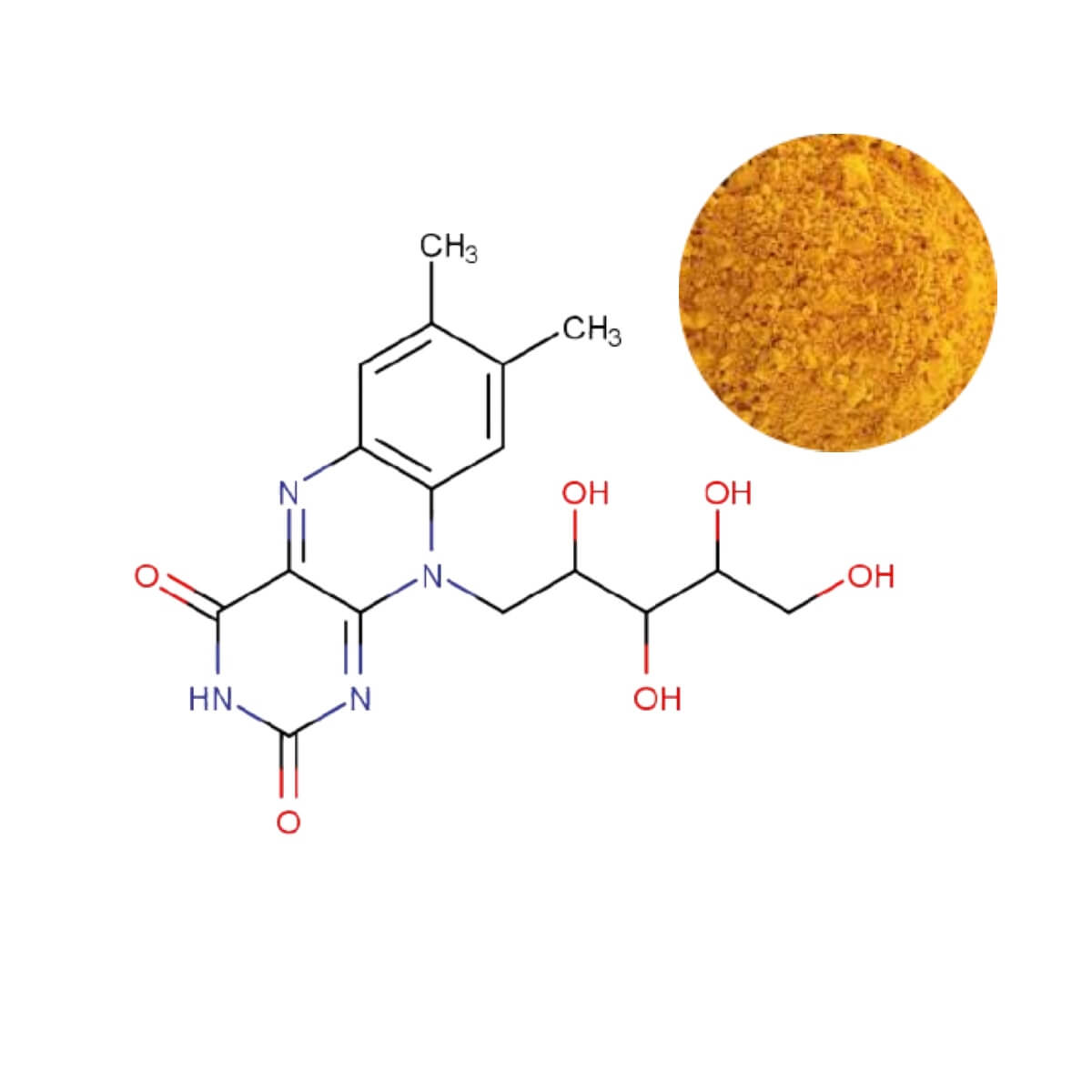
Vitamin B2 (Riboflavin) Powder
| Product Name | Vitamin B2 (Riboflavin) Powder |
| CAS Number | 83-88-5 |
| Appearance | Yellow to orange-yellow crystalline powder |
| Purity | ≥ 98.0% (by HPLC) |
| Packaging | 1 kg/bag, 5 kg/bag, 25 kg/drum |
| MOQ | 5 kg |
Gut-Microbiome Targeted Riboflavin Powder for Premium Gut-Health Formulations
Clinical evidence now positions bulk Riboflavin Powder as a validated gut-microbiome modulator that elevates butyrate production without disrupting microbial ecology. This paradigm shift enables Riboflavin Powder supplier networks to offer formulators a science-backed ingredient capable of differentiating premium digestive-health supplements. Verified batch-to-batch consistency, supported by full compliance dossiers, bridges the gap between R&D innovation and procurement risk management, ensuring audit-ready traceability for global brand owners.
Human Clinical Validation of Butyrogenic Activity and Structure-Function Claim Architecture
Conventional vitamin B2 positioning fails to capture its newly elucidated role in gut ecology. A 2023 randomized controlled trial demonstrated that combining 50 mg/d and 100 mg/d riboflavin supplementation groups over 2 weeks yielded a significant increase in fecal butyrate production, without concurrent gross compositional shifts in the microbiota. This mechanistic specificity directly informs DTC structure-function claims—“supports colonic butyrate production” and “promotes a balanced gut environment”—while remaining compliant with FDA and EFSA framework restrictions on disease claims. For brand R&D teams, this clinical anchor eliminates the “commodity vitamin” stigma and replaces it with a differentiated positioning that commands premium retail pricing in the rapidly expanding digestive-health supplement category.
- Randomized human trial (n=32, 50 mg/d and 100 mg/d groups combined, 2 weeks) demonstrated fecal butyrate elevation without microbiome structural changes.
- Supports label claims such as “supports healthy butyrate production” and “promotes gut barrier integrity” under structure-function rules.
- Enables brand differentiation from generic vitamin B2 products, directly translating into higher per-bottle retail margins.
The clinical data (Antioxidants & Redox Signaling, 2023; doi: 10.1089/ars.2022.0033) serve as the foundational trust anchor, allowing brands to bypass the price-driven competition common in bulk Riboflavin Powder wholesale channels and instead compete on scientific credibility.
Colon-Targeted Delivery Systems and Multi-Vitamin Synergy Engineering
Translating the butyrate-elevation mechanism into finished products requires overcoming riboflavin's photolability and poor aqueous solubility (approximately 0.07 g/L at 20°C). A 2023 formulation study validated a tri-blend capsule (riboflavin, niacin, vitamin C) with pH-responsive ileocolonic release, achieving less than 10% premature release in simulated upper-GI conditions with favorable stability profiles reported under accelerated conditions. This technological milestone allows brand owners to develop proprietary delivery systems that protect the active from degradation while ensuring targeted release at the colonic site, where the butyrogenic effect is most relevant.
| Parameter | ColoVit Capsule Performance |
|---|---|
| Premature release (simulated upper GI) | < 10% |
| Targeted release onset | 277-283 min (ileocolonic pH) |
This colon-targeted engineering directly supports co-formulation with complementary ingredients such as vitamin B3 (niacin), vitamin C, and zinc—each contributing to mucosal integrity and immune support. By adopting this release platform, formulators can create patentable finished products that bypass generic bulk Riboflavin Powder competition, shorten R&D cycle time by leveraging pre-validated process parameters, and secure a clear DTC claim of “targeted colonic delivery” that resonates with health-conscious consumers. (Pharmaceutics, 2023; doi: 10.3390/pharmaceutics15051354) Reduced formulation de-risking translates directly to lower pre-launch capital outlay and faster gross-margin realization.
Global Regulatory Pathways and ADI-Based Label Safety Zones
Riboflavin carries FDA GRAS status (21 CFR 184.1695) and is permitted as a color additive exempt from certification, while the European Food Safety Authority has reaffirmed no numerical Acceptable Daily Intake (ADI) limit due to its exceptionally low toxicity. This dual-status enables brand owners to launch simultaneously in the US and EU without Novel Food notifications or ADI-related dose restrictions, significantly accelerating time-to-market for cross-border product rollouts. Any structure-function claim tied to “gut health” must be carefully phrased to avoid implied disease treatment, using FDA-compliant language such as “supports a healthy gut environment” rather than “prevents dysbiosis.”
- FDA GRAS listing (21 CFR 184.1695) and color additive approval eliminate pre-market clearance barriers.
- EFSA no-ADI status allows flexible dosing across product formats without exceeding safe upper limits.
- Claim-crafting guidelines must distinguish structure-function from disease claims to avoid FDA warning letters.
Pre-approval of label copy using these regulatory guardrails protects brand equity and prevents costly recall or repackaging events. This compliance certainty feeds into the next critical commercial variable: ensuring that the chosen physical grade of Riboflavin Powder integrates seamlessly into high-speed manufacturing lines without additional capital expenditure or process modifications.
Particle Engineering and Direct-Compression Line Efficiency for TTM Acceleration
The physical attributes of the raw material determine whether formulation concepts execute profitably at commercial scale. Commercially available direct-compression (DC) grades of riboflavin, such as Riboflavin DC-95%, feature optimized particle size (≥95% through 80 mesh) and free-flowing granular morphology that eliminate the need for wet granulation. This physical trait cuts processing steps and machine time, delivering substantial cost savings by eliminating granulation equipment, reducing energy consumption, and shortening batch cycle time compared to conventional granulation-dependent processes. For brand owners, a TTM reduction of 8-12 weeks, faster speed-to-shelf, and lower scrap rates follow—each contributing to healthier project economics and quicker return on formulation investment.
- DC-grade riboflavin avoids wet granulation, reducing processing steps and capital equipment needs.
- ≥95% through 80 mesh ensures consistent die fill and content uniformity in high-speed rotary presses.
- Elimination of granulation cuts batch cycle time and energy consumption, directly improving margin.
Proper export packaging with desiccated PE-lined drums protects against moisture-induced caking during sea or air freight, preserving flow characteristics upon arrival. This physical robustness, paired with rigorous quality control, ensures that the ingredient performs identically in every production run, reducing line stoppages and rework. The cumulative effect is a supply chain that accelerates speed-to-market while stabilizing manufacturing costs—a precondition for the total-cost-of-ownership analysis procurement executives demand.
Total Cost of Ownership, Supply Resilience, and Procurement Risk Mitigation
The true financial impact of bulk Riboflavin Powder on a brand's P&L is governed by total cost of ownership (TCO)—batch consistency, lead-time reliability, and regulatory documentation completeness. Given that China accounts for approximately 58-62% of global riboflavin production capacity (varying by reporting year and methodology) and that environmental compliance has led to temporary shutdowns of roughly 1,200 metric tons of capacity in recent years, supply disruptions remain a tangible risk. Procurement teams that prioritize suppliers with robust inventory safety-stock strategies and documented lot-to-lot reproducibility effectively hedge against production halts that could cost significantly more than the raw material price differential. A single week of production downtime can erase any per-kilo savings, not to mention the loss of retail shelf presence and consumer trust; it is a specification-grade material meeting Oclean Nutra quality benchmarks and audit-ready traceability standards that provides the necessary supply-chain resilience.
| Cost Component | Impact on Brand P&L |
|---|---|
| Batch rejection due to spec deviation | Full batch material + disposal + reorder freight |
| Lead-time extension (2-4 weeks) | Lost sales + potential retailer delisting |
| Inconsistent particle size | Tablet weight variation → scrap + line slowdown |
Partnering with a spec-verified Riboflavin Powder supplier that provides comprehensive COAs and cross-referenced regulatory dossiers reduces the procurement department's validation burden, enabling faster supplier qualification and shorter internal approval cycles. This operational efficiency, combined with supply-chain visibility, transforms procurement from a cost center into a value-adding function that secures uninterrupted production and brand reputation.
Accelerate R&D Validation with Pre-Qualified Technical Documentation
Evaluating a new riboflavin source typically consumes weeks of internal testing, stability checks, and regulatory cross-referencing. Collapsing this timeline begins with a sample package that includes full lot-specific COAs, method validation summaries, and cross-reference dossiers matching USP/EP/FCC specifications. This eliminates redundant analytical work, allowing R&D to proceed directly to pilot-scale trials while procurement receives all compliance paperwork needed for supplier approval. Secure Riboflavin Powder sample with full dossiers and begin de-risking your next product launch.
Frequently Asked Questions
Share this product
Related Products
Ready to get started?
Contact our team for technical specifications, pricing, and customized solutions.