
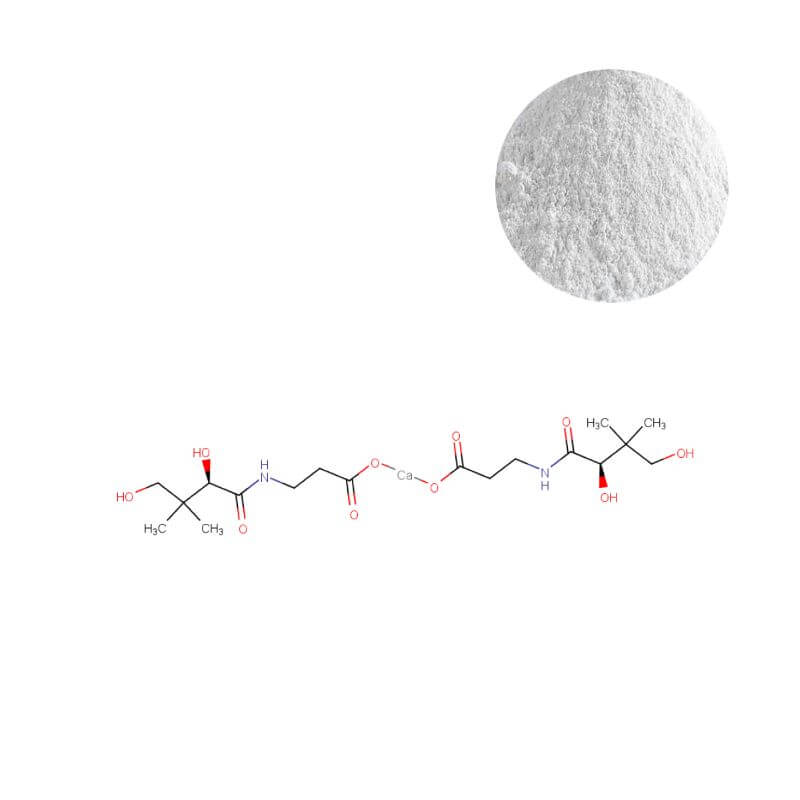
Calcium Pantothenate Powder (Vitamin B5)
| Product Name | D-Calcium Pantothenate Powder (Vitamin B5) |
| CAS Number | 137-08-6 |
| Appearance | White to off-white crystalline powder |
| Purity | 98.0% - 101.0% (on dried basis) |
| Packaging | 1 kg/foil bag, 25 kg/cardboard drum |
| MOQ | 1 kg |
D-Calcium Pantothenate: A Metabolic Cornerstone for Energy & Cardiovascular Formulations
For supplement brands, the gap between a basic vitamin label and a scientifically credible formula often lies in the quality of the B‑vitamin core. Many buyers treat vitamin B5 as a generic additive, yet its role as the obligate precursor to coenzyme A (CoA) makes it critical for energy metabolism and cardiac health. Premium D‑Calcium Pantothenate (CAS 137-08-6; anhydrous, 98.0%–101.0% assay on dried basis) provides the foundation for evidence‑backed claims—when supported by batch‑specific COA and GMP‑certified supply chains. The challenge is not finding any source, but selecting one that delivers consistent purity, stability, and regulatory alignment. As regulators tighten heavy metal limits and consumers demand clinically credible ingredients, choosing a USP‑compliant anhydrous grade directly enables premium positioning and reduces compliance risk—turning a commodity vitamin into a strategic brand asset that defends pricing power and accelerates cross‑border market access.
Beyond Basic Nutrition: How Vitamin B5 Powers CoA‑Dependent Metabolism
Pantothenic acid is the essential building block of coenzyme A (CoA), a cofactor required for over 70 enzymatic reactions, including the tricarboxylic acid cycle, fatty acid oxidation, and acetylcholine synthesis 10.1038/s42255-024-01059-y. Without adequate CoA, cellular energy production stalls and neurotransmitter balance is compromised. From a strategic formulation perspective, this elevates D‑Calcium Pantothenate from a commodity filler to a functional driver for energy, stress, and neurological health products. Beyond baseline metabolism, emerging evidence links CoA homeostasis to cardiac performance. Restoring CoA levels via vitamin B5 and its derivatives has been discussed as a supportive approach in heart failure management 10.1002/jimd.12737. For brands, this dual relevance enables two distinct product tracks: general wellness (energy, stress) and cardiovascular support. The commercial implication is clear—a single ingredient can anchor multiple SKUs, reducing qualification costs and inventory complexity. This level of mechanistic clarity means formulators can confidently design products with distinct claim structures—energy for active consumers and cardiac support for aging populations—without reformulating the vitamin B5 source itself. However, the mechanism is only as reliable as the ingredient’s purity. This directly leads to the critical quality attributes that separate premium suppliers from commodity traders.
Quality Benchmarks: What Defines a Premium Bulk D‑Calcium Pantothenate Supplier
For procurement teams evaluating bulk D‑Calcium Pantothenate suppliers, three objective metrics go beyond a simple “≥99%” label:
- Anhydrous form with tight assay range (98.0%–101.0% on dried basis) – eliminates hydration‑related weight variability. A 1% assay drift can shift finished tablet content by up to 2% in high‑speed blending, risking non‑compliance in regulated markets.
- Specific rotation (+25.0° to +28.5°) – confirms the biologically active D‑enantiomer. Racemic mixtures (D+L) would show lower rotation, undermining efficacy and label claims. A quick check: missing specific rotation on a COA often signals inferior or untested material.
- Heavy metals control (Pb ≤2.0, As ≤1.0, Cd ≤0.5, Hg ≤0.1 mg/kg) – meets USP and ICH Q3D standards, essential for US (FDA GRAS) and EU (Regulation 1925/2006) compliance.
For procurement teams, this directly translates to reduced rejection risk during finished product stability studies and faster regulatory filings. A reliable D‑Calcium Pantothenate distributor provides batch‑specific COA with all above parameters within 24 hours. It’s worth noting that residual solvent compliance (USP <467>) is another hidden differentiator—especially for brands exporting to Japan or Australia, where stricter limits apply. From a production efficiency standpoint, tight assay control directly lowers overage needs (typically 3–5% less buffer), cutting raw material costs while maintaining label claim confidence. The table below summarizes critical quality levers and their business impact:
| Quality Attribute | Premium Specification | Impact on Brand’s Business |
|---|---|---|
| Assay (anhydrous basis) | 98.0% – 101.0% | Ensures label claim accuracy, avoids regulatory warnings |
| Specific Rotation | +25.0° to +28.5° | Confirms D‑form activity; prevents use of inferior racemates |
| Loss on Drying | ≤5.0% | Prevents moisture‑related clumping in powder blends |
Formulation in Practice: Stability, Synergy, and Processing Nuances
D‑Calcium Pantothenate is freely soluble in water (≈0.5 g/mL) and flows well (≥95% through 80 mesh). However, its slight hygroscopicity demands practical adjustments during manufacturing. Consider these guidelines for common dosage forms:
- Powder blends / stick packs – Process at ≤45% relative humidity. Avoid strongly acidic excipients (pH <4) which accelerate hydrolysis. A common mistake is adding vitamin B5 directly with citric acid without a buffer; this can degrade potency by 15% over 12 months.
- Tablets / capsules – Use standard lubricants (magnesium stearate ≤1%). For high‑dose units (>50 mg), pre‑blending with microcrystalline cellulose improves uniformity. Direct compression works well, but over‑milling can cause electrostatic charging.
- Liquid shots / effervescents – Maintain pH 6.8–8.0 using phosphate or citrate buffers. At pH below 5, the amide bond undergoes hydrolytic cleavage into pantoic acid and beta-alanine, rendering the ingredient biologically inactive.
Synergistically, vitamin B5 performs best within the B‑complex family. For cardiac‑oriented products, combining D‑Calcium Pantothenate with magnesium taurate (ratio 1:2) supports myocardial energy production. From a strategic formulation perspective, the water solubility enables innovative formats like effervescent tablets or single‑serve energy sticks—categories with higher margins than standard capsules. A practical formulation example: a “stress & energy” powder containing 50 mg D‑Calcium Pantothenate, 25 mg vitamin B6 (as Pyridoxine HCl), 2 mg vitamin B12 (as Cyanocobalamin), and 200 mg magnesium citrate powder. This turns a commodity vitamin into a differentiated blend that appeals to active consumers.
Mitigating Risk: A Sourcing Checklist for Bulk D‑Calcium Pantothenate
Price per kilogram is only the visible cost. Total cost of ownership includes quality consistency, supply reliability, and regulatory support. For brands sourcing bulk D‑Calcium Pantothenate, the following checklist represents industry best practices:
- GMP certification and third‑party audits – confirms adherence to current good manufacturing practices, minimizing cross‑contamination risks.
- Full transparency of starting materials – even synthetic ingredients should come with allergen and non‑GMO declarations, plus residual solvent data.
- Accelerated and real‑time stability data – a 36‑month shelf life when stored in tight, light‑resistant containers at 15–30°C is standard; request 12‑month interim reports.
- Regulatory dossier availability – TDS, MSDS, COA (USP/EP/FCC), allergen statement, and flow agent declaration should be provided within 24 hours.
For procurement teams, this directly translates to fewer batch failures, lower safety stock requirements, and faster time‑to‑market. A partner that offers free samples (10‑20 g) with full documentation allows your R&D team to run pilot stability studies before committing to large volumes. This low‑risk approach—testing the ingredient in your actual production environment—is far more valuable than any upfront price concession. Using a Total Cost of Ownership lens, a slightly higher unit cost from a fully documented supplier often proves cheaper than one rejected batch that triggers a full stability re‑run (costing $5,000–$15,000) or a customs hold due to missing residual solvent data. Moreover, ask about the supplier’s change control procedure: how are raw material sources or manufacturing sites communicated? This reveals whether they treat quality as a reactive document or a proactive system.
Next Steps for Your Product Development
D‑Calcium Pantothenate (Vitamin B5) combines decades of regulatory safety (FDA GRAS, EU authorized) with emerging science in cardiac metabolic support. By sourcing a USP‑compliant, anhydrous grade with batch‑specific COA, you gain a versatile building block for energy, stress, and cardiovascular health supplements. To accelerate your evaluation, request your complimentary sample and full technical dossier – including stability summary, regulatory status, and a sample COA. This allows your formulation team to verify blend uniformity and stability under your specific processing conditions, significantly lowering development risk before commercial launch.
Frequently Asked Questions
Share this product
Related Products
Ready to get started?
Contact our team for technical specifications, pricing, and customized solutions.