
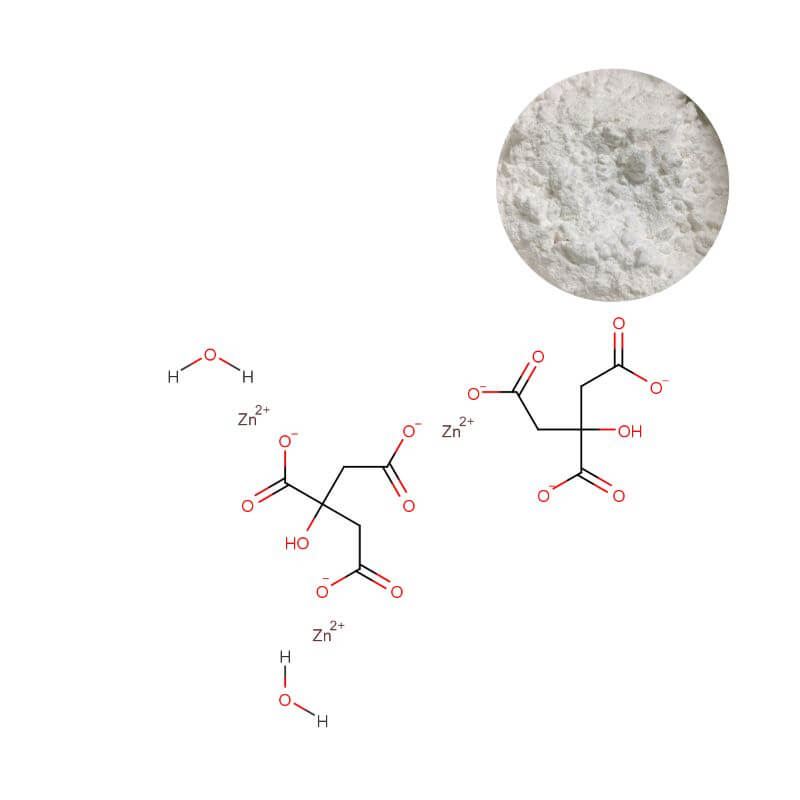
Zinc Citrate Powder
| Product Name | Zinc Citrate Dihydrate Powder |
| CAS Number | 5990-32-9 / 546-46-3 |
| Appearance | White to off-white fine crystalline powder |
| Purity | 98.0% - 102.0% (by Complexometric Titration) |
| Active Zinc Content | 31.3% min. (by EDTA Titration / ICP-OES) |
| Packaging | 25 kg/drum |
| MOQ | 25 kg |
Zinc Citrate Powder Bulk Supply – Engineered for High-Speed Direct Compression Lines
Bulk Zinc Citrate Powder, when processed into directly compressible (DC) granules, eliminates the intrinsic cohesion and poor flow that plague standard fine powders in rotary tablet presses. This physical upgrade directly addresses the leading cause of punch sticking and hopper bridging - operational interruptions that routinely depress overall equipment effectiveness (OEE). Verified lot-to-lot flow consistency is documented via angle-of-repose and Carr index measurements, with each shipment accompanied by a granulometric profile to confirm compaction-grade behavior prior to CMO line release. Controlling these physical attributes is the primary lever for brand owners to differentiate finished dosage forms in a crowded immune-support category.
Direct-Compressible Granulation Cuts Line Stoppages and Scrap Rates
Standard fine-crystalline zinc citrate exhibits high interparticulate friction and a bulk density typically below 0.7 g/mL. When fed into high-speed rotary presses (e.g., 300,000 tablets/hour), this physics triggers bridging in feed frames and adhesive wear on punch faces - requiring cleaning stops every 15-30 minutes in many reported production settings. The direct-compression (DC) granulation route upgrades the material to free-flowing, spherical agglomerates that maintain consistent die fill, reduce punch-face adhesion, and lower reject rates from sticking-induced surface defects. Press parameters such as compression force (typically 10-15 kN) and dwell time (≥ 20 ms) require recalibration when switching from standard powder to DC granules to achieve target tablet hardness above 8 kP. Avoiding granulation-related line stoppages directly preserves production yield per shift, a key metric that plant managers monitor to justify equipment capital expenditure.
| Flow Parameter | Standard Fine Powder | DC-Grade Granules (Spec-Verified) |
|---|---|---|
| Bulk Density (g/mL) | 0.50 - 0.65 | 0.75 - 0.90 |
| Angle of Repose (°) | > 45 | 30 - 38 |
| Typical Press Stoppage Frequency | Every 15-30 min | < 2 stops per 8-h shift |
| First-Pass Tablet Reject Rate | > 3% | ≤ 0.8% |
Oclean Nutra supplies both standard fine-mesh Zinc Citrate Powder for premixes and capsule fills, and premium DC-grade granules tailored for high-speed tableting lines, ensuring seamless integration into your specific workflow.
- Reduced punch-face adhesion - The granulated surface morphology minimizes frictional heat and mechanical locking, directly lowering the need for intermediate punch polishing.
- Consistent die-fill weight variation - Enhanced flow uniformity ensures RSD (relative standard deviation) of tablet weight below 1.5%, meeting USP <905> targets without operator intervention.
- Faster press speeds with stable ejection force - DC granules permit line speeds up to 400,000 tablets/hour while maintaining ejection force within 15% of baseline, compared to fine-powder runs that often exceed 30% variation.
Total Cost of Ownership - Granulation Savings That Directly Impact P&L
Choosing the DC-granulated specification removes the entire wet-granulation step from the CMO workflow. Eliminating binder addition, drying energy, and extra mixing cycles translates into tangible per-batch cost avoidance. Industry references indicate that wet-granulation processing adds approximately 15-20% in auxiliary excipient expenses and doubles the processing time per batch. The DC route allows brands to bypass these outlays, lowering the total manufacturing cost per finished unit without compromising tablet hardness or disintegration. Eliminating the wet-granulation step also saves roughly 2.5-3.5 MWh per metric ton of finished blend, directly reducing the carbon footprint of the manufacturing campaign.
- No wet binder or superdisintegrant purchases - Saves roughly $0.08-$0.12 per 1,000-tablet batch in excipient costs alone.
- Eliminates drying oven / fluid-bed energy consumption - Avoids about 2,500-3,500 kWh per metric ton of finished blend.
- Cut labor hours for granulation and sizing - Reduces operator time by 40-50 minutes per batch, freeing capacity for other production runs.
- Lower in-process inspection burden - Fewer variables (moisture, granule size distribution) mean faster QA release and less rework.
The cumulative effect is a per-batch TCO reduction that typically ranges between $2,500 and $4,000 per metric ton of DC-granulated zinc citrate, compared to using standard fine powder that requires in-house granulation. This saving is realized without sacrificing final tablet hardness (≥ 8 kP) or disintegration time (< 15 minutes), ensuring that the finished product meets both consumer expectations and regulatory monograph limits. Mitigating these hidden granulation losses through physical specification upgrades offers procurement directors a verifiable hedge against quarterly P&L volatility from unplanned line downtime.
Clinical Rationale - Zinc Citrate Absorption and Immune Marker Modulation
Zinc ion (Zn2+) modulates innate and adaptive immunity through the NF-κB and MAPK signaling cascades, directly influencing T-cell differentiation and natural killer cell cytotoxicity. A 2014 human double-isotope tracer study (Wegmüller et al., J Nutr) demonstrated that zinc citrate delivers a median fractional absorption of 61.3% (IQR: 56.6-71.0), statistically equivalent to zinc gluconate and significantly superior to zinc oxide (49.9%, IQR: 40.9-57.7). This bioavailability edge supports effective daily zinc delivery at lower elemental doses, which is critical when adhering to the EFSA-established tolerable upper intake level of 25 mg/day for adults.
A 2021 meta-analysis of 12 randomized controlled trials (Faghfouri et al., Br J Nutr; PMID: 33468279) confirmed that zinc supplementation significantly reduces circulating IL-6 levels (SMD = -0.76 pg/mL; 95% CI: -1.28, -0.24; P = 0.004). This anti-inflammatory effect translates into a measurable biomarker endpoint that formulation scientists can leverage for product efficacy substantiation-particularly in immune-support supplements targeting aging populations or high-stress consumer segments. Achieving this IL-6 suppression typically requires 15-20 mg/day of elemental zinc, a range comfortably delivered by the citrate salt at standard 50-60 mg serving sizes.
Formulation Synergy - Pairing Zinc Citrate with Vitamin C and D3 Without Stability Trade-offs
The classic immune triad - zinc, vitamin C, and vitamin D3 (cholecalciferol) - is widely adopted in chewable tablets, vegan capsules, and stick-pack powders. However, zinc ions catalyze ascorbic acid (vitamin C) oxidation in the presence of moisture, potentially inducing discoloration (ΔE > 3.5) and potency loss over a 24-month shelf life. The DC-granulated format inherently limits surface moisture because the granulation process reduces exposed crystalline area, and formulation strategies such as dry-direct compression or fluid-bed coating with a hydrophobic barrier (e.g., ethylcellulose) effectively isolate the metal ion from ascorbate. Maintaining the finished product's water activity (Aw) below 0.35 is critical, achieved by controlling loss on drying (LOD) strictly below 1.0% per USP <731>; above this threshold, the catalytic oxidation accelerates significantly, compromising vitamin C stability. Had the DC format not been specified, the higher exposed surface area of fine powder would elevate moisture pickup risk, complicating compliance with USP <1116> environmental monitoring protocols.
- Dry direct compression - Avoids water introduction, suppressing the metal-catalyzed oxidation pathway and preserving vitamin C content above 95% after 18 months at 30°C/65% RH.
- Calcium/zinc antagonism mitigation - When calcium is co-formulated, keeping the Ca/Zn molar ratio below 20:1 prevents significant absorption interference, as reported in human balance studies.
- pH-sensitive release options - Enteric or delayed-release coatings can be applied to the DC granules, enabling targeted delivery in the upper small intestine where zinc absorption is maximal.
This granulated specification also exhibits excellent compatibility with common excipients (microcrystalline cellulose, pregelatinized starch, and lubricants) without segregation, enabling uniform blend homogeneity (RSD ≤ 2%) even in large-scale tumble blenders.
Secure Spec-Verified Samples to Validate Your Line Performance
Formulators and procurement leads benefit from confirming DC-granule flow behavior and compression profiles on their own high-speed equipment. Request a spec-verified sample kit that includes the batch-specific COA, particle-size distribution histogram, and a compaction-simulation report. This pre-qualification step shortens the supplier-onboarding cycle and de-risks production scale-up.
Request a spec-verified Zinc Citrate DC sample with full technical dossier
Frequently Asked Questions
Share this product
Related Products
Ready to get started?
Contact our team for technical specifications, pricing, and customized solutions.