
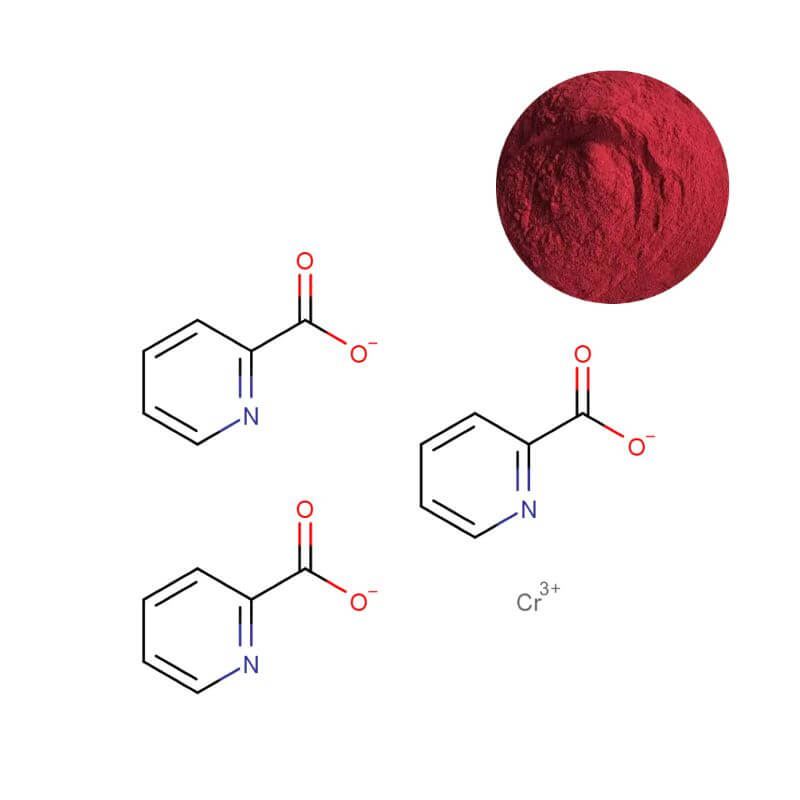
Chromium Picolinate Powder
| Product Name | Chromium Picolinate Powder |
| CAS Number | 14639-25-9 |
| Appearance | Fine purplish-red crystalline powder |
| Purity | 98.0% - 102.0% (On Dried Basis by Titration) |
| Chromium Content | 12.0% - 12.4% (Calculated on dried basis) |
| Packaging | 1 kg/bag, 5 kg/bag, 25 kg/drum |
| MOQ | 1 kg |
Chromium Picolinate Powder with Optimized Particle Kinetics: Eliminating Blend Segregation and Tablet Weight Variance in Large-Scale Production
For brand owners and procurement directors, the primary challenge with mature mineral ingredients is not whether they work, but how consistently and economically they perform under high-throughput conditions. Batch-to-batch variability in flowability, blend uniformity, and compaction behavior directly translates to production downtime, rejected batches, and hidden operational costs. Premium B2B Chromium Picolinate Powder—standardized to USP-grade specifications—addresses these engineering pain points by prioritizing physical material science alongside chemical purity. In an era of tightened global compliance and margin compression, locking in such tightly controlled physical specifications becomes the strategic lever for building a defensible scientific barrier and capturing product premium at retail.
USP-Grade Purity and Heavy Metal Control: The Non‑Negotiable Baseline for Cross‑Border Compliance
The chemical identity of Chromium Picolinate (CAS 14639-25-9) is well‑established, but the gap between “meets spec” and “regulatory ready” lies in the rigor of testing. Premium B2B grades define assay by titration on a dried basis—typically 98.0%–102.0%—with chromium content independently quantified at 12.0%–12.4%. For cross‑border regulatory teams, the real differentiator is heavy metal and residual solvent control. For export into regulated markets, lead is capped at ≤1.0 mg/kg, inorganic arsenic at ≤1.0 mg/kg, cadmium at ≤0.5 mg/kg, and total mercury at ≤0.1 mg/kg, verified by ICP‑MS. Residual solvents must comply with USP <467>. These limits are not arbitrary; they represent the customs clearance thresholds for dietary supplement imports into the US, EU, and Japan. A 2025 systematic review (doi: 10.17306/J.AFS.001440) explicitly notes that inconsistent clinical outcomes of chromium supplementation are often traced back to variability in raw material purity. What this means for brand KPIs: a COA that includes all above parameters directly shortens customs quarantine cycles, reduces product recall risks, and builds consumer trust through demonstrable safety margins.
Particle Size Distribution and Bulk Density: Hidden Drivers of Direct Compression Efficiency
Microbiological quality—total aerobic count ≤1,000 CFU/g, yeast/mold ≤100 CFU/g, E. coli and Salmonella absent—is standard. What separates industrial‑grade from truly production‑ready material is physical behavior under mechanical stress. Premium Chromium Picolinate Powder exhibits ≥95% passage through 80 mesh (≤177 µm) with a bulk density between 0.50 and 0.70 g/mL. In practical manufacturing scenarios, this fine yet consistent particle size distribution minimizes segregation during hopper flow when the ingredient is used at low inclusion rates (e.g., 50–200 µg elemental chromium per serving). For formulators operating high‑speed rotary presses, the commercial implication is direct: reduced tablet weight variation, less tooling wear, and lower reject rates. It’s worth noting that overly fine material (e.g., >95% through 200 mesh) can become airborne and cause loss, while coarser fractions increase the risk of blend non‑uniformity. The 80‑mesh specification represents the industrial sweet spot for both blend homogeneity and compaction efficiency. For brand owners, this translates into measurable reductions in production line stoppages and per‑batch scrap rates—directly protecting gross margins.
| Physical Parameter | Premium B2B Specification | Production Impact |
|---|---|---|
| Particle Size | ≥95% through 80 mesh (≤177 µm) | Prevents segregation in low‑dose blends |
| Bulk Density | 0.50–0.70 g/mL | Predictable die fill, reduced weight variation |
| Loss on Drying | ≤4.0% (105°C, 4 h) | Controls microbial risk and flowability |
Formulation Synergies and Stability Considerations for Metabolic Health Products
For product developers targeting glucose and lipid metabolism, Chromium Picolinate is often combined with standardized polyphenols from cinnamon bark extract, high-purity Berberine HCl crystals, or zinc. The mechanistic basis is well‑documented: chromium enhances insulin responsiveness via AMPK activation, leading to GLUT4 translocation and increased glucose uptake. A mechanistic study (doi: 10.1016/j.jnutbio.2014.01.007) quantified a 2‑ to 3‑fold increase in AMPK phosphorylation and a 1.5‑fold enhancement in glucose uptake in insulin‑resistant cells. From a formulation chemistry perspective, this ingredient is slightly hygroscopic. In clean‑label powdered blends without anti‑caking agents, moisture uptake over extended storage can cause agglomeration. Practically speaking, two mitigation strategies are industry‑proven:
- Secondary drying during pre‑blending if the manufacturing environment exceeds 50% relative humidity.
- Incorporation of ≤1% silicon dioxide or magnesium stearate as a flow aid when permitted by the label claim.
For tablet formulations, direct compression is feasible when the excipient system includes a co‑processed diluent (e.g., microcrystalline cellulose + colloidal silicon dioxide). This standardized matrix allows lifestyle brands to bypass traditional processing bottlenecks and accelerate time‑to‑market. Choosing a supplier that provides batch‑specific particle size data lets your contract manufacturer skip an entire process optimization step—reducing R&D overhead and formulation cycle time.
Total Cost of Ownership: Why the Cheapest Kilogram Invoice Often Backfires
When sourcing mature ingredients like Chromium Picolinate, procurement directors often default to lowest‑price‑per‑kilogram. However, a more strategic approach evaluates total cost of ownership (TCO). Hidden costs include:
- QC retesting: If the supplier’s COA lacks USP <467> residual solvent data or ICP‑MS heavy metal values, your incoming inspection lab must run those tests—costing $200–$500 per batch.
- Production line stoppages: A single lot with poor flowability can cause 2–4 hours of cleaning and recalibration on a high‑speed press, valued at >$1,000 in lost runtime.
- Regulatory rejection: Material that fails customs due to missing arsenic speciation data may be destroyed or returned, incurring freight and replacement costs that triple the original spend.
Premium B2B suppliers provide a fully traceable, batch‑specific COA that includes all the parameters listed above—dried basis assay, chromium content by AAS/ICP‑OES, particle size, LOD, full heavy metals panel, residual solvents, and microbiology. By shifting the strategic focus to a comprehensive TCO evaluation, brand owners can justify a slightly higher unit price that guarantees compliance and process reliability, avoiding the “cheap until it fails” trap. For global business teams, this rigorous quality traceability acts as the ultimate insurance against catastrophic overseas returns, bulk cargo caking and scrapping, or customs compliance lockdowns.
De‑risking Your Supply Chain: A Technical Audit Checklist for Procurement Teams
To qualify a Chromium Picolinate supplier, operations directors should request the following documentation before issuing a purchase order. Each item addresses a specific failure mode observed in global trade:
- USP‑compliant COA – Must include assay (98.0-102.0% on dried basis), chromium content (12.0-12.4%), and loss on drying (≤4.0%).
- ICP‑MS heavy metal report – Pb ≤1.0, inorganic As ≤1.0, Cd ≤0.5, Hg ≤0.1 (all mg/kg).
- Residual solvent GC chromatogram – Declared compliance with USP <467>.
- Particle size analysis (sieve or laser diffraction) – ≥95% through 80 mesh.
- Stability study summary – 24‑month shelf life under “cool, dry, away from strong light” conditions.
Requiring these documents upfront eliminates 90% of customs holds and production surprises. Suppliers who cannot provide any of these items should be considered high‑risk for regulated dietary supplement applications.
Technical Dossier Access: From COA to Custom Formulation Support
Accelerating product development requires more than a raw material—it demands a complete technical package. For every shipment of Chromium Picolinate Powder, we provide batch‑specific COAs covering all identity, purity, heavy metal, microbial, and physical parameters. Beyond documentation, our technical team supports R&D with custom blending, OEM/ODM formulation guidance, and private label solutions. All technical datasheets are delivered within 24 working hours upon formal request.
Request Your Complimentary Sample & Technical Dossier – Receive a 10‑20 g sample, a full COA, and a formulation checklist for tablet or capsule applications.
Frequently Asked Questions
Share this product
Related Products
Ready to get started?
Contact our team for technical specifications, pricing, and customized solutions.