
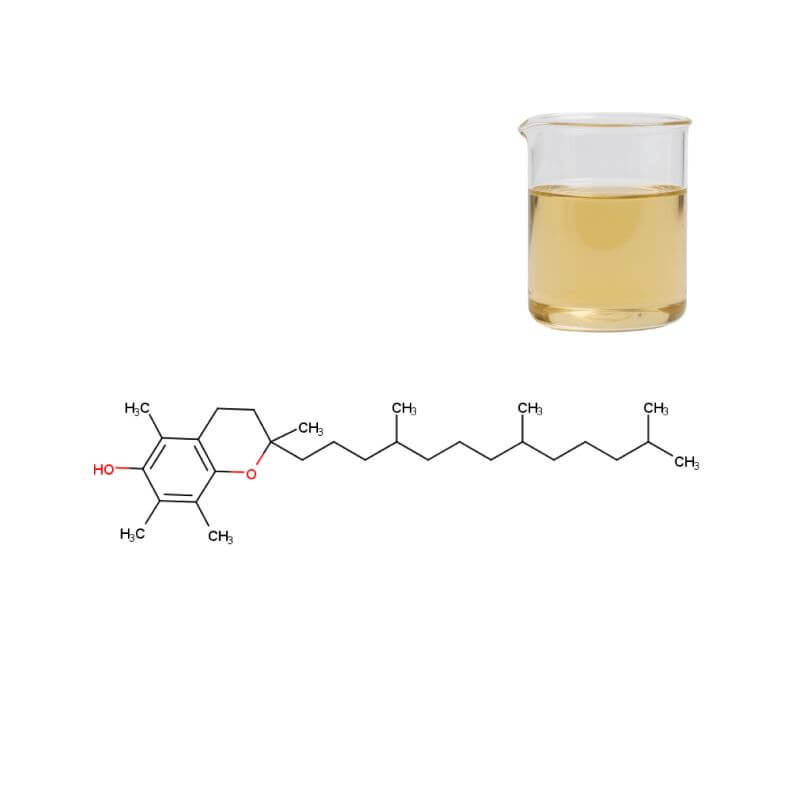
d-alpha-Tocopherol Oil
| Product Name | d-alpha-Tocopherol Oil (Natural Vitamin E Oil) |
| CAS Number | 59-02-9 |
| Appearance | Light yellow to reddish-brown clear viscous liquid |
| Activity | 1000 IU/g, 1300 IU/g (by HPLC) |
| Packaging | 1 kg/bottle, 5 kg/drum, 25 kg/drum |
| MOQ | 5 kg |
Bulk d-alpha-Tocopherol Oil (Natural Vitamin E Oil) Supplier for Clean-Label Liquid Systems
The neat d-alpha-Tocopherol Oil, with a documented viscosity of approximately 1100 cP at 25°C, presents an inherent physical barrier to direct aqueous incorporation—a barrier that dictates the entire formulation strategy for functional beverages and oral liquids. This rheological reality, rather than generic antioxidant claims, becomes the primary R&D challenge for brands entering the liquid supplement space. Spec-verified supply chains provide validated process parameters for self-emulsification, with colloidal stability metrics recorded in each Certificate of Analysis. This batch-specific data ensures reproducible droplet-size distribution across multi-ton production campaigns. Specification-driven physical control of this oil matrix directly determines whether a brand can command premium positioning in the increasingly crowded liquid antioxidant segment.
Self-Emulsification Controls Define Natural Vitamin E Oil Economics
Transitioning a lipophilic oil into a stable aqueous dispersion demands exact control of the oil-water interface. For d-alpha-Tocopherol, the emulsifier system must achieve an HLB value of 15-18 to produce kinetically stable nanoemulsions. High-pressure homogenization at 1000-1200 bar, conducted over three cycles, generates mean droplet sizes of 120-180 nm—a physical prerequisite for product clarity and shelf stability. Without this architecture, Ostwald ripening drives visible oil separation, manifested as surface ringing or creaming within 72 hours.
| Processing Parameter | Critical Limit | Failure Consequence |
|---|---|---|
| Emulsifier HLB range | 15-18 | Coalescence and droplet coarsening >500 nm |
| Homogenization pressure | 1000-1200 bar, 3 cycles | Polydispersity index exceeds 0.3; sedimentation within 7 days |
| Emulsion pH range | 3.5-6.5 | Interfacial film rupture; creaming index >5% |
| Inlet oil temperature | 25±2°C | Viscosity-induced cavitation variation; batch-to-batch PDI drift |
Formulators must also account for free fatty acid (FFA) content as a surface-active impurity—FFA levels exceeding 1.0 mg KOH/g compromise interfacial film integrity, elevating emulsifier demand by 15-20% per batch. This hidden cost amplifies as production scales, directly reducing gross margins on finished liquid products. Securing oil lots with consistent FFA profiles eliminates this variable from the formulation budget. Eliminating batch-to-batch viscosity drift prevents emulsifier overage costs and reduces unnecessary homogenization rework cycles during scale-up campaigns.
Thermal and Pressure Stress During Air-Freight Degrades Oxidative Stability
Transcontinental cargo transport imposes two simultaneous physical assaults: temperature spikes on tarmacs (container interiors reach 65°C) and cabin pressure fluctuations that introduce oxygen into headspace. Auto-oxidation of d-alpha-Tocopherol follows first-order kinetics, with peroxide value accelerating from 1.0 to 3-5 meq/kg per month when storage exceeds 30°C. Sensory rancidity thresholds are breached at PV > 5.0 meq/kg, rendering finished goods unsellable.
- Thermal runaway at tarmac level: Phase-change material (PCM) liners with 18°C transition points maintain internal temperatures below 25°C for 72 hours against 60°C ambient. This passive cooling window covers typical customs clearance and ground handling delays.
- Pressure-related oxygen ingress: Negative pressure differentials during altitude changes draw ambient air into the drum headspace. A 99.99% nitrogen positive-pressure blanket, combined with oxygen residual below 0.5% v/v, suppresses oxidation throughout the 30-45 day logistics chain.
- Barrier integrity validation: PET/AL/PE three-layer composite liners deliver water vapor transmission rate below 0.01 g/(m²·24h) and oxygen transmission rate under 0.5 cm³/(m²·24h·atm)—certified by ISTA 3E simulated transport testing.
The first-order oxidative kinetics documented for d-alpha-tocopherol under thermal stress (Int J Pharm, 2021; doi: 10.1016/j.ijpharm.2020.120057) inform the barrier engineering applied to the liquid-phase material. While solid-state alterations via cocrystallization remain within the molecular research portfolio, the primary commitment at the receiving dock centers on preserving the pristine oil matrix—through multi-layer barrier engineering as validated by ISTA 3E simulated transport protocols. Verification of these barrier specifications at the receiving dock protects procurement budgets from container rejection and costly quarantine-related disposal fees.
Chiral Chromatography Intercepts Synthetic Adulteration at Receiving Dock
Natural d-alpha-Tocopherol and synthetic dl-alpha-Tocopherol are visually and olfactorily indistinguishable, yet chromatographically unambiguous. USP-NF 2023 specifies normal-phase HPLC with fluorescence detection (Ex 295 nm / Em 330 nm) on chiral stationary phases such as Chiralpak AD-H. The natural RRR-α-tocopherol exhibits a delta retention time of 1.2-1.5 minutes relative to the all-rac synthetic mixture.
| Adulteration Vector | Detection Method | Quantitative Threshold |
|---|---|---|
| Synthetic dl-alpha blending (5%-15%) | Chiral HPLC, fluorescence detection | LOD = 0.5%; LOQ = 1.5% (mass fraction) |
| Spent-clay reprocessed oil (BaP > 2 μg/kg) | USP tocopherol impurity profile; 280 nm absorbance loss | Abnormal UV shoulder peak; BaP quantitation by GC-MS |
| Non-declared botanical source switch | Sterol profiling; tocopherol homolog distribution | β/γ-tocopherol ratio shifts beyond 0.3-0.5 range |
Supercritical fluid chromatography (SFC) on polysaccharide chiral stationary phases resolves RRR-α-tocopherol from all-rac mixtures within a 35-minute runtime (J Food Compos Anal, 2023; doi: 10.1016/j.jfca.2023.105135). This fast, green analytical protocol provides incoming QA with definitive identity confirmation before material enters production, eliminating fraud-induced label recalls and regulatory penalties. Standardizing this chiral screening protocol into the incoming inspection workflow shortens customs release cycles and guarantees nutrition label accuracy across multiple regulatory jurisdictions.
Bilayer-Embedded Chain-Breaking Antioxidant Mechanism
European Food Safety Authority defines d-alpha-Tocopherol as the primary lipophilic chain-breaking antioxidant within cell membranes. The molecule orients perpendicular to phospholipid acyl chains, intercepting lipid peroxyl radicals at a 1:1000 stoichiometric ratio—protecting polyunsaturated fatty acid sites from oxidative propagation. Pharmacokinetic data from stable isotope studies confirm the natural stereoisomer's superior retention: plasma half-life extends to 48-72 hours, versus 24 hours for synthetic dl-α-tocopherol, due to preferential α-tocopherol transfer protein (α-TTP) binding.
- Serum Cmax (400 IU single dose): Reaches 26.8 μmol/L at Tmax of 12-16 hours, providing predictable absorption timing for delayed-release capsule architectures.
- Oxidative stress marker reduction: Daily 300 mg supplementation over 12 weeks decreases plasma 8-iso-PGF2α by 18.7% (P < 0.01)—a clinically quantified biomarker response that validates efficacy claims for formulated products.
- Tissue retention advantage: The natural d-α isomer's extended half-life supports once-daily dosing protocols, directly influencing formulation cost structure and consumer compliance metrics.
This quantitative pharmacological profile transforms the "antioxidant" claim from a vague marketing abstraction into a verifiable physiological endpoint. Brands can leverage these data points directly in consumer-facing communications, addressing the primary driver of supplement skepticism—unsubstantiated efficacy—with clinically demonstrated reduction in lipid peroxidation markers.
Synergistic Triad Architecture and Processing Failure Points
The gold-standard ternary complex—d-alpha-Tocopherol combined with L-ascorbic acid powder and selenium—exploits a cross-phase redox cycle. Ascorbate regenerates the tocopheroxyl radical at the aqueous interface, while selenium-dependent glutathione peroxidase clears lipid hydroperoxides. This architecture is widely deployed in softgel fill masses and functional beverage shots, but two failure mechanisms routinely disrupt manufacturing yields.
First, crystalline co-precipitation occurs when d-alpha-Tocopherol exceeds 30% of the oil phase in combination with MCT and high-dose Ubiquinone (CoQ10) powder (>200 mg). β-form crystals nucleate during 2-8°C cold-chain transit, producing visible aggregates within 90 days. Mitigation demands solid fat content (SFC) below 2%, supplemented with 5%-10% oleic acid as a crystallization inhibitor—a formulation adjustment that protects visual product integrity. Second, gelatin cross-linking during encapsulation is accelerated when free fatty acid levels exceed 1.5 mg KOH/g. The gelatin mass at 60-70°C for 2-4 hours drives cross-linking reactions, dropping dissolution from 98% to 72% under accelerated storage (40°C/75%RH). Maintaining acid value at or below 1.0 mg KOH/g preserves dissolution performance, eliminating a 3%-5% batch rejection rate and securing manufacturing throughput.
Qualification Sampling for Clean-Label Formulation Pipelines
Spec-verified d-alpha-Tocopherol Oil establishes a complete technical dossier for supplier onboarding—encompassing chiral authentication protocols, self-emulsification characterization, and transport-stability certification. These documented safeguards eliminate adulteration risk, production-line surprises, and shelf-life failures. Request qualification samples with full analytical documentation to verify batch conformance and streamline the procurement qualification process.
Frequently Asked Questions
Share this product
Related Products
Ready to get started?
Contact our team for technical specifications, pricing, and customized solutions.