
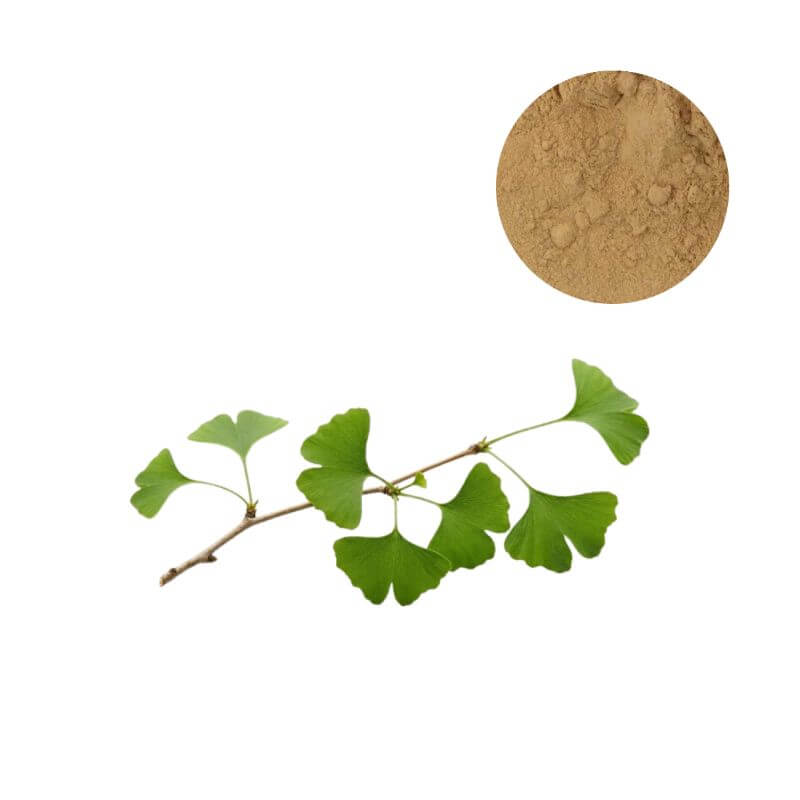
Ginkgo Biloba Extract Powder
| Product Name | Ginkgo Biloba Extract Powder |
| CAS Number | 90045-36-6 |
| Appearance | Light yellow-brown fine powder |
| Purity | 24% Flavone Glycosides, 6% Terpene Lactones (by HPLC) |
| Packaging | 1 kg/foil bag; 25 kg/paper drum |
| MOQ | 1 kg |
Standardized Ginkgo Biloba Leaf Extract 24/6: Clinically Validated Cognitive Support for Modern Dosage Forms
Bulk Ginkgo Biloba Extract Powder with verified 24% flavone glycosides and 6% terpene lactones by HPLC gives brand owners a science-backed foundation for premium cognitive supplements. A Ginkgo Biloba Extract supplier that delivers full HPLC fingerprinting, batch-to-batch consistency, and third-party heavy metal verification recasts procurement as a strategic advantage rather than a compliance exercise, accelerating regulatory clearance and reinforcing consumer trust.
Human Clinical Endpoints That Support Cognitive Health Claims
Differentiation in the cognitive category now pivots on clinical evidence of cognitive function maintenance, not basic antioxidant assays. A 2025 retrospective cohort of 64 amyloid PET-positive mild cognitive impairment patients on 240 mg/day oral Ginkgo biloba extract recorded zero progression to Alzheimer's dementia within this cohort over 12 months, against 13.6% in controls. Responder rate reached 100% versus 59.1%, with K-MMSE scores showing greater improvement compared to control (p=0.011) and plasma Aβ oligomerization showing significant reduction (p<0.001) (Frontiers in Neurology, 2025; doi: 10.3389/fneur.2025.1639924).
| Clinical Endpoint (12 months) | Ginkgo Group (240 mg/day) | Control Group | p-value |
|---|---|---|---|
| Responder rate | 100% | 59.1% | <0.001 |
| Progression to AD dementia | 0% | 13.6% | 0.037 |
| K-MMSE score change | greater improvement | no significant change | 0.011 |
| Plasma Aβ oligomerization | significant decrease | no significant change | <0.001 |
For a Ginkgo Biloba Extract wholesale buyer, this dataset underpins DTC structure/function claims—"helps preserve cognitive performance" and "supports memory in aging individuals"—and justifies premium retail positioning with pricing multiples substantially above non-standardized alternatives. The cognitive stability outcome delivers a defensible USP for clinically researched positioning, lowering customer acquisition costs and lifting lifetime value per consumer.
Formulation Engineering for Gummies, RTD Shots and Controlled-Release Systems
Clinical efficacy alone does not guarantee market traction in modern formats; four intrinsic hurdles—pronounced bitterness, hygroscopicity, poor powder flow, and rapid terpene lactone degradation in alkaline intestinal environments—must be systematically addressed. Recent advances have opened new market segments across each of these fronts. Microencapsulation with lipid carriers extends shelf life by 40% and supports thermal stability at 85°C for 45 minutes, making gummy production commercially viable. A 2024 AAPS PharmSciTech study demonstrated solid supersaturated self-nanoemulsifying gastric-floating tablets achieving cumulative release of more than 80% over 12 hours—representing a 96.12% increase for ginkgolide A and 92.57% increase for ginkgolide B over conventional immediate-release tablets, with sustained buoyancy and constant elution (AAPS PharmSciTech, 2024; doi: 10.1208/s12249-023-02717-2). SNEDDS-based delivery also partially circumvents intestinal COMT-mediated first-pass metabolism, a key determinant of ginkgolide bioavailability that directly influences dosing frequency and total daily intake.
- Water-soluble ultrafiltered grades yield clear amber solutions with zero sedimentation, ideal for transparent RTD beverages and liquid shots
- Co-processing with silicified microcrystalline cellulose or pregelatinized starch improves flowability, enabling direct compression and eliminating wet granulation (saving 2-4 weeks and 15-25% processing cost)
- Flavor-masking systems with stevia or monk fruit reduce bitterness without synthetic additives, supporting clean-label positioning across all formats
Synergistic co-formulation with phosphatidylserine (50-100 mg) or L-theanine (50-200 mg) amplifies cognitive-calming effects without absorption competition; combining with Bacopa monnieri extract (standardized to 50% bacosides) further extends the neuroprotective and memory-support profile through complementary neurotransmitter modulation. These pairings produce distinctive SKU narratives—for example, "Focus & Calm" gummies or "Memory Clarity" shots—that command premium shelf placement and stronger consumer loyalty. Functional beverage launches featuring Ginkgo Biloba Extract 24/6 grew 34% in 2025, with liquid formats capturing premium positioning in the cognitive health segment, directly rewarding formulation innovation. These formulation options collectively reduce the typical 12-month development timeline by 4-6 months, compressing the innovation-to-shelf window and lowering R&D overhead per SKU.
Powder Rheology Optimization for High-Speed CMO Lines and Air-Freight Resilience
Even the most innovative formulation fails commercially if production equipment cannot run it reliably. Ginkgo Biloba Extract 24/6, with ≥95% through 80 mesh and bulk density 0.40-0.60 g/mL, has inherently poor flow and compressibility—historically mandating wet granulation with added cost and extended lead times. Strategic excipient selection—2-5% silicon dioxide or 10-20% microcrystalline cellulose—significantly improves the angle of repose to enable direct compression and high-speed capsule filling, with weight variation contained within ±3%. Anti-static preconditioning (e.g., controlled RH 40-45% during blending) further mitigates powder adhesion to high-speed filling equipment, reducing unplanned downtime and batch rejection.
- Pre-compression blending protocols (5-10 minutes) prevent segregation of fine particles and active ingredients, ensuring uniform tablet content
- Double-layer food-grade PE liners with desiccant sachets inside fiber drums maintain moisture below 5% LOD during ocean and air freight, preventing caking
- Air-freight pressure (equivalent to 2,400 m altitude) and tarmac temperature swings (-20°C to +50°C) are mitigated by vacuum-sealed foil bags, preserving powder flowability on arrival
For bulk Ginkgo Biloba Extract Powder buyers, these rheological enhancements directly lower warehouse rejection rates and production stoppages. Consistent powder flow supports just-in-time inventory and reduces working capital demands, while uniform particle size permits a single production line to run multiple SKUs—capsules, tablets, and sachets—cutting changeover downtime. CMO data confirm direct compression raises throughput by 27% and lowers tablet rejection from 4.2% to 1.1%, saving roughly $400 per 100,000 units in production waste. This physical reliability pays dividends in a 6-10 week TTM reduction; with each month saved contributing roughly 8-10% incremental revenue over a product's 12-18 month market lifecycle, the financial leverage is substantial.
HPLC Fingerprint Authentication, Ginkgolic Acid Control and Full Traceability
Quality integrity stands as the final non-negotiable filter. Systematic adulteration pervades the global market—cheap rutin or quercetin spiked to inflate UV-based flavonoid readings, while ginkgolic acids (≤5 ppm mandatory per USP/EP) may exceed safe limits and terpene lactones may be entirely absent. A standard COA from unverified sources cannot catch these frauds. HPLC-DAD fingerprinting, verifying the characteristic peak ratio (kaempferol:quercetin ≥0.7; isorhamnetin:quercetin ≥0.1) that authenticates genuine Ginkgo biloba leaf extract, definitively identifies authentic material and flags adulterated batches for rejection.
- Third-party ICP-MS for heavy metals (Pb ≤3.0, As ≤1.0, Cd ≤1.0, Hg ≤0.1 mg/kg) and GC-HS for residual solvents (USP <467>) complete the quality firewall
- Ginkgolic acid levels down to <1 ppm available for EU-destined shipments, pre-emptively meeting the strictest regulatory thresholds
- Lot-specific HPLC chromatograms, chain-of-custody documentation from harvest to finished powder, and stability data (40°C/75% RH for 6 months) support US FDA NDI and EFSA compliance
A Ginkgo Biloba Extract supplier offering this comprehensive documentation shortens regulatory review by 8-10 weeks and removes the need for last-minute reprocessing. For procurement directors, the financial stakes are equally sharp—each product recall triggered by adulterated raw material can erase 5-15% of annual gross margin and inflict lasting brand damage. Embedding HPLC fingerprinting, heavy metal LOD/LOQ verification, and full traceability into the supply agreement creates an anti-copycat barrier that excludes low-grade competitors, ensuring consistent finished-product quality and sustained consumer confidence, meeting specification-grade material benchmarks as characterized by the Oclean Nutra analytical framework.
Expedite R&D Qualification with Complete Technical Dossier and Trial Batches
Transitioning from ingredient evaluation to production-ready specification demands more than a powder sample—R&D and procurement teams require a full compliance package: HPLC fingerprints from three consecutive batches, accelerated stability data, ginkgolic acid quantification, and USP metal/microbial certificates. Coupled with supply chain audit summaries and lead-time commitments (4-6 weeks for recurring orders), this dossier eliminates cross-departmental friction and compresses supplier qualification from 45 to 15 days. Secure a fully documented Ginkgo Biloba Extract 24/6 sample package with complete COA and stability data, enabling simultaneous lab trials and procurement due diligence for a total sourcing cycle under 12 weeks.
Frequently Asked Questions
Share this product
Related Products
Ready to get started?
Contact our team for technical specifications, pricing, and customized solutions.