
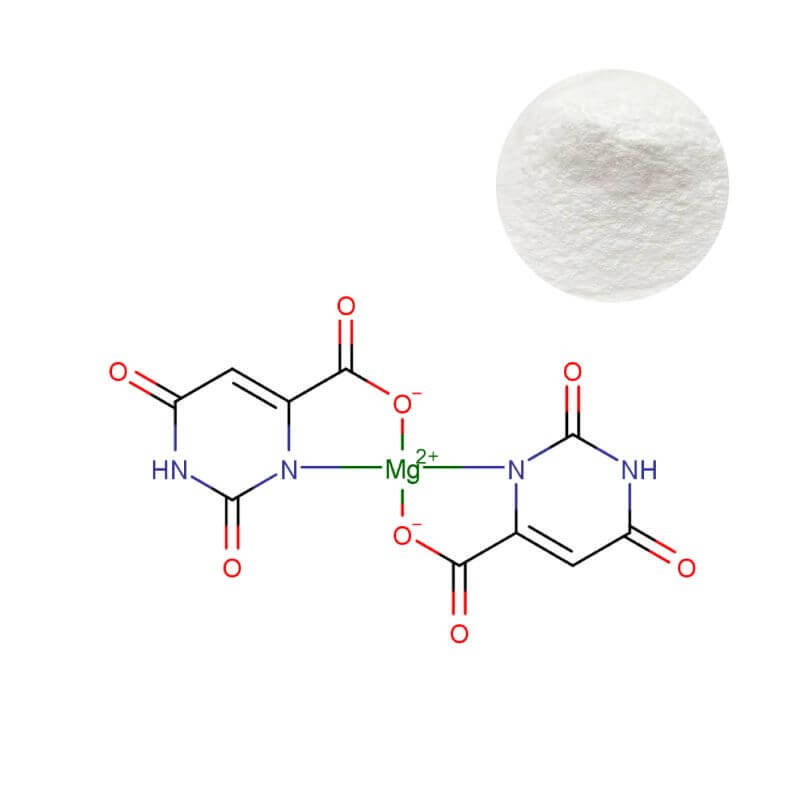
Magnesium Orotate Powder
| Product Name | Magnesium Orotate Dihydrate Powder |
| CAS Number | 34717-03-8 |
| Appearance | White to off-white crystalline powder |
| Purity | 98% - 101% (by Complexometric Titration) |
| Packaging | 1 kg/bag, 5 kg/bag, 25 kg/drum |
| MOQ | 25 kg |
Bulk Magnesium Orotate Powder: High-Speed Manufacturing and Formulation Strategies
Crystalline magnesium orotate dihydrate presents a unique set of physical handling challenges that directly influence high-speed tablet compression and capsule filling efficiency. Bulk magnesium orotate powder procured from a spec-verified distributor must demonstrate consistent flow properties and electrostatic control to avoid disruptive production stoppages. These physical characteristics are systematically quantified through standardized USP <1174> powder flow testing and bulk density profiling, ensuring that every lot supplied meets the mechanical demands of modern high-throughput encapsulation lines and rotary presses, thereby safeguarding continuous manufacturing operations and batch-to-batch reproducibility. A disciplined physical specification approach strategically depresses downstream product recalls and supports premium pricing in crowded sports nutrition segments.
Processing Bulk Magnesium Orotate Powder: Overcoming Electrostatic and Flowability Barriers
Industrial-scale processing of crystalline magnesium orotate is frequently compromised by electrostatic charge accumulation and poor powder flow, leading to bridging in feed hoppers and die table sticking. These phenomena are not merely inconveniences; they translate directly into measurable financial losses through unplanned line stoppages, increased scrap rates, and elevated labor costs for cleaning interventions. Surface charge densities on the crystalline particles typically range between 0.5 and 1.2 nC/g during pneumatic conveying, necessitating active grounding of all transfer equipment to depress static-related feed interruptions.
| Processing Parameter | Impact on High-Speed Lines | Mitigation Strategy |
|---|---|---|
| Electrostatic charge density | Die sticking, content uniformity drift | Controlled humidity environment (≤ 35% RH) |
| Bulk density | Feed shoe bridging, weight variation | Pre-compression & milling to target particle size |
| Particle size distribution | Segregation, filling inconsistency | 95% through 80 mesh specification |
The crystalline habit of magnesium orotate dihydrate exhibits a pronounced tendency toward electrostatic adhesion at the punch-tooling interface, particularly when relative humidity drops below 30% - a condition frequently encountered in climate-controlled manufacturing suites during winter months. Specifying a controlled particle size profile with 95% through 80 mesh significantly improves mass flow uniformity across high-speed encapsulators, mitigating the need for frequent line purges. This proactive physical characterization reduces downtime-related losses and ensures uninterrupted production throughput for contract manufacturers. Vibratory feeder assist systems at 60 Hz have been shown to depress hopper bridging incidents by approximately 40% across continuous compression runs exceeding 8 hours.
TCO Assessment: High-Purity Magnesium Orotate Dihydrate in High-Speed Manufacturing
Beyond the immediate processing challenges, the total cost of ownership (TCO) for magnesium orotate dihydrate extends far beyond the per-kilogram price point. The crystalline nature and high assay purity (98%-101% on dried basis) of this material confer distinct advantages in high-speed manufacturing environments, directly impacting waste reduction and operational efficiency.
- Reduced overages and buffer stock: The precise assay range (98%-101%) eliminates the need for overages typically required to compensate for low-purity lots, delivering cost savings across large-scale production runs.
- Elimination of re-processing costs: Consistent particle size (95% through 80 mesh) ensures powder flow remains stable across multiple production shifts, precluding costly re-milling or re-sieving interventions.
- Lower waste and scrap rates: Minimized content uniformity drift and die sticking directly reduce rejection rates, improving overall equipment effectiveness (OEE) metrics.
- Consistent supply chain predictability: Reliable lot-to-lot physical consistency shortens incoming inspection cycles, allowing faster warehouse-to-production floor transitions.
The crystalline morphology and narrow assay tolerance of magnesium orotate dihydrate effectively reduce variability-related waste, enabling contract manufacturers to maintain tighter process control limits and lower overall manufacturing costs. This translates into a more predictable production environment with fewer unplanned interventions and lower operational overhead. At 1,000 kg batch scale, specification-compliant lots demonstrate scrap rate reductions of 2-3%, improving first-pass yield and lowering the total landed cost per finished unit.
Scientific Evidence Base: BCS Classification and In-Vivo Absorption Kinetics
Advanced biopharmaceutical characterization of magnesium orotate dihydrate establishes its fundamental absorption profile, directly informing formulation design for optimal bioavailability. A comprehensive dissolution and in-vivo pharmacokinetic study, encompassing both bio-relevant pH gradient dissolution and IVIVC correlation, provides the quantitative framework necessary for evidence-based formulation development.
- Dose-dependent BCS classification: 500 mg dose - BCS Class I (high solubility, high permeability); 1,000 mg dose - BCS Class II (low solubility, high permeability).
- Dissolution kinetics: Complete dissolution achieved within 180 minutes, aligning precisely with human Tmax (3 hours).
- High-dose absorption: Relative extent of absorption exceeds 90% at a single high dose equivalent to 1,524 mg in humans.
- IVIVC correlation: Correlation coefficient R2 = 0.9303 established between in-vitro dissolution and in-vivo absorption, enabling predictive formulation design.
This dose-dependent boundary shift provides a clear mechanistic rationale for formulation strategy-at lower strengths (500 mg range), the compound behaves as a Class I active compound requiring minimal dissolution-enabling excipients; at higher strengths (1,000 mg range), the formulation must compensate for solubility limitations. This insight enables formulators to tailor binder selection and disintegration profiles precisely to the target dosage, minimizing over-engineered formulations and reducing both development timelines and material costs (Magnes Res, 2022; doi: 10.1684/mrh.2022.0505). The bio-relevant dissolution method employs a pH gradient spanning 1.2 to 6.8 across the gastrointestinal transit window, correlating directly with ICH Q3D elemental impurity limits (Pb ≤ 1.0 ppm, As ≤ 1.0 ppm) during scale-up validation. Batch-to-batch consistency in dissolution performance directly depresses content uniformity failures on high-speed rotary presses, enabling formulation teams to compress scale-up validation timelines.
Formulation Compatibility: Data-Driven Excipient Selection for Magnesium Orotate Products
Rational excipient selection stands as a critical determinant of final product performance, particularly for crystalline mineral salts that exhibit specific compatibility profiles with common USP-grade excipients. Systematic compatibility screening across multiple binder, filler, and lubricant categories provides formulators with a validated framework for minimizing development risks and accelerating time-to-market for multi-ingredient systems combining orotate minerals with synergistic nutrients such as taurine powder.
| Excipient Category | Compatibility Outcome | Formulation Recommendation |
|---|---|---|
| Polyvinyl-pyrrolidone (PVP) | Optimal compatibility (FTIR + TG-DTG verified) | Preferred binder for high-load formulations |
| Corn Starch / Microcrystalline Cellulose | Partially compatible | Acceptable at routine use levels |
| Talcum | Potential incompatibility identified | Avoid in magnesium orotate formulations |
Multi-method analytical validation - combining TG-DTA-DTG thermal analysis, FTIR spectroscopy, and XRD diffraction-confirms polyvinyl-pyrrolidone as the optimal binder for magnesium orotate formulations, providing superior physical stability at elevated storage temperatures. Talcum, conversely, exhibits potential incompatibility and should be systematically excluded from formulation design. This evidence-based excipient selection framework significantly reduces trial-and-error development cycles and enables formulation scientists to prioritize low-risk, high-compatibility excipient combinations from the outset (Farmacia, 2022; doi: 10.31925/farmacia.2022.3.12). Long-term stability monitoring at 25°C / 60% RH over 24 months confirms PVP-based formulations retain full assay integrity and crystalline morphology with no detectable polymorphic transition, directly supporting extended shelf-life claims. Systematically verifying heavy metal profiles at USP <232>/<233> limits expedites multi-jurisdictional customs clearance and substantially reduces quarantine-related inventory holding costs.
Streamlined Supplier Qualification: Technical Documentation and Product Sampling
Comprehensive technical dossiers, including batch-specific Certificates of Analysis (COAs) and validation data for USP <232>/<233> elemental impurity compliance, are essential for rapid supplier qualification and master file referencing. Integrating traceability into physical handling documentation provides procurement directors with auditable TCO guardrails against off-spec deliveries. Request a spec-verified magnesium orotate powder sample with complete technical documentation to accelerate internal evaluations and regulatory filing preparation. Secure your sample with full COA packages to streamline R&D assessment and procurement workflows.
Frequently Asked Questions
Share this product
Related Products
Ready to get started?
Contact our team for technical specifications, pricing, and customized solutions.