
Luteolin vs. Apigenin and Quercetin: A B2B Guide to Flavonoid Selection
Flavonoid selection fails on kilogram price or a single IC50. This guide compares luteolin, apigenin and quercetin on solubility, flow, thermal limits and cost-in-use to align molecule, dose and audit trail.
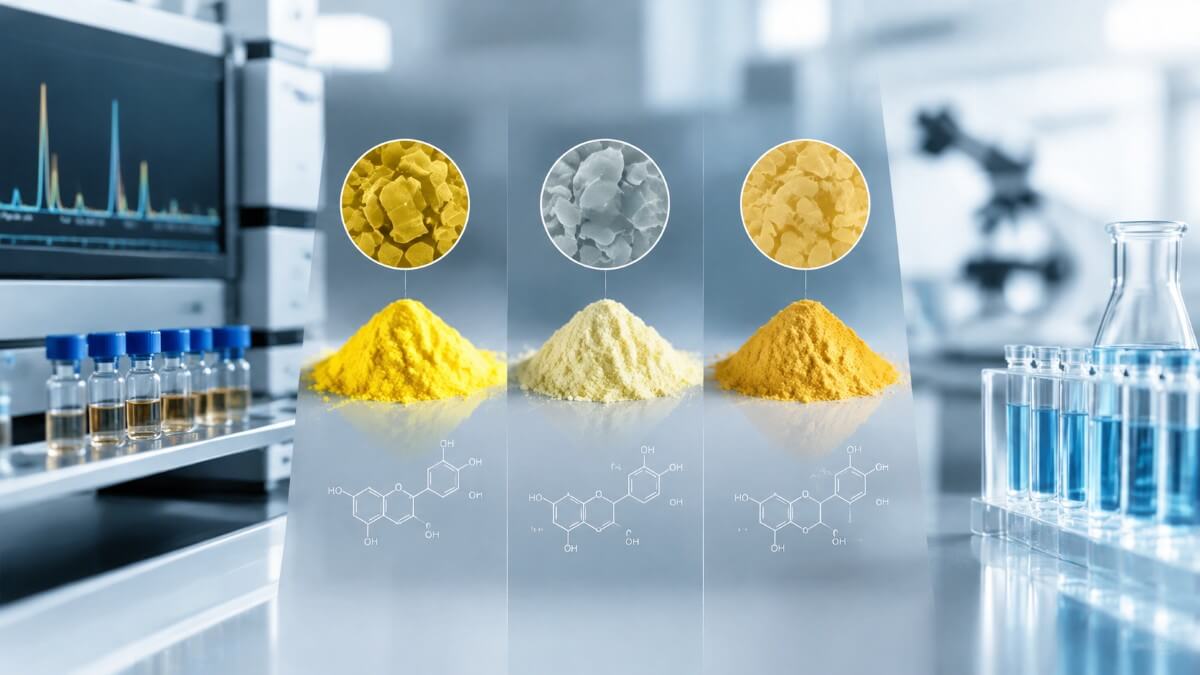
Most flavonoid formulation failures do not originate in the choice of active. They originate in the assumption that three molecules sharing a yellow color and an antioxidant narrative can be substituted for one another. Replacing quercetin with luteolin, or treating apigenin as a drop-in alternative, changes dissolution behavior, powder flow, thermal loss during gummy deposition, and the analytical basis of the certificate of analysis. This guide converts structural differences into procurement and formulation criteria that survive scale-up.
Crystal Form, Solubility, and Powder Flow as Pre-Formulation Variables
All three aglycones share the low aqueous solubility that characterizes free flavonoids, but the differences between them are measurable and operationally relevant. Luteolin dissolves to roughly 3.01 µg/mL at 35°C, apigenin is reported at approximately 1.35 µg/mL in aqueous media though literature values for this aglycone span a wide range, and quercetin dihydrate reaches 2.63 µg/mL at 25°C. None of these values supports a clear-beverage claim without a solubilization strategy; the ranking matters only when selecting which carrier system to budget for.
| Parameter | Luteolin | Apigenin | Quercetin Dihydrate |
|---|---|---|---|
| Aqueous solubility | 3.01 µg/mL at 35°C | ~1.35 µg/mL, method-dependent | 2.63 µg/mL at 25°C |
| Bulk density (typical) | 0.47 g/mL | not reported | not reported |
| Carr Index | ~23% | not reported | not reported |
Apigenin is reported to show higher Caco-2 permeability than luteolin in the published literature, while luteolin carries a higher efflux ratio in the datasets where both directions were measured. Permeability and efflux must therefore be evaluated together, and a formulation team that selects luteolin for superior systemic exposure without addressing efflux is optimizing on the wrong variable. The luteolin powder specification used in supplement matrices typically requires the efflux question to be resolved at the carrier level, not at the molecule level.
Quercetin dihydrate illustrates a second conditional variable. Its solubility advantage over the anhydrous form is temperature-gated rather than universal, as the table below shows.
| Temperature | Anhydrous Quercetin | Quercetin Dihydrate |
|---|---|---|
| 25°C | 0.00215 g/L | 0.00263 g/L |
| Up to 80°C | similar behavior | similar behavior |
| 140°C | 0.665 g/L | 1.49 g/L |
Below 80°C the two forms are effectively interchangeable; only above 100°C does the dihydrate deliver a 1.5- to 2.5-fold solubility benefit. For an ambient-temperature gummy or a cold-fill ready-to-drink base, the dihydrate label is a processing variable rather than a performance upgrade. Price per kilogram rewards the cheapest acceptable lot, while cost per effective dose rewards the grade that reaches the target exposure with fewer milligrams. Procurement scorecards should weight the second metric alongside impurity-profile depth, because a cheaper lot that demands a higher dose or an added carrier system erases its own discount.
Divergent Bioactivity Across Endpoints and the Limits of Upgrade Claims
Flavone and flavonol skeletons do not rank on a single potency axis. Head-to-head in vitro data show luteolin inhibiting LPS-induced nitric oxide with an IC50 of 14.26 µM against 62.4 µM for quercetin, a roughly 4.4-fold gap. On COX-2 inhibition the same pair narrows to 59.9 µM versus 72.3 µM, a difference of about 1.2-fold. The gap is endpoint-dependent rather than fixed, and a single-endpoint potency ranking therefore does not transfer across assays (Frontiers in Endocrinology, 2023; doi: 10.3389/fendo.2023.1117489).
The commercial consequence is direct. A label claim built on a single endpoint IC50 cannot be transferred to a second endpoint, and a procurement specification that reduces three molecules to one potency number will not survive a formulation review. R&D teams should define the target endpoint first, then select the aglycone, then decide whether a carrier strategy is required to reach the exposure that endpoint demands.
From a commercial scale-up perspective, small shifts in bulk density and a Carr Index near the flowability threshold become feeder, tooling, and throughput commitments on high-throughput lines.
Scale-Up Dynamics in Tableting, Capsule Filling, and Gummies
Luteolin enters high-speed encapsulation with a Carr Index near 23% and a Hausner Ratio of 1.30, classifying it as passable rather than free-flowing under USP criteria. At production-scale filling rates, this profile warrants a line-specific fill-weight uniformity study before commercial commitment, because the risk of bridging and content uniformity drift depends on the interaction between powder cohesion and the dosator or tamping system in use.
Thermal behavior adds a second constraint: the reported activation energy of 51.4 kJ/mol for luteolin aglycone, against 120 kJ/mol for its 7-O-glucoside, places the aglycone among the more heat-sensitive forms under the 30-130°C processing window examined in the published kinetics study.
Gummy deposition typically runs between 90°C and 105°C, which means the thermal window and the process window overlap. Practical mitigation follows a short list:
- Dose the flavonoid into the cooling stage rather than the cook stage to limit cumulative thermal exposure.
- Pre-blend with a glidant or move to a granulated grade if the line-specific fill-weight study identifies flow as the limiting variable.
- Accept that the intense yellow color of luteolin will require equipment cleaning protocols between campaigns.
- For apigenin, verify whether the incoming material is a standardized extract or a purified aglycone, because the extract matrix changes flow and dose equivalence.
Platforms specifying the Oclean Nutra technical grade of luteolin generally require batch-specific impurity profiling along with particle size distribution, which moves the audit burden upstream to the extraction stage rather than the finished-goods release. For teams working with a standardized matrix rather than a purified aglycone, the apigenin extract powder route introduces different flow and assay considerations that should be validated on the target filling line before commercial commitment.
Analytical Arbitration, Supplier Audits, and Cost-in-Use
Identity testing is where supplier quality separates most sharply. Total-flavonoid UV-Vis methods lack the specificity to distinguish a luteolin aglycone from its 7-glucoside, whose molecular weight of 448.38 differs from the aglycone value of 286.24, and their deviation from chromatographic quantitation is matrix-dependent, running in either direction. A certificate reporting 98% by UV without a chromatogram and peak assignment does not constitute identity evidence. In a validated flavonoid panel of Artemisia afra, HPLC/MS detection returned limits of detection 50-150 times lower than HPLC-UV, including an approximately 67-fold difference for apigenin under the reported conditions, and it uses mass-to-charge information to support compound identification and quantitation alongside chromatographic separation.
Procurement audits should therefore request:
- The chromatogram with every integrated peak assigned, not just the main peak percentage.
- Declared upper limits for apigenin, kaempferol, and chrysoeriol in 98% grade material, since the residual 2% composition is the real differentiator between grades.
- Process-specific residuals tied to the actual route, whether direct botanical extraction, semi-synthetic conversion, or total synthesis.
- Particle size distribution and bulk density for any grade destined for tableting or high-speed filling.
Cost-in-use reframes the price conversation. A kilogram price multiplies against the dose per serving, and because luteolin and quercetin are formulated at different dose ranges, the per-serving cost multiple can diverge substantially from the per-kilogram multiple. Procurement scorecards should model the comparison at the serving level before a sourcing decision is made. The quercetin dihydrate powder specification should be evaluated on that per-serving basis, with the caveat that the dihydrate form only justifies its position inside a high-temperature aqueous process.
Conclusion: Select by Endpoint and Process, Not by Kilogram Price
Flavonoid selection fails when it starts from the kilogram price or from a single potency figure. It succeeds when the target endpoint is defined first, the exposure required to reach that endpoint is modeled, and the powder characteristics are matched to the filling or deposition line. Quercetin dihydrate earns its place in high-temperature aqueous systems and not elsewhere. Apigenin's permeability advantage matters only if efflux is managed. Luteolin's endpoint-specific potency requires a carrier strategy before it becomes a label claim. Bring the formula matrix, the target dose, and the intended process temperature to the selection table, and the raw material decision follows. Share your formula matrix for a flavonoid fit assessment and receive a specification review aligned to your endpoint and line conditions.
Share this article
Found this helpful? Share it with others!
Related Products
Products mentioned in this article
Related Articles
You might also be interested in
Overcoming Bioavailability and Processing Bottlenecks of Luteolin in Solid Dosage Forms via Advanced Delivery Systems
Overcome luteolin's low solubility, thermal sensitivity, and poor flowability in solid dosage manufacturing. This technical guide evaluates advanced microencapsulation platforms and equipment scale-up parameters for reliable production.
Want to learn more?
Explore our products or contact our team for personalized solutions and expert advice.