
Urolithin A COA Checklist: Route-Specific Impurities and Quality Verification
Two Urolithin A certificates can both report 98% HPLC purity and still describe different materials. This guide shows how production route, identity testing, and residual solvents change what a COA proves.
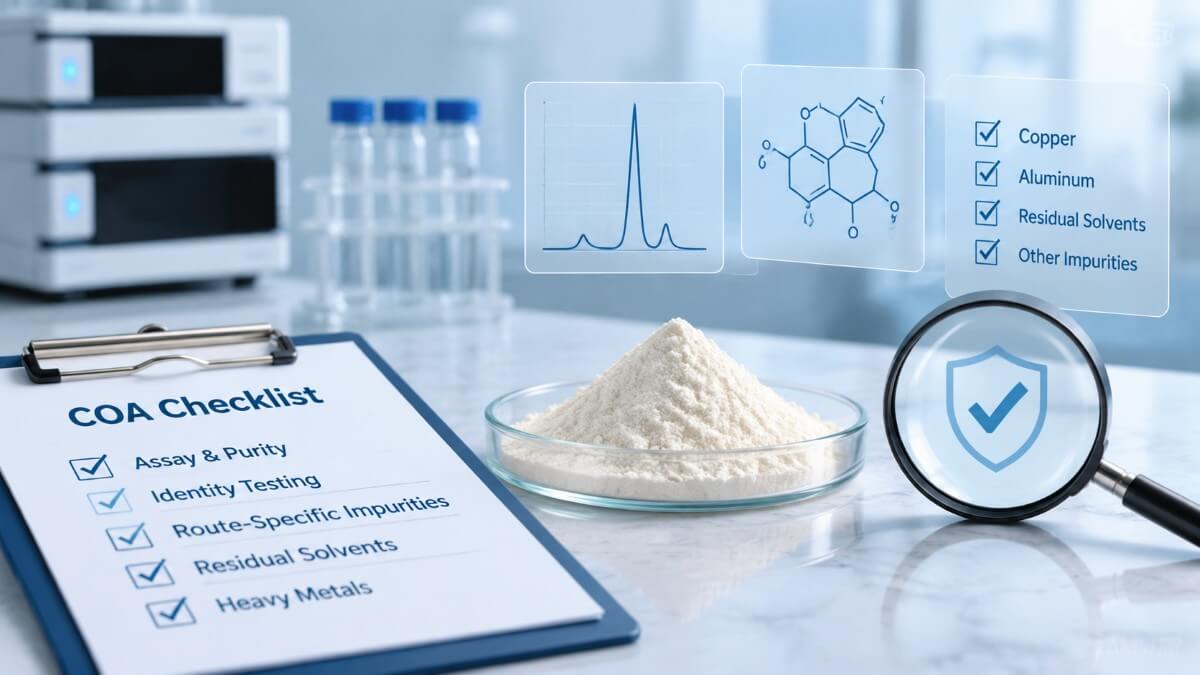
Two Urolithin A certificates of analysis can both report 98% by HPLC and still describe materials with different impurity profiles, identity evidence, and residual solvent panels. For procurement teams and quality reviewers, the practical question is not whether the number is high, but what the number actually measures and what it leaves out. The checks below move from the assay line through route-specific impurities and identity testing to the documents a supplier should be ready to supply on request.
Why Is 98% HPLC Purity Not Enough to Verify Urolithin A Quality?
If the figure is based on HPLC area normalization, 98% means that the main peak accounts for 98% of the total integrated peak area. External standardization calculates the sample content against a reference standard and does not represent the same measurement. Area normalization reports the main peak as a share of all integrated peaks, without correcting for how strongly each component responds at the detection wavelength. External standardization depends on the purity of that reference and on the calibration range used.
The calculation basis is rarely printed on a specification sheet. A buyer may compare two quotes that both read "98% by HPLC" and end up comparing numbers that answer different questions. The gap is not theoretical. Researchers measured the Urolithin A content of commercially sold supplements by HPLC-MS/MS and compared it with the label claim. For the four Urolithin A products tested, measured deviations from label claims ranged from -15.5% to +28.6% (GeroScience, 2024; doi: 10.1007/s11357-024-01257-2). Those were finished consumer products rather than raw material, so the result describes label accuracy rather than powder purity.
Purity is also only one line of a specification. The GRAS notice for Urolithin A (GRN 791) specifies an HPLC area purity of at least 97%. Alongside it are separate limits for intermediate A, impurity AZX1, any other individual impurity, copper, aluminum, and five residual solvents. A certificate that reports 98% and a single generic heavy metals line leaves each of those categories unaddressed.
Urolithin A Synthesis Routes: Which Impurities and Residual Solvents Should Buyers Check?
The impurities and solvents a buyer needs to see on a certificate depend on which synthetic route the material came from, not on the fact that it is synthetic. The GRAS notice for Urolithin A (GRN 791) describes two copper-catalyzed routes. Both share a coupling step but diverge in the solvents and reagents used afterward. One route runs the coupling in alkaline methanol and removes the methyl group with aluminum chloride in toluene. It then dissolves the crude product in DMSO and precipitates it by adding water, triturates with acetic acid, and washes with methyl tert-butyl ether. The other runs the coupling in alkaline water and finishes with acetic acid neutralization and trituration. It uses no toluene, DMSO, methyl tert-butyl ether, or methanol.
The certificate should reflect this divergence through route-specific, item-by-item solvent results rather than a single total solvents figure. A supplier running the aqueous route has fewer solvents to declare, but copper applies to both routes; aluminum is specific to Process 1, although GRN 791 lists a limit for the notified material.
| Specification item | Limit stated in the GRAS notice |
|---|---|
| Urolithin A HPLC area purity | ≥97% |
| Intermediate A | ≤0.5% |
| AZX1 | ≤0.4% |
| Any other individual impurity | ≤0.3% |
| Copper | ≤100 mg/kg |
| Aluminum | ≤2,000 mg/kg |
| Methanol | ≤3,000 mg/kg |
| Toluene | ≤890 mg/kg |
| Methyl tert-butyl ether | ≤1,000 mg/kg |
| DMSO | ≤5,000 mg/kg |
| Acetic acid | ≤5,000 mg/kg |
Copper deserves separate attention because process capability and specification limits treat it very differently. A process patent describing the synthesis reports copper below 1 ppm and aluminum below 17 ppm in certain process examples and PLPD experiments. The GRN 791 specification limits are 100 mg/kg for copper and 2,000 mg/kg for aluminum. These patent results are process examples rather than routine batch releases, but they show that actual results can sit far below the specified limits. A certificate that reports copper as a measured value for each batch is therefore more informative than one that folds copper into a generic heavy metals total.
Emerging Urolithin A Biotransformation Routes: What Quality Risks Should Buyers Evaluate?
If Urolithin A is produced through a microbial biotransformation route, the powder carries a different impurity panel from a synthetic one. The published limits written for synthetic material do not apply to it. Research on microbial conversion of ellagic acid to Urolithin A has identified specific strains and conversion efficiencies. In one study, an anaerobic culture of Enterococcus faecium FUA027 converted roughly 32% of ellagic acid to Urolithin A (Frontiers in Nutrition, 2022; doi: 10.3389/fnut.2022.1039697). Urolithin C appeared as an intermediate before the final dehydroxylation step. A separate strain, Streptococcus thermophilus FUA329, reached about 82% conversion over 50 hours.
Both figures describe molar conversion in a culture system, not the HPLC assay of a purified powder. What a powder certificate shows depends on the downstream purification, which determines the impurity panel. Depending on the strain and biotransformation pathway, the impurity panel may need to evaluate residual ellagic acid, Urolithin C, iso-Urolithin A, Urolithin B, and other route-related metabolites. It should also cover whatever solvents the extraction and purification steps use. Relevant targets should have defined acceptance limits and appropriate analytical methods with stated limits of quantification, rather than a generic pass/fail statement. None of these compounds appears on a specification written around a copper-catalyzed synthesis. A fermentation certificate that copies the synthetic limits without naming them has not described its own process.
How to Verify Urolithin A Identity and Interpret HPLC, NMR and LC-MS Results?
Retention time on an HPLC chromatogram shows that a peak elutes where Urolithin A elutes. It does not show that the peak is Urolithin A. A certificate that reports only "HPLC: complies" under identification has provided no structural evidence independent of the chromatographic method.
| Method | What it establishes | What it cannot establish alone |
|---|---|---|
| HPLC-UV | The main peak elutes at the expected retention time and gives an assay value | That the peak is Urolithin A rather than a co-eluting compound |
| 1H NMR | The hydrogen signal pattern and integration ratio match the structure | Trace impurities, unless their signals are resolved |
| LC-MS/MS | Negative-mode SRM 227.1→198 and molecular mass match Urolithin A | Unique assignment among isomers without chromatographic separation |
For mass spectrometry, the expected ions are well defined. In negative mode the deprotonated molecule appears at m/z 227, and a common selected-reaction-monitoring transition runs from 227.1 to 198. In positive mode the protonated molecule appears at m/z 229. These signals support the expected molecular mass and fragmentation pattern. A single m/z reading, however, does not separate Urolithin A from an isomer eluting at the same time. Chromatographic separation and fragment pattern together carry that part of the argument.
NMR provides independent structural evidence by probing the chemical environment of hydrogen atoms rather than relying on chromatographic retention time. A spectrum consistent with the expected structure can therefore strengthen the identity assessment. For fermentation material, NMR may reveal sufficiently abundant and spectrally resolved signals from Urolithin B or iso-Urolithin A. Low-level impurities should be evaluated using suitable chromatographic methods. Pairing an HPLC assay with orthogonal structural evidence from NMR or properly separated LC-MS/MS provides a stronger basis for identity verification than relying on either method alone.
How to Review a Urolithin A COA and Qualify a Reliable Supplier?
A certificate without a batch number is a specification sheet, not an analysis certificate. A specification describes what a process is designed to deliver. A batch certificate describes what a specific lot was tested for and found to contain. A usable certificate carries the lot number, the production date, the test date, the testing laboratory, and the signature of the person who released it. Its product name, CAS number 1143-70-0, and molecular weight 228.20 should match the specification, the quotation, and the sample label. A mismatch in CAS number or molecular weight between any two of those documents is the cheapest early signal a buyer will get.
A certificate that fails at identity makes the impurity data irrelevant. A certificate that omits the route makes the impurity data uninterpretable.
- Identity method. Look for a structural confirmation by 1H NMR; LC-MS/MS supports identity with adequate separation and fragment data.
- Assay method and basis. Confirm whether the figure comes from area normalization or external standardization. Check whether it is reported on an as-is or dried basis. Check whether the reference standard is traceable.
- Route-specific impurities. For a synthetic route, expect copper, aluminum, and the solvents the process actually uses. For a fermentation route, evaluate residual ellagic acid and route-related metabolites such as Urolithin C, iso-Urolithin A, and Urolithin B, where relevant to the strain and process.
- Residual solvents, item by item. A single line reading "conforms to ICH" does not show which solvents were tested, and a solvent the process uses but the certificate omits is a gap rather than a pass.
- Heavy metals as measured values. Each element should carry a number and a method such as ICP-MS. The limits published with the GRAS notice for Urolithin A (GRN 791) are lead at or below 0.5 mg/kg, cadmium at or below 0.5 mg/kg, arsenic at or below 1.5 mg/kg, and mercury at or below 0.1 mg/kg. These are the notified limits for the material in GRN 791, not a statutory maximum for all urolithin A.
- Retained sample and independent re-test. Before releasing a lot, ask for a retention sample and have an independent laboratory repeat the assay and identity work on it. Store it as stated on the COA and test within the stated retest period. This checks whether the figures on the certificate can be replicated. That is a different question from whether the document looks complete.
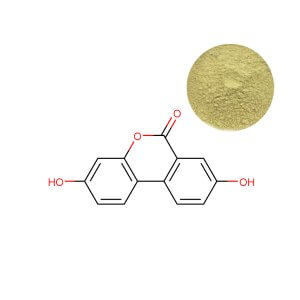
Review the specification against the same checklist. Material offered as Urolithin A Powder can be assessed with the production route declared upfront so the impurity panel is checked against the actual process rather than a generic list.
Reviewing route, assay method, identity evidence, and impurities together helps buyers identify documentation gaps before the first shipment.
Related Products
Products mentioned in this article
Related Articles
You might also be interested in
Overcoming Urolithin A Solubility & Cohesiveness: Industrial Scale-Up and Bioavailability Optimization in Solid Dosage Forms
Overcome Urolithin A solubility barriers and punch sticking in high-speed manufacturing. This guide details particle sizing, lipid wet granulation, and stability protocols for solid dosage lines.

Urolithin A vs. The Rest: How to Choose the Right Anti-Aging Ingredient for Your Product Formulation
Confused by anti-aging ingredients? This guide cuts through the hype, comparing Urolithin A's targeted cellular benefits against NMN, Fisetin, and pomegranate extract. Learn key selection criteria—from clinical evidence to formulation stability—to make an informed choice for your next product.
Beyond Single-Ingredient Longevity: Strategic Urolithin A Synergies for Next-Gen Mitochondrial & Cellular Health Formulations
Clinical data and supply constraints drive the pivot toward Urolithin A formulation stacks. Discover key raw material market dynamics, NMN synergies, and strategic sourcing solutions for next-gen cellular health products.
Need Help With Your Formulation?
Tell us what you are working on. Our team can help with ingredient selection, technical specifications, samples, and supply options.