
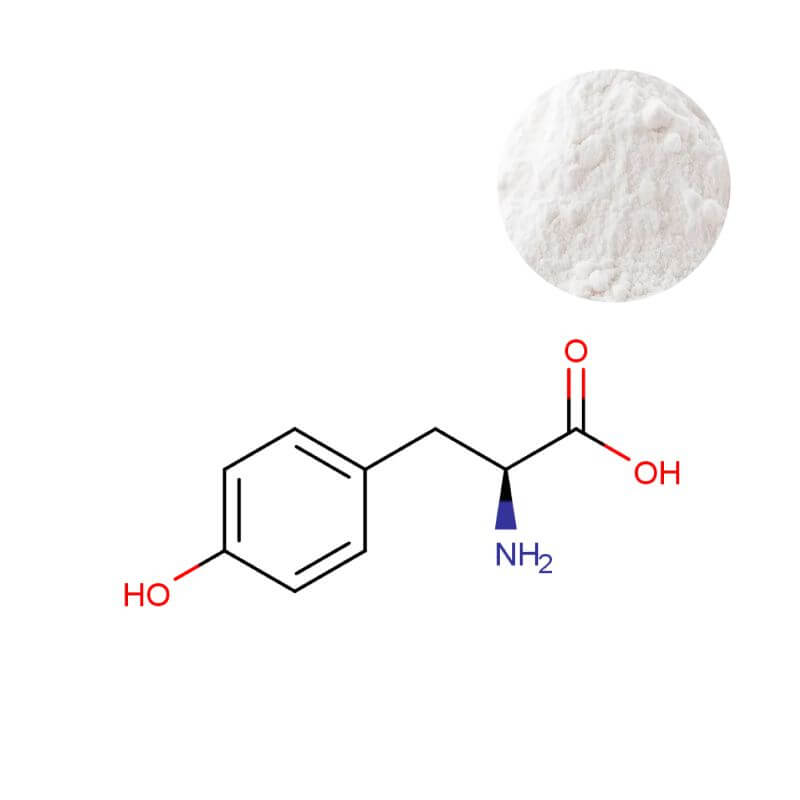
L-Tyrosine Powder
| Product Name | L-Tyrosine Powder |
| CAS Number | 60-18-4 |
| Appearance | White crystalline powder |
| Purity | 99.0% min. (by HPLC) |
| Packaging | 25 kg/drum; 1 kg/bag available for sampling |
| MOQ | 25 kg |
L-Tyrosine Powder (≥99%): A Strategic Cognitive Support Ingredient for Stress-Resilient Formulations
Formulating for cognitive health under pressure is no longer optional—it is a core consumer demand. Premium L-Tyrosine powder (≥99% purity) offers a fundamentally different mechanism: it supports neurotransmitter synthesis precisely when the brain is under high cognitive or environmental load. For brands sourcing bulk L-Tyrosine, the critical differentiator lies in batch-to-batch performance verified by a comprehensive Certificate of Analysis (COA). This article outlines the science, quality benchmarks, formulation strategies, and risk mitigation for sports nutrition and nootropic products. For brand owners, locking in a verified ≥99% L-Tyrosine powder with batch-specific COA is a strategic move to de-risk regulatory filings and build formulation credibility without expensive reformulation cycles.
Science of Stress Resilience: How L-Tyrosine Modulates Cognitive Performance Under Load
L-Tyrosine is the direct precursor to dopamine, norepinephrine, and epinephrine—catecholamines that govern focus, motivation, and the stress response. Under acute stress (e.g., cold exposure, high cognitive demand, sleep loss), these neurotransmitters become rapidly depleted, leading to reduced working memory, slower reaction times, and increased decision errors. Supplementing with bulk L-Tyrosine replenishes this precursor pool. A double-blind, placebo-controlled crossover study in healthy males (n=28) using a single 2g dose demonstrated two quantifiable outcomes: reduced autonomic arousal (lower heart rate and reduced pupil dilation variability) and decreased decision thresholds without sacrificing accuracy, measured via computational modeling of reinforcement learning tasks (doi: 10.1371/journal.pcbi.1010785). From a strategic formulation perspective, this means L-Tyrosine enables brands to create non-stimulant, stress-adaptive products that maintain mental sharpness during high-pressure scenarios—ideal for pre-workout blends, exam-focused nootropics, or shift-worker support formulas. From a product development angle, this mechanism allows brands to replace or reduce stimulants (e.g., caffeine) in day-long focus formulas, directly addressing consumer demand for jitter-free cognitive support.
Formulation in Practice: Dosage, Synergy, and Stability Considerations
Translating L-Tyrosine's clinical profile into a stable, consumer-friendly product requires attention to three practical domains: effective dosage range, synergistic co-ingredients, and physical stability. Below is a summary of evidence-based formulation parameters:
| Parameter | Recommendation for B2B Formulators | Rationale / Reference |
|---|---|---|
| Daily active dose (cognitive stress) | 1.5 – 3 g (acute use) or 500 mg – 1.5 g (daily maintenance) | Based on clinical trials using 100–150 mg/kg body weight; higher single doses are used in acute stress protocols |
| Preferred format | Capsules (size 00 or 0), stick packs, or effervescent tablets | Powder is poorly soluble in cold/neutral pH; acidic beverages (e.g., orange juice) improve dispersion |
| Synergistic ingredients | Caffeine + L-theanine, B-vitamins (B6, B12), adaptogens (Rhodiola rosea) | B-vitamins act as cofactors in catecholamine synthesis; caffeine + L-theanine provides acute focus while L-Tyrosine sustains cognitive resilience |
For procurement teams, this directly translates to two formulation realities: (a) avoid using L-Tyrosine in ready-to-drink (RTD) beverages without micronization or a suspension system, as sedimentation damages consumer perception; (b) consider pre-blending with flow agents (e.g., silicon dioxide) to prevent clumping in stick packs. A common industry practice is to pair L-Tyrosine with a small amount of natural fruit acid (citric or malic) in instant powder formats—this enhances dispersion without altering the ingredient's stability. It's worth noting that L-Tyrosine is remarkably stable under dry, cool conditions (<25°C) when protected from light; however, high humidity (>60% RH) during manufacturing can lead to agglomeration, which directly impacts blend uniformity and fill weight accuracy. Implementing humidity control in the mixing suite (target ≤45% RH) is a practical, often overlooked quality measure.
Quality Benchmarks Beyond Purity: What a Reliable COA Must Include
While many suppliers offer ≥99% L-Tyrosine, the true differentiator for a premium ingredient lies in what the Certificate of Analysis (COA) verifies—and what it does not. For a GMP L-Tyrosine powder used in cognitive or sports formulations, three quality clusters are non-negotiable: specific optical rotation (to confirm L-enantiomer purity), residual solvent profile (apt for fermentation-derived material), and heavy metals speciation (especially inorganic arsenic). Key sourcing considerations include the following checklist:
- Identity confirmation: CAS 60-18-4, specific rotation -11.0° to -12.3° (20°C, c=4 in 1N HCl) ensures no D-tyrosine contamination.
- Purity & related substances: HPLC assay ≥99.0% on dried basis, with loss on drying ≤0.3% and residue on ignition ≤0.1% (USP standards).
- Heavy metals: Pb ≤1.0 mg/kg, inorganic As ≤1.0 mg/kg, Cd ≤0.5 mg/kg, Hg ≤0.1 mg/kg – critical for international regulatory acceptance.
- Microbiological safety: Absence of Staphylococcus aureus, E. coli, and Salmonella in 25g (USP <62>).
From a compliance standpoint, the EFSA's 2024 renewal assessment of L-tyrosine as a feed additive (doi: 10.2903/j.efsa.2024.8845) reinforces the ingredient's broad safety profile when purity and impurity controls are respected—a signal that procurement teams can use as an additional risk mitigation reference. For brands evaluating bulk L-Tyrosine suppliers, a batch-specific COA that includes all the above parameters is not a luxury; it is the minimum requirement to ensure regulatory compliance in the EU and US markets. Failure to verify, for instance, the specific rotation test can lead to receiving an inactive D-tyrosine blend, which directly undermines your product's clinical efficacy and brand credibility. Consequently, procurement teams that prioritize full-panel COA verification shorten their supplier qualification timeline and avoid costly batch rejection—directly improving R&D throughput and time-to-market.
Supply Chain Resilience: Total Cost of Ownership and Risk Mitigation
The price per kilogram of L-Tyrosine powder is only one variable in the total cost of ownership. Hidden risks—inconsistent particle size, undocumented residual solvents, or missing microbial tests—can cause production line stoppages, failed finished product stability studies, or expensive recall events. A robust procurement strategy therefore includes three proactive steps:
- Demand lot-to-lot consistency: Ask for three consecutive batch COAs; check if particle size distribution (e.g., ≥95% through 80 mesh) remains stable. Variation here directly affects blend homogeneity in tablet compression.
- Audit the fermentation source: Since L-Tyrosine is primarily produced via microbial fermentation, confirm that the supplier uses non-GMO or GMO-free substrates if your brand targets clean-label positioning.
- Secure secondary sourcing optionality: Even with a primary partner, maintain a qualified backup supplier to mitigate geopolitical or logistic disruptions—this is standard practice for professional bulk ingredient buyers.
For procurement teams, this directly translates to preferring suppliers who offer fully traceable, batch-specific documentation within 24 working hours of request. A partner that proactively provides stability data (e.g., 24-month shelf life under recommended storage conditions) and a clear policy on certificate renewals reduces your internal quality assurance burden. Practical industry wisdom: never accept a “representative COA” for a new material—always request the COA that matches the actual lot you intend to purchase. Adopting a total cost of ownership lens, the small upfront effort to verify lot-specific COA avoids downstream losses from production halts or failed customs clearance—a direct ROI driver for any serious supplement brand. In the B2B L-Tyrosine market, reliability of documentation is often the quietest but most valuable dimension of a supplier relationship.
Next Steps: De-risk Your Formulation with Full Technical Support
You now have the scientific rationale, the quality checklist, and the formulation guardrails to confidently integrate L-Tyrosine powder into your next sports nutrition or cognitive health line. Moving from data to development requires one low-risk action: evaluating the physical material itself alongside its complete technical dossier. Request your complimentary sample and batch-specific COA to verify particle size, flowability, and assay values in your own lab. Our formulation team is ready to answer compatibility questions or provide stability protocol recommendations—within 24 working hours. Start your formulation with evidence, not assumptions.
Frequently Asked Questions
Share this product
Related Products
Ready to get started?
Contact our team for technical specifications, pricing, and customized solutions.