
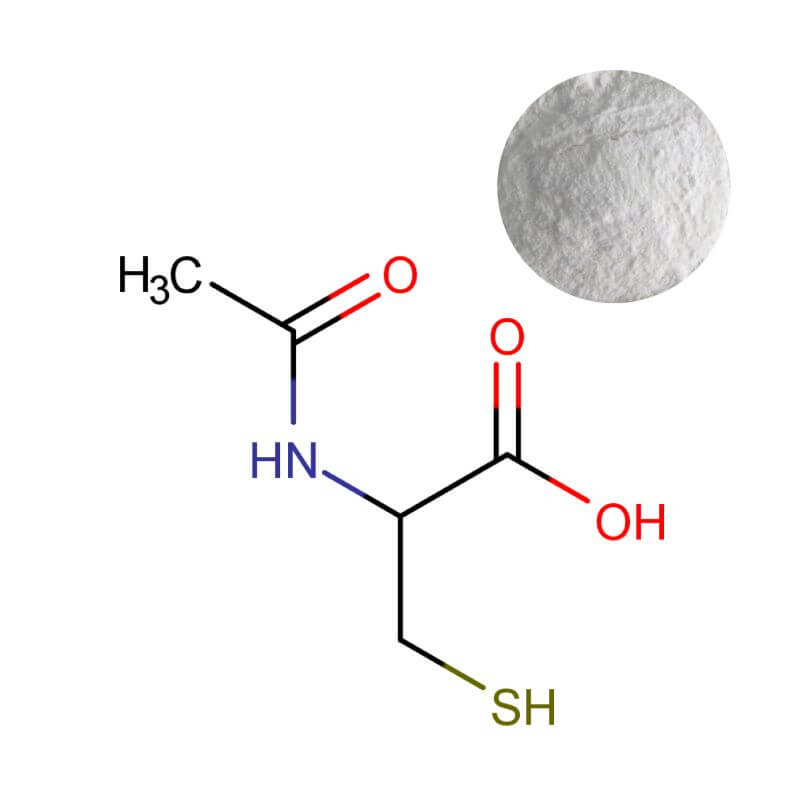
N-Acetyl Cysteine (NAC) Powder
| Product Name | N-Acetyl Cysteine (NAC) Powder |
| CAS Number | 616-91-1 |
| Appearance | White crystalline powder |
| Purity | 98.5% - 101.0% (by HPLC) |
| Packaging | 1 kg/bag, 5 kg/bag, 25 kg/drum |
| MOQ | 1 kg |
N-Acetyl Cysteine (NAC) Powder (98.5% - 101.0% HPLC): A Strategic Backbone for Oxidative Stress Management in Cognitive & Sports Nutrition
For brands developing next-generation antioxidant formulations, the challenge is no longer adding a single radical scavenger. It is about supporting the cell's own defense network. N-Acetyl Cysteine (NAC) powder, standardized to 98.5% - 101.0% assay by HPLC, offers precisely that, a freely water-soluble glutathione precursor (approximately 100 mg/mL in water with heating) with documented multi-pathway activity. Sourcing bulk N-Acetyl Cysteine (NAC) Powder from a GMP-compliant partner using fermentation-derived or synthetic routes ensures batch consistency, verified by COA. This purity grade eliminates variability in glutathione precursor delivery, allowing brands to build defensible claims and justify premium pricing in cognitive health and sports recovery.
Mechanism Matters: Why NAC Functions as a Glutathione Precursor and More
N-Acetylcysteine (NAC) is an acetylated derivative of L-cysteine. Once absorbed, it is deacetylated to L-cysteine, the rate-limiting substrate for glutathione (GSH) synthesis. GSH is the most abundant endogenous antioxidant, essential for detoxification, mitochondrial health, and immune competence. Unlike direct antioxidants that are consumed stoichiometrically, NAC's effect is catalytic; it replenishes the cell's own defense reservoir. A 2025 synthesis of two decades of evidence highlights NAC's additional modulation of Nrf2-ARE signaling, ferroptosis pathways, and glutamatergic/dopaminergic neurotransmitter systems (Curr Issues Mol Biol, 2025; doi: 10.3390/cimb47090710).
This multi-target profile allows NAC to support cognitive health, liver function, and recovery from oxidative stress, not as separate claims but as connected outcomes. This requires raw material with verified assay (98.5% - 101.0%) and low related substances, because impurity profiles can interfere with enzymatic conversion. The table below summarizes key benefits.
| Mechanism Pathway | Functional Outcome for End Product |
|---|---|
| GSH replenishment (rate-limiting) | Supports cellular antioxidant capacity, liver phase II detox |
| Direct thiol-mediated radical scavenging | Helps reduce oxidative damage in neural and muscle tissue |
| Modulation of glutamatergic signaling | Contributes to normal neurological stress response |
Formulations built on NAC's multi-pathway profile can target multiple health concerns with a single active, streamlining SKU complexity and R&D costs. Understanding these pathways leads to the next question: how does a buyer verify that a batch of NAC powder delivers this performance consistently? That requires a closer look at quality benchmarks.
Quality Benchmarks: What Defines a Premium NAC Powder Specification
When sourcing bulk N-Acetyl Cysteine, purity alone, even at 98.5% - 101.0%, is not sufficient. Leading formulators examine interlocked specifications that guarantee stability and functional equivalence across batches. Key parameters beyond assay include:
- Loss on Drying (≤0.5%): Low moisture prevents hygroscopic clumping and hydrolysis-related degradation during storage or high-humidity manufacturing.
- Specific Rotation (+21.0° to +27.0° at 20°C, c=1 in H2O): Confirms correct enantiomeric purity; deviation may indicate racemization or contamination.
- Residue on Ignition (≤0.1%): Low inorganic residue reflects clean processing and avoids catalytic oxidation in finished products.
- Heavy metals (Pb ≤1.0 mg/kg, As ≤1.0 mg/kg, Cd ≤0.5 mg/kg, Hg ≤0.1 mg/kg): Essential for global regulatory compliance, especially for EU Novel Food applications and Canadian NHP registration.
This reduces compliance risk and total cost of ownership. A batch failing any parameter can derail product registration or cause off-spec goods. A reliable N-Acetyl Cysteine (NAC) Powder supplier provides a batch-specific COA from an accredited lab, covering all USP <621> (HPLC), <731>, <781>, and <281> methods. USP compliance also ensures residual solvents meet <467> standards, critical for clean-label positioning. Batch-specific control of heavy metals and residual solvents protects brands from import rejections and regulatory delays, especially when targeting the EU or Canadian markets. With quality benchmarks defined, the next practical question is how to formulate with NAC without compromising stability.
Formulation in Practice: Stability, Synergy, and Delivery Solutions for NAC
NAC presents three practical challenges: hygroscopicity, characteristic sulfurous odor, and pH-dependent degradation. NAC exhibits acceptable stability across a mildly acidic to near-neutral range (pH 4.0-7.0), with commercial formulations standardized to pH 6.0-7.5 to balance oxidation against amide hydrolysis. In neutral or alkaline environments, oxidation accelerates, forming disulfide dimers. Effective formulation strategies for different dosage forms include:
- Capsules and tablets: Use low-moisture excipients (microcrystalline cellulose) and avoid alkaline fillers like calcium carbonate. Dry granulation improves flow without introducing water.
- Powdered drink mixes: Incorporate citric acid or fruit acids to maintain an acidic microenvironment. Mask the sulfurous note with natural flavors (lemon, orange, berry).
- Liquid preparations: Only viable if pH is adjusted to ≤3.5 and packaging is light-protective and airtight, typically not recommended for mass market due to stability risks.
A 2024 systematic review and meta-analysis confirmed that NAC supplementation (typical oral doses 600-2,400 mg/day) reduced muscle soreness at 24 hours post-exercise (MD -0.43, 95% CI -0.81 to -0.04, p=0.03), lactate (MD -0.56 mmol/L, 95% CI -1.07 to -0.06, p=0.03), and IL-6 (SMD -1.71, 95% CI -3.26 to -0.16, p=0.03), with TBARS also reduced (SMD -1.03, 95% CI -1.90 to -0.15, p=0.02), while increasing GSH (J Cell Mol Med, 2024; doi: 10.1111/jcmm.70198). From a strategic formulation perspective, this data supports positioning NAC in sports recovery stacks alongside magnesium glycinate. For cognitive blends, synergy with phospholipids (e.g., phosphatidylserine (PS)) or Lion's Mane extract is common. Avoid co-processing NAC with reducing agents (like ascorbic acid) in wet granulation; sequential addition is safer. The thiol odor is a trade-off premium brands accept. Once formulation is optimized, the final piece is securing a reliable supply chain.
Mitigating Supply Risk: A Sourcing Checklist for Bulk NAC Powder
Procurement of N-Acetyl Cysteine requires more than price negotiation. Given its sensitivity to moisture and regulatory variations across regions, a due-diligence checklist helps secure quality and continuity. In November 2025, a China-origin NAC-containing supplement was flagged in the EU RASFF system for non-compliant ingredients and banned from sale in Poland.
- Quality documentation: Does the supplier provide a batch-specific COA covering assay (HPLC), heavy metals (ICP-MS), residual solvents (GC), and microbiology (USP <61>/<62>)? Are tests from an accredited third-party lab?
- GMP compliance: Verify that the production site follows GMP standards for dietary supplements (NSF, BRC, or equivalent). This ensures hygiene, traceability, and process validation.
- Regulatory support: Can the supplier provide a technical dossier (allergen, non-GMO, stability data)? For EU buyers, ask about Novel Food status; for US buyers, confirm alignment with FDA's March 2025 final guidance and monitor the proposed rule expected January 2026. Note that enforcement discretion does not apply to adulterated or misbranded products.
- Logistics and stability: Request 24-month stability data under recommended storage (cool, dry, 15-25°C, protected from light). Packaging integrity, triple-layer polyethylene bags inside aluminum foil or HDPE drums, is standard.
For procurement teams, this directly translates to lower total cost of ownership. Higher upfront cost from a reliable distributor eliminates risks such as batch rejection, production line downtime, or failed regulatory filings. A 5% price premium on GMP-verified NAC is negligible compared to the potential 20x cost of a recall or failed customs clearance. A supplier offering free samples (10-20 g) allows validation before full drums, a practice leading formulators consider non-negotiable.
Next Steps: De-risk Your Development with Verified NAC Specifications
Developing a successful product around N-Acetyl Cysteine powder requires science-aligned sourcing, stability planning, and regulatory foresight. By choosing a N-Acetyl Cysteine (NAC) Powder wholesale partner that provides HPLC-verified 98.5% - 101.0% purity, GMP compliance, and full traceability, your brand gains a competitive edge in cognitive health, sports recovery, and detox segments. To accelerate your project, request a complimentary sample and complete technical dossier, including batch-specific COA, stability report, and application guide. Request Your Complimentary Sample & Batch-Specific Technical Dossier and move from concept to shelf with confidence.
Frequently Asked Questions
Share this product
Related Products

Ready to get started?
Contact our team for technical specifications, pricing, and customized solutions.