
Fisetin vs. Quercetin & Resveratrol: Senolytic Potency, Synergistic Formulations, and Cost-Effective Absorption
An technical guide evaluating Fisetin, Quercetin, and Resveratrol across LogP, PK metrics, and processing stability. Resolve scale-up challenges and optimize cost-effective absorption strategies.
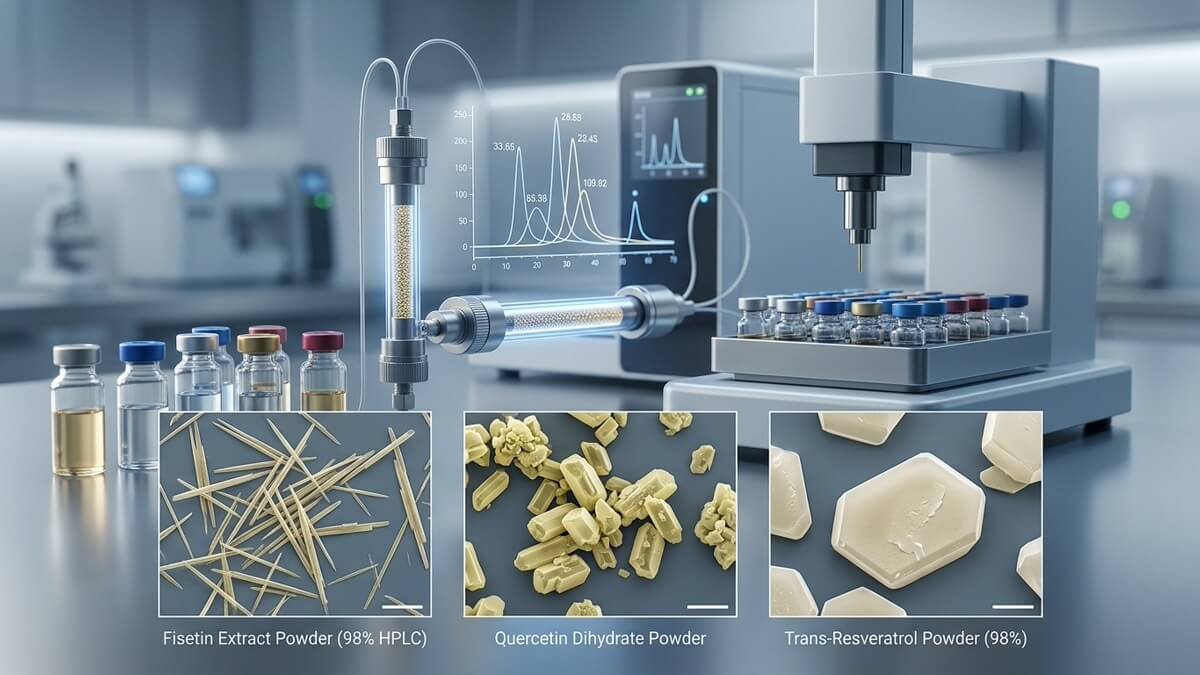
Formulators and procurement leads evaluating senolytic actives often encounter a recurring dilemma: standard HPLC purity figures fail to predict in-vivo performance, while physical instability during scale-up routinely undermines batch consistency. Selecting between Fisetin, Quercetin, and Resveratrol requires more than a price-per-kilo comparison-it demands a systematic review of molecular bioavailability and degradation kinetics. This guide dissects these three polyphenols across quantifiable technical parameters to support evidence-based ingredient sourcing.
Physical Benchmarks and Processing Forensics: A Comparative Snapshot
Despite overlapping antioxidant classifications, Fisetin Extract Powder (3,3',4',7-tetrahydroxyflavone) stands apart with a distinct catechol B-ring motif that enhances senolytic potency while simultaneously increasing susceptibility to enzymatic conjugation. Quercetin shares the catechol feature but differs in hydroxylation density, whereas Resveratrol employs a stilbene backbone with fundamentally different conformational behavior. These structural distinctions directly correlate with measurable physical properties that dictate formulation compatibility:
| Property | Fisetin (98% powder) | Quercetin (95% powder) | Resveratrol (98% powder) |
|---|---|---|---|
| Water solubility (25°C, mg/mL) | < 0.01 (literature range: 0.001-0.151) | < 0.01 | 0.05 |
| LogP (octanol-water) | 1.2-3.2 (literature-dependent) | 1.8 | 3.1 |
| Melting point (decomposition) | > 330°C | 316-323°C | 261-263°C |
| Hygroscopicity | Pronounced | Moderate | Low |
Fisetin's LogP (reported in the range of 1.2-3.2 depending on literature source) suggests moderate lipid affinity, which may offer some compatibility with oil-based systems-though the difference versus Resveratrol is marginal. However, its pronounced hygroscopicity imposes strict processing constraints: without maintaining ambient relative humidity below 40%, powder flowability deteriorates rapidly, leading to inconsistent die fills on high-speed encapsulators. Procurement teams should request bulk density and Carr index data from suppliers to validate flow performance before committing to large-scale production. Additionally, requesting particle size distribution (D10, D50, D90) with a target D50 range of 40-60 µm ensures homogeneous blending with excipients during high-shear mixing operations, reducing segregation risks in multi-component blends.
Mechanistic Pathways, PK Benchmarks, and Label-Relevant Differentiation
These three actives engage discrete biological circuits. Fisetin operates primarily as a senolytic agent, selectively clearing p16INK4a-positive senescent cells, while concurrently activating Nrf2-mediated antioxidant defenses via competitive HDAC3 inhibition. Quercetin also exhibits senolytic properties, though in academic research it is often studied alongside pharmaceutical synergistic agents to achieve potency comparable to Fisetin's intrinsic activity. Resveratrol follows a different trajectory-it functions as a SIRT1 allosteric modulator, influencing mitochondrial biogenesis without direct senolytic clearance. This divergence creates a clear dual-mechanism synergy: pairing Fisetin with Trans-Resveratrol Powder allows brands to support both senescent cell clearance and sirtuin activation within a single finished product.
The clinical relevance of these pathways, however, hinges entirely on systemic exposure. A 2022 randomized double-blinded crossover pharmacokinetic study in healthy volunteers provided the first human baseline for unformulated Fisetin powder. At a 1,000 mg oral dose, the AUC0-12h registered only 12.67 ng·h/mL, with a Cmax of 9.97 ng/mL (Journal of Nutritional Science, 2022; doi: 10.1017/jns.2022.72). This quantifies the scale of first-pass glucuronidation that standard powder formulations must overcome. Comparative data shows Quercetin Dihydrate Powder suffers even lower fractional absorption, while Resveratrol rapidly sulfates to inactive conjugates. Quercetin's sulfate conjugation rate exceeds 80% in enterocytic metabolism, and Resveratrol-3-sulfate accounts for over 75% of circulating metabolites within 30 minutes post-dose-contrasting sharply with Fisetin's glucuronidation-dominated clearance profile. The implication for R&D directors is clear: intrinsic potency measured in vitro cannot be extrapolated to finished-product efficacy unless deliberate absorption-enabling excipients are incorporated.
Scale-Up Dynamics: From Powder Blends to Gummies and RTD Beverages
The transition from lab-scale blending to industrial manufacturing amplifies subtle physical differences into critical failure points. Fisetin's degradation rate constant (k) at 37°C increases from 8.30×10⁻³ h-1 at pH 6.0 to 0.202 h-1 at pH 7.5-a 24-fold acceleration that effectively rules out alkaline RTD formulations without advanced encapsulation. Thermal stability presents a further constraint: while Fisetin's half-life in boiling water reaches 131 minutes (based on published stability studies of polyhydroxy flavonols in boiling water, which included Fisetin as a specific test compound), the 90-105°C gummy cooking process reduces unshielded activity retention to approximately 55%, necessitating post-cook addition or protective lipid coatings.
Processing recommendations for each format:
- Capsules and tablets: Pre-blend with PVP K30 (as binder) and silicon dioxide or microcrystalline cellulose (as glidant and filler). Maintain manufacturing suite RH below 40% to prevent hygroscopic caking. Target an Angle of Repose below 35° and a Carr index under 25% to achieve consistent fill weights; punch sticking rates exceeding 2% during compression indicate a need for lubricant rebalancing or additional glidant inclusion, as this threshold represents the operational breakpoint where tablet weight deviation exceeds USP <905> uniformity criteria.
- Gummies: Add Fisetin during the final cooling phase, if feasible. Target finished-product pH between 4.5 and 6.0 to minimize degradation during shelf life.
- RTD beverages: Avoid direct dissolution in aqueous systems. Employ cyclodextrin complexation or incorporate into oil-in-water nanoemulsions.
- Softgels: Leverage the LogP by suspending in medium-chain triglycerides for enhanced lymphatic transport.
From a commercial scale-up perspective, these physical property benchmarks directly dictate equipment selection-solubility profiles inform emulsifier choice and mixing shear rates, while particle size distribution and angle of repose data drive hopper design, feeder calibration, and compression parameters on high-throughput rotary presses.
Analytical Integrity, Supply Chain Verification, and Cost-In-Use Logic
Analytical Traps and Origin Fraud Detection
Standard HPLC detection at 360 nm cannot differentiate botanical Fisetin from synthetic equivalents-both produce identical chromatographic profiles. This creates a verifiable supply-chain vulnerability. For brands carrying clean-label or non-GMO commitments, ASTM D6866 radiocarbon analysis measures the biogenic carbon fraction of the total organic carbon content. Plant-derived Fisetin from Cotinus coggygria typically registers a high biogenic carbon percentage, while petrochemical-sourced material yields a significantly lower reading-providing a forensic tool for origin verification. QA teams should mandate full chromatographic raw data and integration parameters in each COA, moving beyond single-number purity assertions. A validated RP-HPLC method with an LOD of 17.26 ng/mL and recovery rates of 98.24-100.65% establishes the minimum analytical rigor required for incoming material approval. Suppliers operating under GMP standards consistent with the technical specifications of Oclean Nutra typically provide full method validation packages alongside each batch.
Cost-In-Use (CIU) without Unit-Price Bias
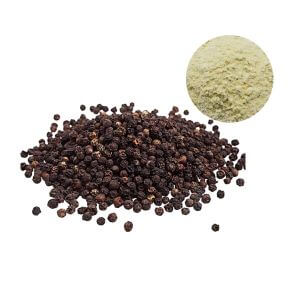
Effective procurement strategy evaluates per-serving economic efficiency rather than raw FOB/kg quotations. Fisetin's higher senolytic potency translates to lower active loading requirements versus Quercetin to achieve comparable biological endpoints-directly reducing per-unit raw material expenditure and capsule fill weight. The addition of Black Pepper Extract (Piperine 95%) at 5-10 mg per serving inhibits intestinal glucuronidation, delivering a measurable AUC uplift at minimal incremental material cost. This approach consistently outperforms pre-engineered encapsulated alternatives in terms of cost-per-unit efficacy, provided the base Fisetin powder meets verified purity and flow specifications. Beyond the per-serving economics, procurement leaders should align supplier selection with batch-to-batch consistency metrics-coefficient of variation below 5% for assay values-and on-site audit rights for processing aids, shifting the sourcing conversation from unit-price bidding to long-term supply-chain resilience.
Regulatory Divergence and Market Entry Barriers
- United States: Available as a dietary ingredient under DSHEA; brands targeting the US market should verify with their supplier whether the specific grade holds a self-affirmed GRAS position, as this status is product-grade specific.
- European Union: Classified as a Novel Food when derived from Cotinus coggygria bark at ≥98% purity-pre-market authorization under Regulation (EU) 2015/2283 is mandatory for this specific grade and source.
- Australia: Permitted as a listed complementary medicine under the TGA regulatory framework.
This divergence demands that global brands align ingredient sourcing with target-market regulatory strategy during the early formulation phase to avoid costly product registration delays or reformulation requirements later.
Conclusion: A Balanced Sourcing Framework
Fisetin delivers quantifiable senolytic advantages over Quercetin and provides meaningful SIRT1/Nrf2 crosstalk that synergizes with Resveratrol for dual-pathway longevity positioning. Yet its intrinsic hygroscopicity, pH-driven degradation, and low baseline human oral bioavailability mandate deliberate formulation engineering-specifically lipid carriers and glucuronidation inhibitors-rather than relying on simple powder encapsulation. For procurement and QA leaders, verifying origin via ASTM D6866 and demanding validated HPLC raw data de-risks the supply chain effectively. To initiate technical evaluation, contact our procurement support team for comprehensive COA packages and pilot-scale sampling options.
Share this article
Found this helpful? Share it with others!
Related Products
Products mentioned in this article
Related Articles
You might also be interested in
The Senolytic Revolution: Why Fisetin is Dominating the Next-Generation Longevity Formulations
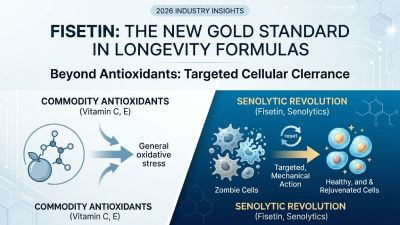
The shift from antioxidants to senolytics is redefining healthy aging. This article analyzes Fisetin’s market dominance, clinical superiority, and strategic formulation stacks with NMN to help brands drive high-margin innovation.
Want to learn more?
Explore our products or contact our team for personalized solutions and expert advice.