
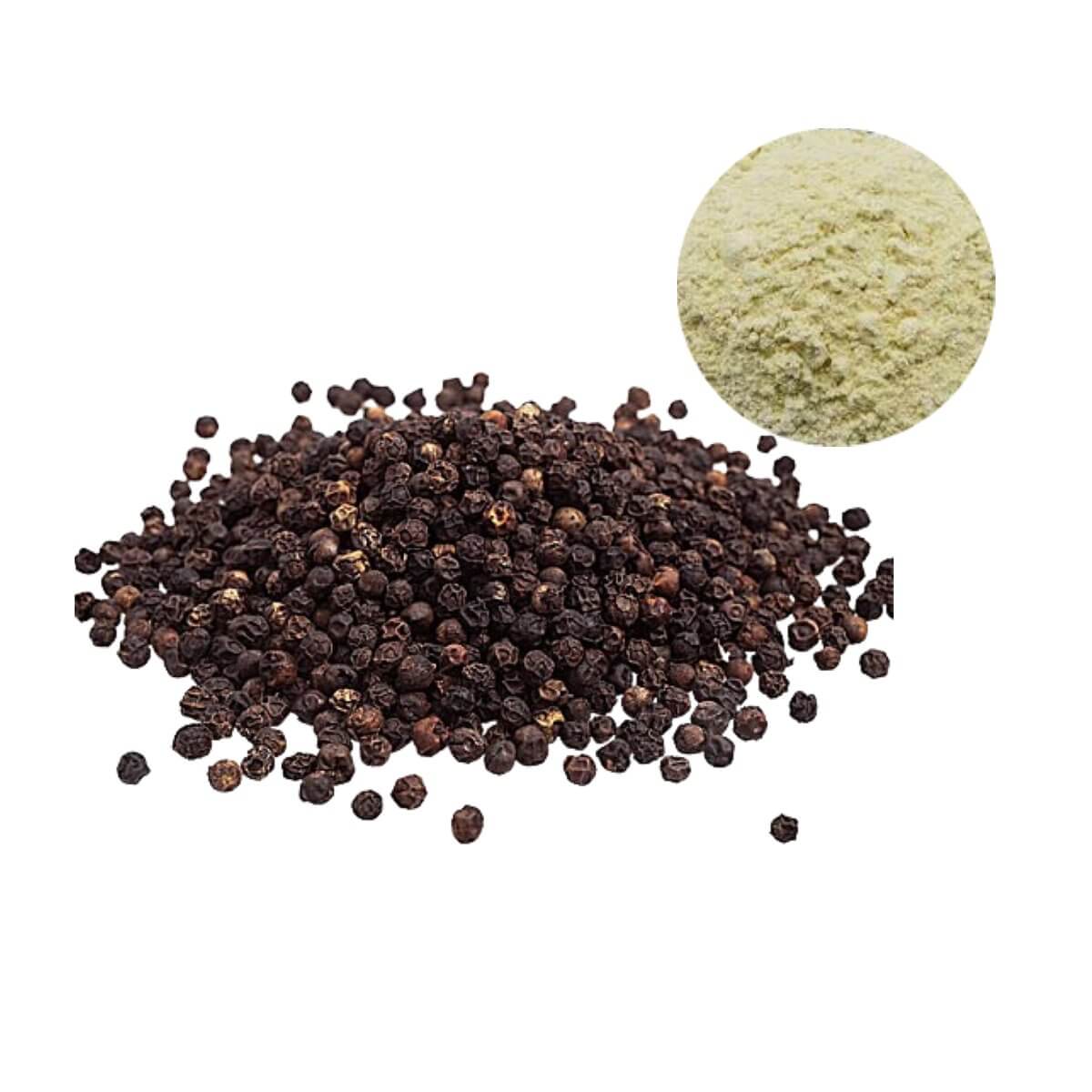
Black Pepper Extract (Piperine)
| Product Name | Black Pepper Extract Powder |
| CAS Number | 94-62-2 |
| Appearance | Light yellow to off-white fine powder |
| Purity | ≥95.0% (by HPLC) |
| Packaging | 1 kg/bag, 5 kg/bag, 25 kg/drum |
| MOQ | 1 kg |
Clinically Validated Piperine Powder for Bioavailability-Enhancing Supplements & Metabolic Health Formulations
Bulk Black Pepper Extract Powder with ≥95% piperine by HPLC bridges clinical metabolic evidence and finished-dose innovation, enabling supplement brands to enter the fast-growing bioavailability-enhancer segment with scientifically defensible claims. Spec-verified Black Pepper Extract supplier documentation includes lot-specific COAs and stability protocols, aligning R&D verification with procurement risk control from first inquiry through routine reordering.
Human Clinical Proof Anchors Metabolic Health DTC Claims
Translational research directly addresses the brand owner's core concern: does piperine deliver measurable human benefits beyond enhanced absorption? A randomized double-blind controlled trial administering 5 mg/day piperine to subjects with early-stage hepatic metabolic conditions documented statistically significant reductions in serum ALT, AST, fasting glucose, and HOMA-IR after 12 weeks (Scientific Reports, 2024; doi: 10.1038/s41598-024-51726-z). This Level 1 clinical endpoint evidence transforms Black Pepper Extract from a simple spice derivative into a clinically validated metabolic health ingredient, directly supporting DTC claims such as "clinically studied to support healthy glucose metabolism" and "helps maintain liver enzyme function within normal range." Daily piperine doses ranging from 5-20 mg are clinically validated, with PBPK-modeled data showing 20 mg/day over 7 days increasing CYP3A4 substrate AUC by 31-59%, enabling formulators to predict systemic exposure levels and reduce dose-finding costs during product development. For formulation R&D teams, this human data eliminates the need for speculative mechanism extrapolation and shortens the internal validation phase by providing publishable-grade evidence for regulatory submission dossiers. The 5 mg dose level aligns precisely with standard co-formulation ranges (5-15 mg per serving), making the clinical outcome directly transferable to finished products without reformulation risk.
Formulation Engineering Unlocks Solubility Constraints and Expands Dosage Formats
The same clinical efficacy established above must survive the transition into scalable finished dosage forms-yet piperine's hydrophobic nature and electrostatic behavior create well-known hurdles in high-speed tableting and encapsulation. Hot-melt extrusion (HME) of amorphous polymer-phospholipid solid dispersions offers a commercially validated path to overcome these barriers, enabling curcumin and piperine co-delivery (Pharmaceutics, 2024; doi: 10.3390/pharmaceutics16080999). XRD amorphization and DSC-confirmed miscibility, alongside PAMPA permeability data from the same study, demonstrate substantially elevated dissolution rates versus crystalline material, directly substantiating "enhanced delivery" DTC claims that justify premium retail pricing and improve conversion rates on brand-owned e-commerce channels.
| Dosage Format | Formulation Strategy | Key Benefit for Brand Owner |
|---|---|---|
| High-speed tablets | Dry granulation with silicated MCC; particle size ≥95% through 80 mesh | Eliminates secondary granulation, reduces scrap rate |
| Soft gels / capsules | Lipid-based dispersion or HME amorphous solid dispersion | Enables high-curcuminoid loads with piperine, supports once-daily dosing |
| Gummies / chewables | Microencapsulated piperine with taste-masking carriers | Opens the fast-growing gummy segment without bioavailability loss |
Formulators bypass multiple trial-and-error cycles through this approach, compressing formulation development by 8-10 weeks. Synergistic co-formulation with curcumin (standard 500 mg curcuminoids + 5-10 mg piperine) delivers quantifiable bioavailability enhancement, while pairing with berberine or formulating alongside CoQ10 creates distinctive product lines that command premium retail pricing. These combinations offer a competitive edge that directly supports margin expansion in crowded DTC categories. Bulk Black Pepper Extract powder integrated via HME technology provides consistent dissolution profiles across batches, reducing post-launch stability surprises and preserving brand equity.
Chromatographic Fingerprinting Fortifies Brand Protection and Supply Chain Integrity
Once formulation engineering delivers a stable finished product, procurement and QA/QC face an unavoidable question: how can every lot be authenticated and adulterated or misgraded material rejected? The global market exhibits substantial price differentiation between genuine high-purity piperine and inferior oleoresins or synthetic analogs. HPLC-DAD using a reversed-phase C18 column with acetonitrile/water mobile phase quantifies piperine absorbance at 343 nm while simultaneously isolating minor alkamides-piperanine, chavicine, and isopiperine-that serve as intrinsic chemical fingerprints. This chromatographic approach verifies ≥95% piperine content and flags structural isomers indicative of improper processing or adulteration, providing an anti-counterfeit shield that no visual inspection or simple UV method can match.
- HPLC-DAD distinguishes piperine from chavicine and isopiperine with retention time resolution <0.5 min, enabling rapid authenticity screening
- Stability-indicating RP-HPLC methods validated per ICH guidelines confirm batch-to-batch consistency and detect degradation products from thermal or oxidative stress
- Nitrogen flushing during drum packaging and UV-light-protected containers maintain fingerprint integrity over 24-month shelf life
This chemical authentication layer directly protects brand owners from reputational harm caused by ingredient substitution-a risk that can erase millions in brand value. Tier-1 compliance audits increasingly require full chromatographic profiles rather than simple COA numbers. By offering lot-specific HPLC fingerprints, Black Pepper Extract wholesale suppliers eliminate the "trust but verify" bottleneck, accelerating the vendor qualification process from weeks to days and reducing procurement's total cost of ownership through rejection avoidance.
Global Regulatory Mapping Defines Market Entry Pathways and ADI Guardrails
Having secured chemical identity and batch-to-batch consistency, the final gate for international brand expansion is regulatory acceptance-but piperine's legal status varies sharply across jurisdictions, and missteps here can derail entire product launches. The United States recognizes piperine from black pepper as GRAS for its intended use in foods and supplements, while the European Union classifies it as a "not novel food" based on significant consumption history before 1997. However, the European Commission has placed piperine on the priority review list under Regulation (EC) No 1925/2006, signaling possible future restrictions.
- FDA GRAS status allows straightforward US market entry with structure/function claims (e.g., "helps support nutrient absorption")
- EU "not novel" status enables continued use, but pending review demands careful dose selection; NOAEL established at 5 mg/kg body weight
- Brazil: ANVISA Resolution RE No. 1.038 (March 2025) prohibits commercialization of supplements containing piperine or black pepper extract as bioactive constituents-liquid and powder formats using black pepper as a flavoring agent are exempt
- Canada: HC limits non-medicinal piperine to ≤0.4 mg/day (higher doses permitted when used as a medicinal NHP ingredient); Taiwan FDA sets a daily intake limit of 12 mg/day
The commercial implication is unambiguous: brands must tailor finished-product piperine levels to target markets. For cross-border DTC brands, this regulatory intelligence translates directly into risk-adjusted market entry sequencing-prioritizing the US and EU while deferring or reformulating for Brazil and Canada. R&D teams can avoid costly reformulation cycles by designing a master formulation with adjustable piperine content and modular packaging. Black Pepper Extract supplier partnerships that include jurisdiction-specific compliance dossiers reduce the regulatory validation timeline by an estimated 6-8 weeks, allowing faster time-to-market and protecting revenue streams from unexpected import detentions. When paired with the chromatographic authenticity data above, this compliance package transforms the ingredient from a commodity into a fully auditable, brand-safe strategic component, with cross-jurisdiction compliance dossiers characterized by the Oclean Nutra analytical framework.
Accelerate In-House Validation with Technical Sample and Full Compliance Documentation
Time-to-market for new supplement launches depends heavily on how quickly R&D can verify physical compatibility and procurement can approve supplier quality systems. A standard 10-20 g sample of Black Pepper Extract powder allows immediate wet-lab assessment of particle size distribution, blend uniformity, and compatibility with your chosen carrier systems. The accompanying documentation package-including batch-specific COA, HPLC fingerprint chromatogram, stability summary, and market-specific regulatory mapping-provides the exact data needed to complete supplier qualification and initiate pilot runs within days rather than weeks. Request a Black Pepper Extract sample with technical dossier to de-risk your formulation timeline and secure a compliant, traceable source for commercial production.
Frequently Asked Questions
Share this product
Related Products
Ready to get started?
Contact our team for technical specifications, pricing, and customized solutions.