
Mastering K2 MK-7, D3 & Magnesium Glycinate Premixes: Stability, Uniformity, and Scale-Up Integrity
Mastering K2 MK-7, D3, and magnesium glycinate premixes requires solving solid-state particle segregation and degradation. Learn how microencapsulated grades ensure batch uniformity and shelf-life stability.
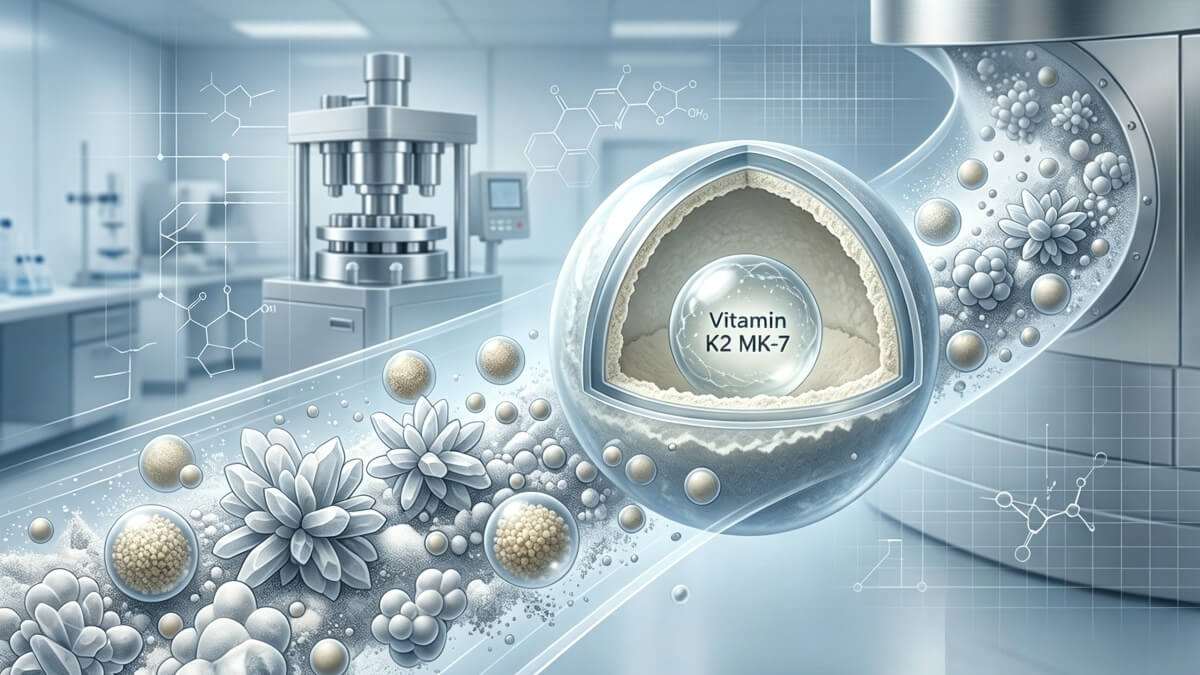
At pilot-plant scale, blending microgram-level K2 MK-7, vitamin D3, and magnesium glycinate often becomes a formulator's nightmare: uniformity failures, segregation, and shelf-life collapse. These issues are rooted in solid-state physics, hygroscopic dynamics, and particle incompatibility. This guide maps each barrier to micronization, microencapsulation, and grade-selection protocols that preserve potency and production economics.
The Physical-Chemical Trilemma: Why MK-7, D3, and Magnesium Glycinate Fight Each Other
Formulators working with vitamin K2 MK-7 powder in multi-component blends must account for its lipophilic naphthoquinone structure, a melting point of 54°C, and pronounced sensitivity to alkaline microenvironments. Vitamin D3 powder (100,000 IU/g) exists as spray-dried particles with 0.5-2 μm oil droplets in an acacia-sucrose matrix, offering a free-flowing yet friable form. Magnesium glycinate, an organic chelate, delivers a mild, near-neutral pH (1% solution: 6.0-7.0) but with a bulk density spanning 0.30-0.80 g/mL depending on the supplier lot.
| Property | MK-7 (98% pure) | D3 100 CWD powder | Magnesium Glycinate |
|---|---|---|---|
| Particle size (mesh) | Not standardized (micro-powder) | 100% pass 30 mesh; ≥90% pass 40 mesh | 80-120 mesh (typical) |
| Bulk density (g/mL) | N/A (vendor-specific) | ~0.5-0.7 | 0.30-0.80 |
| Hygroscopicity | High (moisture-sensitive) | Low (non-hygroscopic) | Low to slight |
| Aqueous pH (1% sol.) | Neutral to slightly alkaline | ~6.5-7.0 | 6.0-7.0 (near-neutral) |
When blended in a V-mixer, the density and size disparities promote segregation by sifting and fluidization. Microgram-level MK-7 particles either adhere electrostatically to larger glycinate crystals or settle at the bottom, causing inter-batch relative standard deviations (RSD) that routinely exceed 6-8% - well above the acceptable <5% RSD for critical nutrients.
The Real Culprit: Alkaline-Induced Degradation and the Magnesium Trap
Beyond physical demixing, chemical incompatibility magnifies the risk. Unprotected MK-7 exposed to even trace alkaline ions undergoes rapid naphthoquinone ring opening. Data show unprotected MK-7 retains only 1% when combined with MgO, and 60%/29% with CaCO3 at 25/40°C after 12 months. This is not merely a formulation inconvenience - regulatory agencies are tightening post-market potency testing, and brands that rely solely on overage rather than genuine stability engineering will face compliance exposure and margin erosion as raw material costs fluctuate.
Using magnesium glycinate powder in place of basic oxides offers a mild near-neutral pH (6.0-7.0) and does not release aggressive free ions. Yet its variable density still creates a microenvironment where moisture - even at 2% water content - can catalyze hydrolysis of the MK-7 side chain. This dual physical-chemical pressure forces formulators to abandon standard overage strategies; overage cannot correct for non-uniform distribution, and excessive overage invites regulatory scrutiny.
Grade Selection as the First Scale-Up Decision: 98% Pure vs. 0.2%/1% Microencapsulated Premix
Choosing the right MK-7 grade is not a procurement detail - it is a process engineering fork. The 98% pure powder suits facilities equipped with high-precision micro-dosing and geometric dilution protocols. However, for most contract manufacturers, handling microgram quantities per batch introduces weighing errors and cleaning cross-contamination risks.
The alternative - 0.2% and 1% microencapsulated MK-7 dilution powders - effectively amplifies the volume fraction. Spray-dried microcapsules with a starch-protein bilayer physically isolate MK-7 from both moisture and alkaline triggers. This format matches the particle size and flow characteristics of 100,000 IU/g vitamin D3 powder and glycinate, enabling direct one-step blending without intermediate geometric dilutions.
| Grade | Volume fraction | Pre-blending required | Risk of segregation | Best suited for |
|---|---|---|---|---|
| 98% pure MK-7 | Very low | Yes (multi-step) | High | Large-scale manufacturers with micro-dosing lines |
| 0.2% microencapsulated | Moderate | No | Low | Standard tablet/capsule lines |
| 1% microencapsulated | High | No | Very low | High-throughput direct-compression & sachet lines |
Accelerated stability trials confirm that microencapsulated MK-7 blended with calcium carbonate retains 96% at 25°C and 86% at 40°C after 12 months - versus 60% and 29% for unprotected material. With magnesium oxide, the protected form achieves 92% (25°C) and 80% (40°C), compared to a catastrophic 1% for the unprotected control. These numbers directly justify the switch to a premix-ready encapsulated grade.
Consumer demand for clean-label, mineral-fortified formats is compressing product development cycles. This directly pressures procurement and R&D to select raw material grades that de-risk scale-up from day one - not next quarter.
Microencapsulation Architecture: Physical Barrier and Process Window
The protective bilayer - typically a combination of modified starch, gum acacia, and a lipophilic inner coating - serves two functions. First, it establishes a glass transition temperature (Tg) above 60°C, ensuring structural integrity during tableting compression and soft-gel drying. Second, the capsule wall limits water activity (Aw) around the active core to below 0.2, effectively arresting hydrolysis.
A 2026 study in the Journal of Food Process Engineering (Journal of Food Process Engineering, 2026; doi: 10.1111/jfpe.70635) documented that unprotected MK-7 in a liquid nanoemulsion follows zero-order degradation, dropping from 52.46 μg/mL to just 6.2% residual potency after 86 days at ambient storage. This quantifies the degradation window that formulators must close - and solid-state microencapsulation does precisely that by removing water and alkaline ions from the reactive sphere.
For the full K2-D3-magnesium premix, selecting microencapsulated grades that align with the powder size of D3 (100% through 30 mesh) and the 80-120 mesh of glycinate ensures uniformity RSD below 3% in a 15-minute V-blender cycle, without over-mixing that could fracture the capsule wall. Under the Oclean Nutra formulation specification, the target bulk density range is harmonized between 0.55 and 0.65 g/mL across all three components, minimizing density-driven segregation.
Selecting the wrong MK-7 grade locks in segregation risk at the blender - no downstream process step can correct it.
Scale-Up Parameters: From Lab Blend to Production Floor
Translating this formulation to commercial equipment demands tight control of three critical parameters:
- Blending time: 12-18 minutes in a double-cone blender (not exceeding 20 minutes) to avoid electrostatic agglomeration.
- Absolute humidity: Maintain workshop RH below 40% to prevent moisture uptake on the glycinate fraction; even a 1% moisture increase can reduce MK-7 stability by 15% at 6 months.
- Compression force: For tablets, limit main compression to 8-12 kN; higher forces risk fracturing microcapsules and exposing MK-7 to alkaline excipients.
For capsule filling, the target tapped density should be 0.70-0.75 g/mL to ensure consistent dosing weight. Routine monitoring of angle of repose (target <35°) provides an on-line proxy for flowability - if it exceeds 40°, segregation is imminent.
Quality Auditing: What to Demand from Your Premix Supplier
When evaluating a multi-component premix or individual encapsulated grades, your quality assurance checklist must go beyond standard COA parameters. Insist on:
- Dissolution profile in pH 6.8 phosphate buffer (USP apparatus 2, 75 rpm): ≥80% release within 60 minutes for both MK-7 and D3.
- Accelerated stability data at 40°C/75% RH for 6 months, with individual potency retention per component.
- Water activity (Aw) of the final premix: ≤0.25, verified at 25°C.
- Bulk/tapped density ratio (Carr index < 20) to confirm flow consistency.
- Third-party certifications: USP-verified (for MK-7 content ≥96.0% and MK-6 impurity ≤3%), Non-GMO Project, and Kosher/Halal where applicable.
Reject any supplier that cannot provide batch-to-batch particle size distribution (PSD) and density data - these are non-negotiable for scale-up reproducibility.
Conclusion: De-Risk Your Next Premix Launch with Engineered Grades
Microencapsulated MK-7 grades eliminate multi-step dilution, reduce segregation, and deliver proven 12-month stability with reactive minerals. Pair with density-matched D3 and low-hygroscopicity glycinate for predictable, audit-ready production.
The technical team offers free consultation on grade selection, custom premix formulations, and accelerated stability trial design. Request a tailored sample kit to validate your specific tablet, capsule, or sachet line. Contact our technical support team to schedule a 1-on-1 session and receive the latest stability white paper for the grade series.
Share this article
Found this helpful? Share it with others!
Related Products
Products mentioned in this article
Related Articles
You might also be interested in

The Trans-MK-7 Purity Trap: Navigating Chiral Degradation and Regulatory Thresholds in K2 Formulation
Navigating K2 chiral degradation and new GB standards is critical for compliance. This guide reveals how all-trans MK-7 secures stability and protects brand equity.
Want to learn more?
Explore our products or contact our team for personalized solutions and expert advice.