
Vitamin K2 MK-7 vs. MK-4: R&D Guide to Bioavailability, Stability, and Synergistic Calcium-D3 Formulations
Compare Vitamin K2 MK-7 and MK-4 across PK profile, flowability, and mineral stability. Learn why 72-hour half-life and C30 isomer purity make MK-7 the ideal choice for Calcium-D3 formulas. Get tech data now.
Formulators and procurement leads often default to MK-4 based on its lower per-kilogram price, only to find that milligram-level addition consumes capsule space, adds cost, and delivers suboptimal carboxylation. A wrong choice at the specification stage cascades into reformulation expenses, failed stability batches, and missed label claims. This guide dissects the technical differentiators between MK-7 and MK-4 across pharmacokinetics, physical processing, and synergistic formulation design, equipping R&D and purchasing teams with quantifiable decision criteria.
Physicochemical Profile and Powder Handling Benchmarks
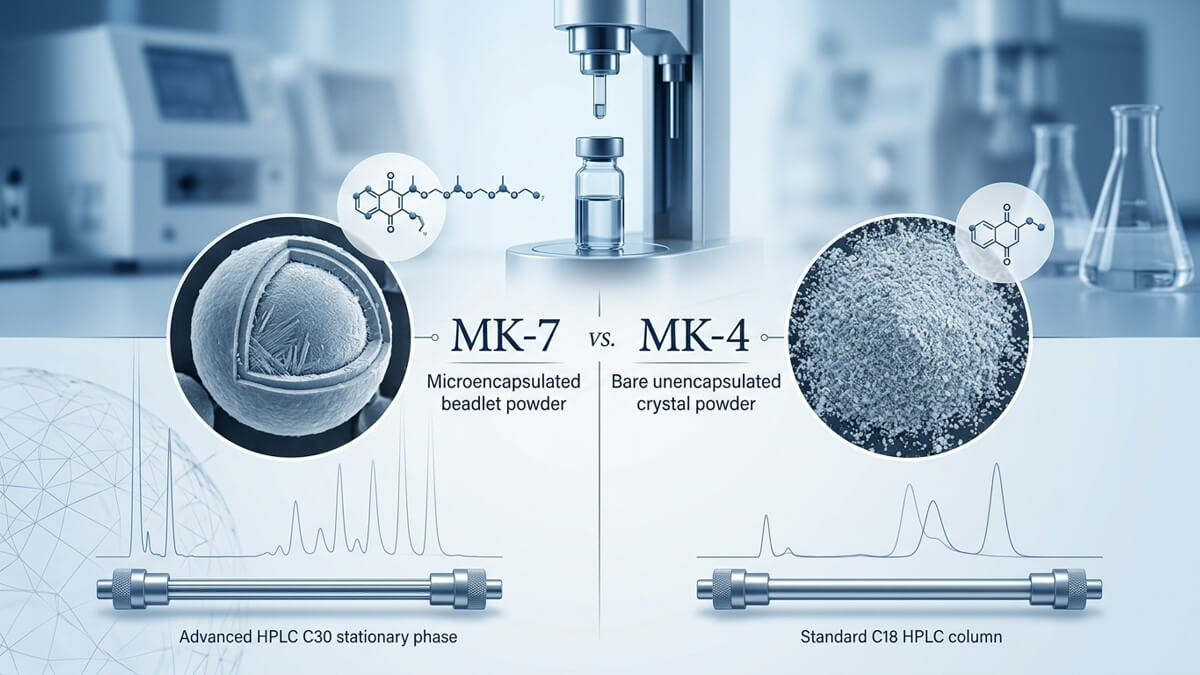
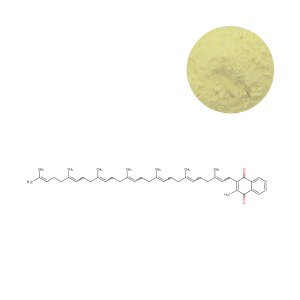
Premium Vitamin K2 MK-7 Powder has a melting point of 54°C and a log P of 14.45, confirming extreme lipophilicity. Its aqueous solubility is practically negligible at 25°C, dictating that water-based systems require advanced emulsification or microencapsulation. MK-4 shares this lipophilic character but differs in dose scale and physical behavior.
Flowability data expose a critical processing gap: MK-7 bulk powder exhibits poor flow characteristics (Carr Index >25%, indicating significant compressibility and cohesion), which signal dosing inaccuracies and content uniformity risks during high-speed encapsulation. Commercial MK-7 is therefore handled as diluted powder (0.2%-2%) or microencapsulated beadlets to overcome this limitation.
| Parameter | MK-7 (All-trans) | MK-4 |
|---|---|---|
| Melting Point | 54°C | 53-54°C |
| Water Solubility | Practically insoluble | Practically insoluble |
| Log P | 14.45 | ~12.0 |
| Typical Dilution Level | 0.2% - 2.0% on carrier | 1.0% - 1.3% on carrier |
| Bulk Density (Diluted) | 0.46 g/mL | Comparable range |
| Carr Index (Pure) | Poor (>25%) | Moderate |
These physicochemical differences are not academic—they directly determine blending behavior, segregation risk in premixes, and the need for specialized carriers when scaling from laboratory to production.
From a commercial scale-up perspective, these powder-flow metrics are not laboratory curiosities. A Carr Index above 30% forces production managers to reduce encapsulation line speed, adjust feeder geometry, or invest in glidant preblends—each intervention adding cost and variability. This physical friction at the hopper level is the first gatekeeper that separates a smoothly validated scale-up from a series of batch reworks and content-uniformity failures.
Pharmacokinetic Divergence and Clinical Validation
The most compelling argument for MK-7 superiority rests on human pharmacokinetic data. A two-part randomized clinical trial (n=5, n=12) quantified MK-7 absorption after a single 1 mg oral dose: mean AUC0-t reached 504.207 hr·ng/mL, Cmax was 24.852 ng/mL, and Tmax occurred at approximately 6 hours post-ingestion, with an exceptionally prolonged elimination half-life (British Journal of Nutrition, 2023; doi: 10.1017/S0007114523001034). The study further confirmed that endogenous MK-7 exhibits no circadian rhythmicity, so once-daily µg-dose supplementation maintains stable serum levels without chronobiological interference.
MK-4 shows a distinctly different profile. At 420 µg, MK-4 is undetectable in serum. At 60 µg/day for 7 days, serum MK-4 does not rise above baseline. In the Sato et al. head-to-head bioavailability study, 45 mg (45,000 µg) of MK-4 was required to achieve quantifiable serum levels—a dose 225 to 450 times the effective MK-7 dose (100-200 µg)—underscoring the fundamental pharmacokinetic gap between the two homologs. Procurement strategies fixated on raw-material FOB pricing miss the real metric: cost-per-effective-dose. A supplier delivering verified all-trans MK-7 at 98%+ purity with full C30 chromatographic disclosure provides tangible value that outweighs any superficial per-kilogram discount.
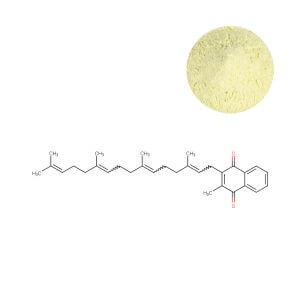
For R&D, the cost-in-use implication is decisive: although MK-7 carries a higher per-kilogram price, Vitamin K2 MK-4 Powder demands such massive overages (45 mg vs. 100-200 µg) that its per-serving cost often exceeds that of MK-7, while delivering inferior carboxylation coverage.
Synergistic Formulation with D3 and Calcium: The Bone-Calcium Deposition Triangle
Vitamin D3 upregulates intestinal calcium absorption, elevating serum calcium levels. Without vitamin K-mediated carboxylation of osteocalcin and matrix Gla-protein (MGP), that elevated calcium may deposit ectopically in vascular tissues rather than being directed into bone matrix. A comprehensive review articulated this functional complementarity, stating that adequate vitamin K supply on top of optimal vitamin D status "seems to add to the benefit of maintaining bone health" (Nutrients, 2024; doi: 10.3390/nu16152420). This mechanistic synergy creates the bone-calcium deposition triangle: D3 provides the calcium substrate, K2 ensures correct destination, and calcium completes the structural scaffold.
The formulation challenge intensifies when magnesium or calcium minerals are co-dosed. Unprotected MK-7 combined with calcium carbonate retains only approximately 60% after 12 months at 25°C, dropping to about 29% at 40°C. With magnesium oxide, the degradation is catastrophic—only about 1% remains under the same conditions. Microencapsulated MK-7 beadlets, however, preserve greater than 95% potency with calcium carbonate at 25°C and approximately 86% at 40°C; even with magnesium oxide, about 92% remains after 12 months at 25°C.
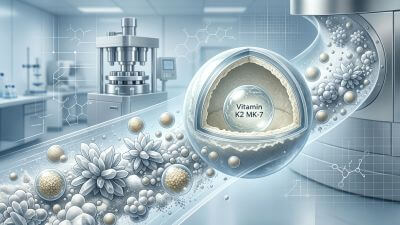
For formulators developing gummies, RTD beverages, or high-mineral tablets, the choice between standard and microencapsulated forms is not about incremental improvement but about avoiding total potency failure. Suppliers with advanced microencapsulation capabilities—such as Oclean Nutra—apply proprietary carrier systems that isolate MK-7 from reactive mineral surfaces, preserving all-trans integrity through the rigors of high-temperature processing and prolonged shelf life.
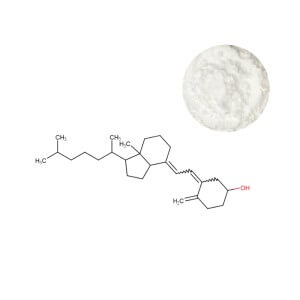
Incorporating microencapsulated Vitamin D3 Powder alongside a protected MK-7 system and a compatible calcium source completes the formulation architecture that simultaneously addresses calcium absorption, targeted deposition, and vascular protection.
| MK-7 Form | Mineral Co-ingredient | Storage Condition | MK-7 Remaining |
|---|---|---|---|
| Unprotected | Calcium Carbonate | 25°C / 12 months | ~60% |
| Unprotected | Calcium Carbonate | 40°C / 12 months | ~29% |
| Unprotected | Magnesium Oxide | 25°C / 12 months | ~1% |
| Microencapsulated | Calcium Carbonate | 25°C / 12 months | >95% |
| Microencapsulated | Calcium Carbonate | 40°C / 12 months | ~86% |
| Microencapsulated | Magnesium Oxide | 25°C / 12 months | ~92% |
Analytical Methodology and Supplier Fraud Prevention
The critical analytical pitfall lies in cis/trans isomer discrimination. Standard C18 HPLC methods co-elute cis and trans MK-7 into a single peak, potentially reporting a 90% trans / 10% cis mixture as 100% pure. The cis isomer possesses less than 1% of the biological activity of all-trans MK-7, yet it is undetectable by routine quality control. USP Monograph mandates all-trans MK-7 content between 96.0% and 101.0% with cis-isomer not exceeding 2.0%.
Shape-selective separation using a C30 carotenoid column at 15-20°C resolves both isomers. Procurement teams should demand chromatograms generated with C30-based methods and require quantitative reporting of cis/trans ratios. If a supplier relies exclusively on C18 HPLC without orthogonal confirmation, the entire batch is essentially untested for its active moiety.
Source-origin auditing adds another layer. Fermentation-derived MK-7 naturally yields high all-trans proportions and carries MK-6 as a characteristic marker. Chemically synthesized MK-7, by contrast, exhibits up to 23 unidentified peaks accounting for 5.67% of total chromatographic area and poses higher risks of solvent residues from organic synthesis. These impurity profiles are not captured by routine identity tests but directly affect long-term stability and finished-product safety.
For QA and procurement leads, the recommended supplier audit checklist includes:
- C30-column HPLC or UPC2 chromatogram with cis/trans separation
- All-trans MK-7 content ≥ 96.0%, cis-isomer ≤ 2.0%
- MK-6 content ≤ 2.0% (fermentation process marker)
- Residual solvents declared as "not detectable" at USP threshold
These criteria filter out synthetic blends masquerading as premium fermented material and protect brand reputation from undetected isomer-driven potency shortfalls.
Conclusion: From Specification to Formulation Success
Selecting the optimal vitamin K2 form demands more than comparing supplier price sheets. MK-7 delivers sustained serum carboxylation at µg-level doses with an approximately 72-hour half-life, whereas MK-4 requires mg-level administration and fails to maintain detectable serum levels on a once-daily schedule. When paired with microencapsulated D3 and a compatible calcium source, MK-7 completes the bone-calcium deposition triangle without the degradation penalties imposed by unprotected actives in mineral-rich matrices.
R&D managers and procurement directors are encouraged to evaluate technical specification packages—including C30-based isomer purity chromatograms and mineral-stress stability data—before committing to a supply partner. For a direct technical review of product specifications, stability protocols, or custom formulation support, reach out to the technical sourcing team for a consultation.
Share this article
Found this helpful? Share it with others!
Related Products
Products mentioned in this article
Related Articles
You might also be interested in
Mastering K2 MK-7, D3 & Magnesium Glycinate Premixes: Stability, Uniformity, and Scale-Up Integrity
Mastering K2 MK-7, D3, and magnesium glycinate premixes requires solving solid-state particle segregation and degradation. Learn how microencapsulated grades ensure batch uniformity and shelf-life stability.

The Trans-MK-7 Purity Trap: Navigating Chiral Degradation and Regulatory Thresholds in K2 Formulation
Navigating K2 chiral degradation and new GB standards is critical for compliance. This guide reveals how all-trans MK-7 secures stability and protects brand equity.
Want to learn more?
Explore our products or contact our team for personalized solutions and expert advice.