
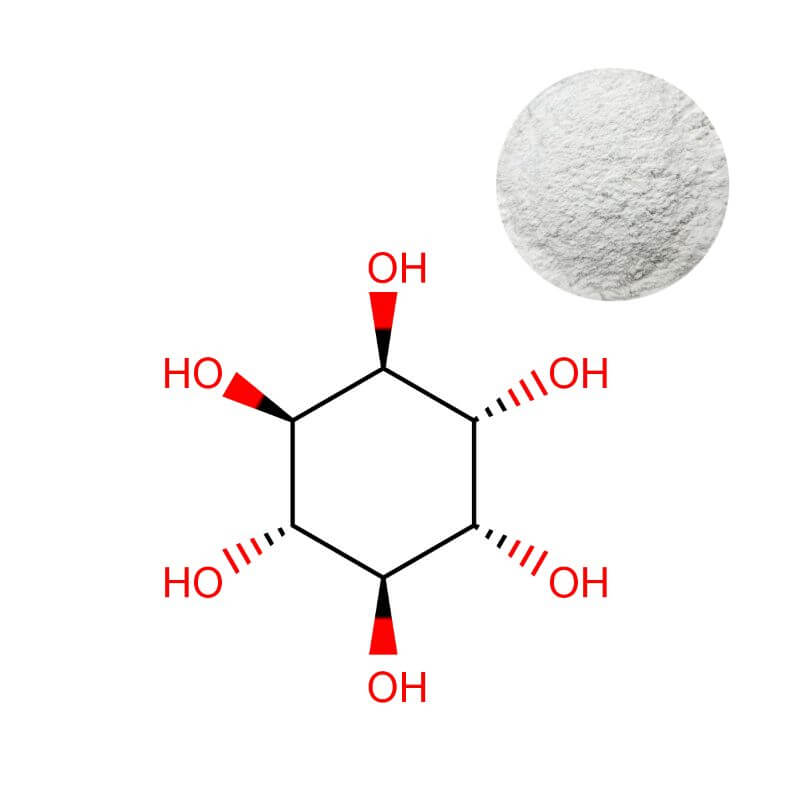
D-Chiro-Inositol Powder
| Product Name | D-Chiro-Inositol Powder |
| CAS Number | 643-12-9 |
| Appearance | White to off-white crystalline powder |
| Purity | ≥ 98.0% (by HPLC) |
| Packaging | 1 kg/foil bag, 5 kg/foil bag, 25 kg/drum |
| MOQ | 1 kg |
D-Chiro-Inositol Powder - Chiral Integrity for Metabolic Health Formulations
Bulk D-Chiro-Inositol Powder exhibits a specific rotation of +63.0° to +67.0° (c=1, H2O), a physical property that directly discriminates optically active D-chiro-inositol from inactive myo-inositol isomers. Spec-verified D-Chiro-Inositol supplier programs enforce this optical signature through USP <781> polarimetry combined with chiral HPLC confirmation. Each commercial batch undergoes mandatory stereochemical verification to ensure lot-to-lot consistency, with full analytical documentation supporting procurement qualification and regulatory filing. Controlling this physical specification supports pricing power in premium metabolic health segments.
Chiral HPLC Authentication Against Synthetic Substitution
The five chiral centers within D-chiro-inositol create a stereochemical fingerprint that distinguishes authentic plant-derived material from petrochemical-sourced racemic mixtures. Non-chiral HPLC cannot resolve these isomers, risking formulation failure due to inactive isomer incorporation. Chiral HPLC method validation per USP <1225> establishes system suitability criteria, with resolution targets determined by the specific stereoisomer pair of concern. For inositol isomer analysis, the critical allo-/muco-inositol pair requires a minimum resolution of 1.6 under optimized HILIC conditions, while DCI and myo-inositol baseline separation is achieved at resolution > 5.0. Reproducibility RSD ≤ 1.0% across triplicate injections.
| Authentication Parameter | Natural Carob-Derived DCI | Synthetic Isomer Contamination |
|---|---|---|
| Specific Rotation [α]D25 | +63.0° to +67.0° (c=1, H2O) | Near-zero or variable rotation |
| Chiral HPLC (chiral stationary phase) retention | Single dominant peak (8-12 min) | Multiple peaks or shifted retention |
| Carbon-14 AMS (ASTM D6866) pMC | ~105-115 pMC (consistent with modern biomass) | 0 ± 0.5 pMC (fossil-derived) |
Carbon-14 accelerator mass spectrometry provides definitive botanical-source authentication, quantitatively separating current-biomass DCI from petrochemical mimics. This analytical dual-lock (chiral chromatography plus C-14 AMS) enables procurement directors to verify natural-origin integrity upon arrival, eliminating hidden reformulation costs from inactive isomer contamination.
Carob-Specific HPLC-DAD Fingerprinting for Incoming Material Verification
While carob pod (Ceratonia siliqua L.) presents a distinctive HPLC-DAD profile, carob-derived D-Chiro-Inositol remains a distinct premium segment in bulk D-Chiro-Inositol wholesale supply, with limited global production concentrated among specialized manufacturers. Incoming inspection leveraging this fingerprint intercepts three common adulteration patterns before material enters production lines.
- Near-Genus Species Substitution: Lower-cost carob relatives or legume-based inositol sources yield divergent oligosaccharide impurity peaks in the 10-15 min retention window, detectable via DAD spectral matching against the carob reference library.
- Spent-Material Re-Extraction: Thermally degraded byproducts (furfural derivatives) appear as elevated 280 nm absorbance, signaling post-industrial solvent stripping of exhausted marc - a practice that compromises batch purity consistency.
- Synthetic Inositol Blending: Elevated exogenous myo-inositol substrates or other isomer ratios relative to the established carob fingerprint indicate exogenous addition, triggering immediate QC rejection.
A 20-minute UPLC-QTOF-MS spectral match against the carob reference library replaces 5-7 day external identity confirmation cycles, reducing incoming inspection holding costs and accelerating batch release. This chromatographic library, when integrated with electronic record systems per 21 CFR Part 11 and USP <857> data integrity guidelines, provides audit-ready evidence chains for FDA facility inspections, eliminating the need for costly downstream dispute resolution. Establishing this chromatographic baseline streamlines customs clearance by enabling port-side spectral verification that collapses regulatory hold periods from three days to a single laboratory shift.
EGOI Consensus on DCI Insulin-Sensitizing Mechanisms
D-Chiro-Inositol functions as a rate-limiting precursor for inositol phosphoglycan (IPG) mediators that activate pyruvate dehydrogenase phosphatase, driving aerobic glucose oxidation independent of the PI3K/Akt pathway. The EGOI expert consensus positions this isomer as mechanistically distinct from myo-inositol, with targeted actions on aromatase transcription modulation and white-to-brown adipose transdifferentiation (Gynecol Obstet Invest, 2024; doi: 10.1159/000536081).
This mechanistic specificity translates directly to formulation architecture: brands targeting PCOS or glycemic management can leverage DCI's validated pathway to justify structure/function claims with clinical consensus backing. The EGOI framework provides regulatory affairs teams with defensible scientific rationale for global submission dossiers, reducing the risk of claim rejection during FDA or EFSA notification reviews. The European Commission updated its Novel Food Status Catalogue in 2025, formally clarifying that D-Chiro-Inositol obtained from non-novel plant-based sources is classified as "Not Novel in Food Supplements" in the official EU Novel Food Status Catalogue, permitting legal use across all 27 EU member states. Any food use beyond dietary supplements may still require novel food assessment.
40:1 MI/DCI Ratio Platform Validated by Head-to-Head Clinical Data
Clinical evidence establishes that a 40:1 myo-inositol-to-D-chiro-inositol ratio in D-Chiro-Inositol wholesale platforms approximates physiological plasma distribution, optimizing tissue-specific uptake. A 2025 head-to-head trial (n=60) benchmarked this ratio against metformin across PCOS phenotypes: 12-week intervention delivered HOMA-IR improvement at p<0.001, ovarian volume reduction at p<0.001, and menstrual regularity restoration at p=0.002 (Naunyn-Schmiedeberg's Arch Pharmacol, 2025; doi: 10.1007/s00210-025-03813-9).
- Myo-Inositol Plus DCI (40:1 fixed ratio): Primary platform for encapsulated blends targeting insulin resistance; requires cooling-jacket mixing (< 20°C) to prevent low-melting-point co-ingredients from softening during high-speed encapsulation, which would otherwise cause die sticking and scrap rates exceeding 3%.
- Alpha-Lipoic Acid (ALA) Co-Formulation: Complementary NF-κB inhibition pathway; but the co-formulated alpha-lipoic acid melting point of 60-62°C demands strict friction-control during blending-exceeding 15-minute mixing cycles triggers tackiness and flow disruption.
- Mineral Separation Protocol: Divalent cations (Zn2+, Fe2+, Ca2+) at >1:1 molar ratio form non-covalent complexes that reduce DCI bioavailability by 18-22%, necessitating multi-layer beadlet systems or staggered granulation to maintain physical separation.
Blender friction-control below 0.2 kW/kg throughput with lubricant (magnesium stearate) addition at 0.5-1.0% of total batch weight effectively mitigates die sticking, validated by in-process tablet hardness monitoring per USP <1217> with friability limits below 1.0%. The clinical data package provides ready-to-submit evidence for finished-product regulatory filings, compressing R&D timelines by eliminating dose-finding studies, reducing pre-commercialization costs. Adopting these blend parameters compresses tablet or capsule fill-weight deviation below 0.5% across 200,000-unit production runs.
Air-Freight Engineering for Crystalline DCI Powder Transport Integrity
Crystalline DCI powder exhibits hygroscopic tendency when moisture ingress occurs during air transit. Three specific threats demand engineered packaging countermeasures: cabin pressure differentials (0.6-0.75 atm) stress seal integrity; tarmac temperature spikes (up to +65°C) generate breathing effects that pump humid air through micro-gaps; rapid cooling during climb creates condensation risk within the headspace.
| Transport Threat | Packaging Engineering Response | Verification Metric |
|---|---|---|
| Cabin low pressure (0.6-0.75 atm) | ≥120 μm VMPET/PE foil laminate, heat seal strength ≥45N/15mm | Zero package rupture in ISTA 3A testing |
| Tarmac temperature spikes (+65°C cycling) | Medical-grade molecular sieve desiccant (1g/5kg bag) holding Aw < 0.15 | Moisture ingress ≤ 0.5% by Karl Fischer |
| Vibration-induced particle fracture | Corrugated outer with anti-vibration insert; headspace nitrogen flush | Particle size shift < 5% post-transit |
Post-transit re-verification across Qingdao-Los Angeles air routes demonstrates loss on drying rise to ≤2.0% maximum (within industry standard limits), and angle of repose variation within ±2.5°-well below the ±5° threshold that triggers hopper bridging in high-speed fill lines. This packaging integrity program reduces CMO reject rates to below 0.3%, directly protecting brand owners from costly production delays and material write-offs. This data enables procurement managers to reduce buffer inventories and working capital costs.
Qualification Batches for Metabolism-Focused Formulation Programs
Commercial-scale D-Chiro-Inositol wholesale with validated chiral purity, source-verified chromatographic identity, clinical ratio platform support, and air-freight-engineered packaging delivers a de-risked supply chain for PCOS and glycemic support brands. Full EGOI-aligned technical dossiers and 40:1 ratio clinical documentation accompany every qualification batch. Request Spec-Verified D-Chiro-Inositol Powder with Complete COA Package for formulation trials.
Frequently Asked Questions
Share this product
Related Products
Ready to get started?
Contact our team for technical specifications, pricing, and customized solutions.