
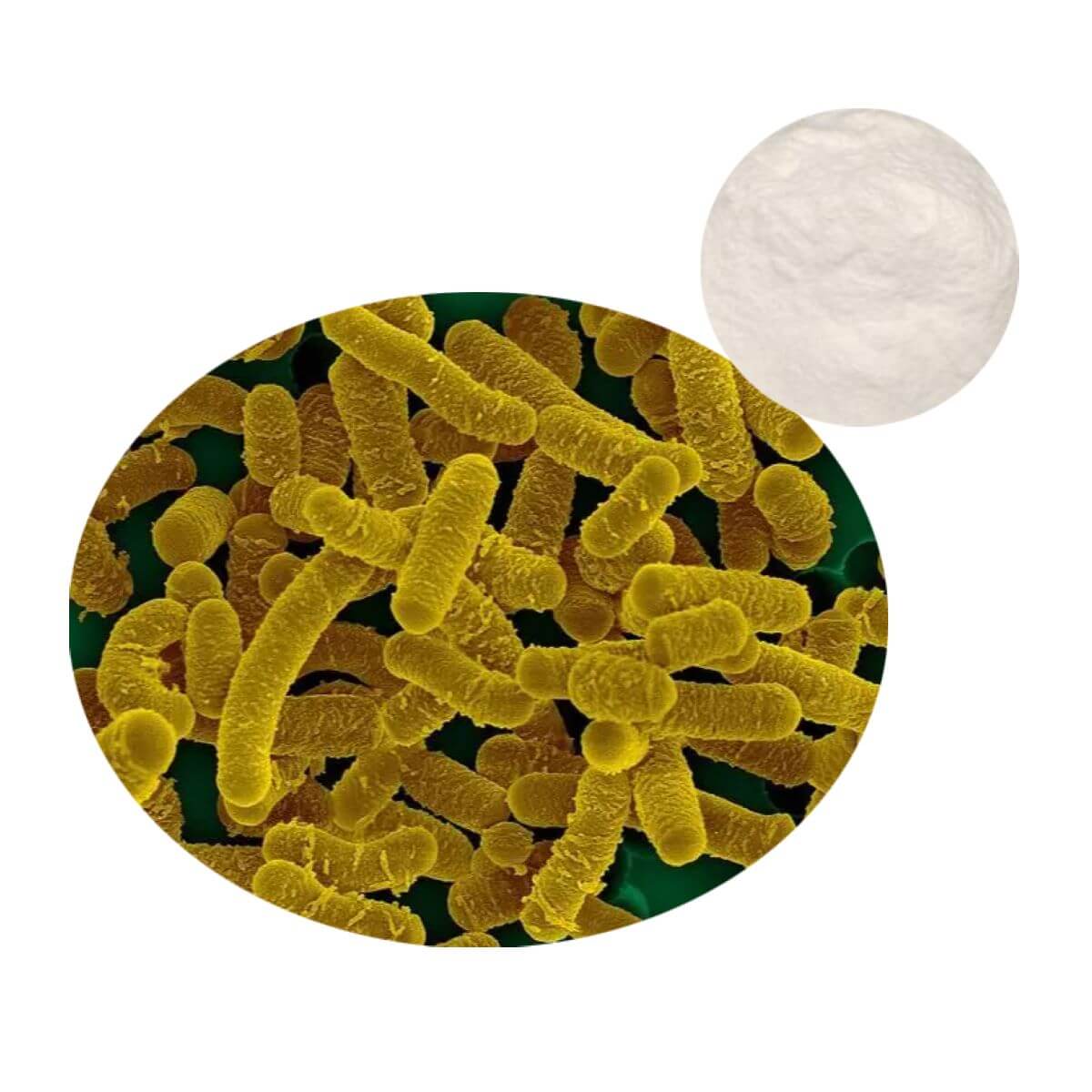
Lactobacillus Salivarius Powder
| Product Name | Lactobacillus salivarius Powder |
| Appearance | White to light yellow free-flowing powder |
| Activity | 100 Billion CFU/g, 200 Billion CFU/g |
| Testing Method | Plate count method (Colony-forming units) |
| Packaging | 1 kg/bag, 5 kg/bag, 25 kg/drum |
| MOQ | 1 kg |
Lactobacillus salivarius Powder – Viability-Centric Processing for Gut Health Formulations
Freeze-drying stress directly dictates post-lyophilisation recovery in Ligilactobacillus salivarius, with survival rates governed by cryoprotectant selection and moisture control. Bulk Lactobacillus salivarius powder from a spec-verified distributor demands Aw ≤0.12 and a glass-transition margin ≥50°C above storage temperature to preserve 100B or 200B CFU/g claims. Routine FTIR tracking of 1058 cm-1 and 1714 cm-1 bands provides a non-destructive QC tool, ensuring batch-to-batch consistency through validated stability markers. In a crowded probiotic ingredient landscape, disciplined physical parameter enforcement becomes the primary differentiator for brand owners seeking to justify premium positioning and defend retail shelf-space against commoditised alternatives.
Bulk Lactobacillus salivarius Kinetics under Low Aw – The Critical Bottleneck for Potency Retention
Freeze-drying and subsequent storage induce membrane damage, protein denaturation, and DNA injury unless the matrix achieves an adequate glassy state. Cells with the highest cyclic fatty acid content and most rigid membranes demonstrate superior resistance, but without precise formulation, viability declines rapidly within weeks.
| Parameter | Critical Threshold | Consequence for Viability |
|---|---|---|
| Water Activity (Aw) | ≤ 0.12 | Maintains dormancy; prevents membrane phase transition and metabolic activation |
| Glass Transition (Tg) margin | ≥ storage T + 50°C | Prevents matrix collapse and loss of cell structural integrity during storage |
| FTIR band shift (1058/1714 cm-1) | Minimised deviation | Non-destructive stability indicator for routine QC release and stability monitoring |
Industrial lyophilisation cycles employ a primary drying plateau at -25°C to -15°C with pressure below 100 mTorr. A glass-transition temperature at least 50°C above the storage temperature is decisive for long-term viability in commercial freeze-dried batches (Cryobiology, 2023; doi: 10.1016/j.cryobiol.2023.104556). This quantitative formulation parameter directly translates into batch-to-batch consistency, eliminating out-of-spec potency risks. Routine FTIR tracking reduces the need for extended stability studies, accelerating product release and lowering QC overhead for contract manufacturers.
Air-Freight Degradation Barriers – Physical Defences against Thermal Shock and Moisture Ingress
Cross-border express airfreight exposes freeze-dried powders to tarmac temperature spikes exceeding 40°C and low-pressure cabin environments that accelerate moisture ingress. Without tailored packaging, viable counts may drop below labelled thresholds within 5-7 days of transit, incurring costly rejection fees.
- Vacuum-sealed aluminium foil with oxygen scavengers: Blocks external moisture and oxidative gases (OTR < 0.5 cc/m²/day), preserving Aw ≤0.12 throughout transit and preventing oxidative membrane damage.
- Desiccant-lined HDPE inner liners: Adsorb residual humidity from temperature fluctuations, preventing particle agglomeration and caking that would otherwise block high-speed filling lines.
- Insulated corrugated outer shippers: Buffer against brief heat exposure; internal temperature rise reduced by up to 8°C during a 2-hour ground hold, protecting viability during airport delays.
These multi-layer barriers ensure arrival powder flowability and viable density match the dispatched COA. Eliminating transit-induced degradation avoids costly re-testing and rejection fees. Each pallet carries temperature loggers (±0.5°C accuracy, 5-minute logging) and packaging complies with ISTA 7D transit validation. Consistent physical appearance (white to light yellow, no caking) also speeds up incoming inspection, reducing warehouse holding time and associated logistics costs. A fully audited transport-validation protocol directly protects the procurement team's total landed-cost forecast, removing the financial uncertainty typically hidden in temperature-excursion claims.
Mechanistic Evidence of Intestinal Barrier Protection and Cellular Immune Harmony
DNBS-induced colitis models confirm that the strain reduces colonic damage and down-regulates pro-inflammatory cytokines, while Caco-2 TEER increases under TNF-α challenge confirm barrier integrity maintenance. The strain tolerates 0.3% bile salt, ensuring gastrointestinal survival.
- IL-8 secretion reduction: Quantitative decrease in inflamed Caco-2 cells (p < 0.05) – directly supports mucosal immune regulation structure-function claims for gut health products.
- TEER elevation (≥20% over control): Objective proof of tight junction protection – a measurable endpoint for brand marketing and label substantiation.
- Bile salt tolerance ≥0.3%: Ensures sufficient survival through the upper GI tract, a prerequisite for effective oral delivery and colon-site activity.
- Absence of antibiotic resistance genes (whole-genome): Eliminates safety audit concerns, streamlining supplier qualification and reducing due-diligence time.
TEER increase and IL-8 suppression are quantifiable endpoints that directly support regulatory-compliant health claims (Front. Microbiol., 2023; doi: 10.3389/fmicb.2023.1270974). The absence of antibiotic resistance genes satisfies EFSA QPS criteria, accelerating EU Novel Food applications. For US brands, this genomic safety data provides extra confidence during FDA inspections, reducing regulatory risk and legal exposure. Translating these mechanistic readouts into manufacturing KPIs, formulators gain a validated justification for lowering capsule fill weights without compromising label claims – an efficiency lever that directly trims per-unit raw-material consumption.
Formulation Compatibility and Co-Blending Synergy – from Synbiotics to Protective Dosage Forms
Synbiotic combinations with inulin or FOS prebiotic substrates amplify pathogen exclusion, but multi-component blending introduces critical physical interactions: hygroscopic excipients raise Aw, breaking dormancy; high-shear blending and friction during capsule filling (≥40°C) damages cell membranes.
- Preferred prebiotics: Utilizing native inulin grading or standard FOS ensures a low baseline Aw and neutral pH, preserving probiotic viability during blending and subsequent storage without inducing osmotic shock.
- Gastrointestinal survival optimisation: Unprotected powder formulations exhibit minimal survival (<0.01%) under simulated gastric conditions, whereas trehalose-stabilised matrices deliver a >20-fold logarithmic recovery advantage during simulated gastroduodenal transit – a performance gap directly attributable to cryoprotectant selection and low-Aw processing.
- Process control limits: Keep encapsulation environment below 25°C; use cryoprotectant-based lubricants; blend in dehumidified air (dew point ≤ -20°C) to prevent moisture pickup and premature activation.
Pre-blending with a portion of the carrier before final mixing reduces direct shear stress on the probiotic. Tailored particle sizing and cryoprotectant coating services eliminate the need for in-house milling, reducing commissioning time. This directly lowers manufacturing overheads and minimises batch rejection rates, improving overall cost efficiency for the brand owner.
Global Regulatory Infrastructure – GRAS Status and Market Access Pathways
Global safety audits for Lactobacillus salivarius (officially reclassified as Ligilactobacillus salivarius) require full taxonomic identification and strain-level safety data. In the USA, the organism is GRAS (self-affirmed or notified) – no NDI filing required, simplifying market entry. The EU demands Novel Food authorisation per strain, requiring complete taxonomy and toxicology dossiers.
| Market | Regulatory Status | Documentation Requirement |
|---|---|---|
| USA (FDA) | GRAS (self-affirmed) | COA, allergen statement, GMP records, strain identity via 16S rRNA sequencing |
| EU (EFSA) | Novel Food – per strain | Full dossier: taxonomy, toxicology, proposed use levels, and QPS compliance evidence |
| Japan (MHLW) | FFC – per strain | Clinical summary and safety evidence specific to the claimed function |
For EU filings, the strain's absence of antibiotic resistance genes (confirmed by whole-genome sequencing) satisfies EFSA's QPS criteria, expediting the risk assessment process. US brands benefit from immediate commercialisation with self-affirmed GRAS, provided all manufacturing records and COAs are retained for audit. This regulatory clarity reduces time-to-market and legal uncertainty, directly impacting the procurement team's risk-adjusted cost calculus. A fully pre-qualified regulatory dossier acts as an import-clearance accelerator, shrinking customs hold periods and enabling seamless multi-jurisdictional product roll-outs without last-minute compliance surprises.
Secure Spec-Verified Samples with Full Technical Dossier
This industrial grade combines strict Aw control, validated FTIR stability markers, and GRAS-aligned documentation to de-risk your supply chain. The combination of low moisture, high membrane rigidity, and precise cryoprotectant formulation ensures each batch delivers labelled potency, even after extended transit. Request a sample package (10-20g) with complete COA, stability protocol, and strain-identity report to verify batch-to-batch consistency before commitment. The dossier includes allergen declaration, GMP certificate, and processing flow chart, enabling rapid supplier qualification.
Frequently Asked Questions
Share this product
Related Products
Ready to get started?
Contact our team for technical specifications, pricing, and customized solutions.