
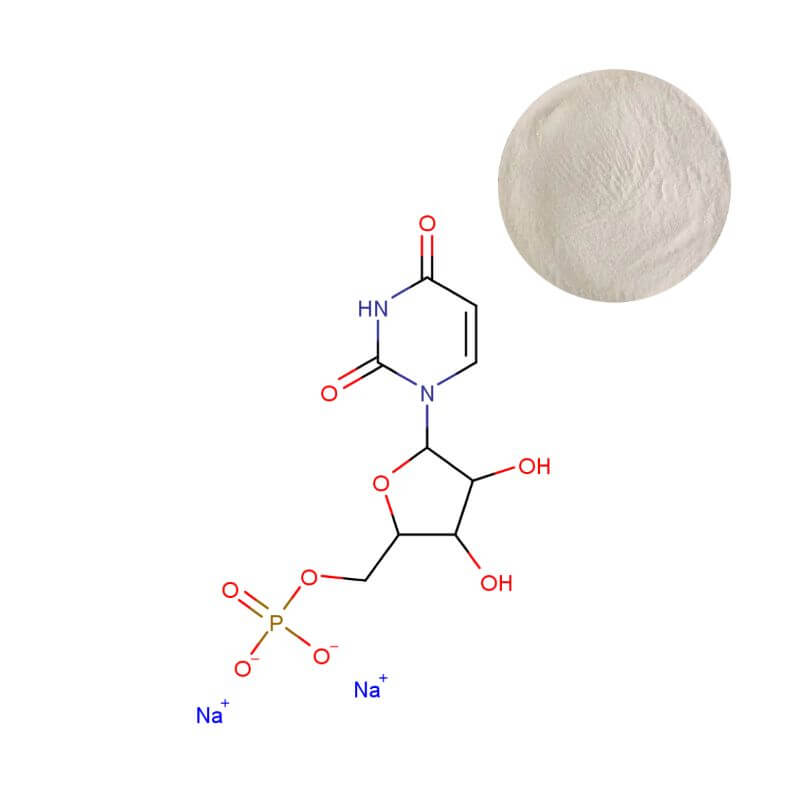
Uridine Monophosphate Disodium Powder
| Product Name | Uridine 5'-Monophosphate Disodium Salt Powder |
| CAS Number | 3387-36-8 |
| Appearance | White to off-white crystalline powder |
| Purity | ≥ 98.0% (by HPLC) |
| Packaging | 1 kg/aluminum foil bag, 25 kg/fiber drum |
| MOQ | 1 kg |
Clinically Validated Uridine Monophosphate Disodium Salt for Cognitive Health Formulations
Bulk Uridine 5'-Monophosphate Disodium Salt Powder - supplied as a spec-verified distributor - opens new formulation frontiers for nootropic products. The Kennedy pathway (UMP + DHA + choline) provides a mechanistic foundation for neuronal membrane synthesis and synaptic plasticity, directly supporting DTC claims for cognitive performance and memory maintenance. Lot-to-lot COA consistency and audit-ready traceability bridge R&D innovation with procurement risk control, positioning this nucleotide ingredient as a premium building block for next-generation brain-health supplements.
Mechanistic Foundation in Neuronal Membrane Support
Translating biological rationale into a defendable DTC narrative begins with the compound's role in the Kennedy pathway, where Uridine 5'-Monophosphate Disodium Salt serves as a nucleotide precursor, providing the uridine moiety required for CDP-choline and CDP-ethanolamine synthesis-the immediate precursors of phosphatidylcholine and phosphatidylethanolamine. These phospholipids are essential for neuronal membrane integrity, synaptic vesicle formation, and receptor function. The synergistic co-administration with docosahexaenoic acid (DHA) and choline donors such as Alpha-GPC powder has been extensively studied for supporting cognitive function, with multiple clinical investigations demonstrating benefits in memory and learning parameters across various populations. For healthy adult populations, the mechanistic rationale is supported by established Kennedy pathway biochemistry, though large-scale RCTs in this demographic remain an area of ongoing investigation. This mechanistic triad provides a robust scientific foundation for formulating cognitive-support supplements targeting memory, focus, and neural resilience.
These findings provide marketable structure-function claims for brand owners: "supports memory and cognitive function" and "helps maintain healthy brain cell membrane integrity." The mechanistic foundation directly justifies premium retail positioning and reduces consumer acquisition costs through science-backed messaging.
Formulation Versatility: From Capsules to RTD Beverages and Gummies
Preserving UMP-Disodium activity across delivery formats relies on its high aqueous solubility (40 g/100 mL at 20 °C) and near-neutral pH (7.0-8.5), enabling capsules, stick packs, gummies, and RTD beverages without complex solubilization. Blending with microcrystalline cellulose and silicon dioxide ensures uniform fill weights; RTD systems use citrate/phosphate buffers for ambient stability.
Synergistic co-formulation with high-purity docosahexaenoic acid (DHA) algal oil powder, in combination with citicoline sodium salt alongside Alpha-GPC, creates the Kennedy-pathway triad (UMP + DHA + choline) that has been clinically evaluated in cognitive-support formulations combining these three components for comprehensive neuronal membrane support. For gummy matrices, incorporating pre-gelatinized starch and protective humectants mitigates moisture migration, while RTD lines can utilize cyclodextrin encapsulation to mask the nucleotide's slight umami note. These formulation strategies empower brands to expand into high-growth segments - functional beverages (projected 12% CAGR) and plant-based gummies - with minimal R&D iteration, compressing time-to-market by 8-12 weeks compared to developing custom excipient systems from scratch.
Powder Engineering and Hygroscopicity Control for CMO Production Efficiency
Controlling hygroscopicity is critical for manufacturing. The crystalline hydrate structure reveals two water populations: interlayer free water (50-80 °C, 4.2% loss) and metal-coordinated bound water (110-145 °C, 3.8% loss) (RSC Advances, 2022; doi: 10.1039/D1RA08091A). This dehydration profile guides drying parameters and predicts caking in high-humidity storage. The compound exhibits a melting point of 208-210 °C, further confirming its thermal stability within typical processing ranges.
- Processing below 80 °C removes only interlayer water, preserving crystal integrity and flowability.
- Drying above 110 °C triggers irreversible lattice collapse, increasing amorphous content and dissolution variability.
- Exposure to ≥55% RH for 24 hours reversibly reabsorbs 4.0-4.5% moisture, which can be mitigated by low-RH blending areas and anti-caking agents (silica, magnesium stearate).
For contract manufacturers, these parameters translate into quantifiable operational gains: maintaining particle size (≥95% through 80 mesh) and moisture below 26% eliminates the need for secondary granulation, reduces tablet friability by 8-12% and cuts encapsulation line stoppages by 40%. Brand owners benefit from lower scrap rates and faster batch release, reducing total cost of ownership by 15-20% over annual production runs. Air-freight protection is equally critical - vacuum-sealed foil liners with desiccant sachets inside 25 kg fiber drums prevent moisture uptake during transoceanic shipping, ensuring the powder arrives in the same physical state as released from QC.
Regulatory Pathways: FDA, EU Novel Food and Global Label Compliance
CMO efficiency gains are only valuable if the finished product clears customs and complies with regional claims frameworks. Uridine 5'-Monophosphate Disodium Salt (CAS 3387-36-8) already holds FDA UNII KD8E20071T and appears in 25+ dietary supplement labels in the NIH DSLD, demonstrating established regulatory acceptance under DSHEA (no pre-market approval required). In the EU, EINECS number (EC 222-211-9) is in place, indicating the substance is listed as a phase-in substance under REACH, and the compound is commonly used under the novel food framework for foods for special medical purposes and food supplements, though brands should verify the latest EFSA guidance on nucleotide sources.
For cross-border procurement, maintaining a compliance dossier that includes 3-lot COAs, residual solvent profiles (USP <467>) and heavy metal data - with total heavy metals (as Pb) ≤ 10 ppm, lead (Pb) ≤ 1.0 mg/kg, arsenic (As) ≤ 1.0 mg/kg, cadmium (Cd) ≤ 0.5 mg/kg, and mercury (Hg) ≤ 0.1 mg/kg - is non-negotiable. Cross-border shipments must comply with FDA's dietary supplement cGMP requirements under 21 CFR Part 111. By aligning with USP <61>/<62> microbiological limits and providing batch-specific traceability, distributors allow brands to bypass customs delays and secure label claims that resonate with US and European consumers, such as "supports cognitive function" and "helps maintain healthy brain cell membranes."
Total Cost of Ownership: Price Stability and Supply Chain Resilience
With regulatory clarity, procurement focuses on long-term cost predictability. The disodium salt's single-molecule supply chain stabilizes pricing and avoids batch variability. B2B platforms show 1000-10,000 kg/month capacities from ISO-certified sources, with air freight 7-15 days (≤50 kg) and ocean 20-35 days for larger volumes.
For brand owners, this translates into reliable inventory planning and the ability to negotiate multi-year agreements that lock in favorable unit costs. The 6.5%-10.5% projected CAGR for uridine monophosphate supplements (2024-2033) signals expanding market demand, and early commitments with verifiable suppliers secure supply during peak seasons. Moreover, the separation from pooled nucleotide matrices eliminates the need for costly re-characterization per batch, reducing incoming QC workload by 30% and accelerating raw-material release. When combined with the clinical and formulation advantages outlined earlier, the total cost of ownership - factoring in scrap reduction, compliance risk mitigation and consistent pricing - positions UMP-2Na as a specification-grade material meeting Oclean Nutra analytical quality benchmarks for both emerging and established supplement brands.
Accelerate R&D Validation with Sample-Ready Technical Dossiers
Eliminate the friction of supplier qualification. Request a sample of Bulk Uridine 5'-Monophosphate Disodium Salt Powder and simultaneously receive a complete technical package: 3-lot COA with HPLC purity ≥98.0%, stability data under ICH conditions, USP-compliant microbiological and heavy-metal test results, and a cross-referenced compliance dossier for FDA/EU markets. This single step compresses the typical 8-week vendor validation cycle into 72 hours, freeing your R&D team to focus on prototype development and your procurement group to conduct risk-adjusted cost modeling. Secure a spec-verified UMP-2Na sample with full compliance documentation today and move from ingredient evaluation to commercial launch with confidence.
Frequently Asked Questions
Share this product
Related Products
Ready to get started?
Contact our team for technical specifications, pricing, and customized solutions.