
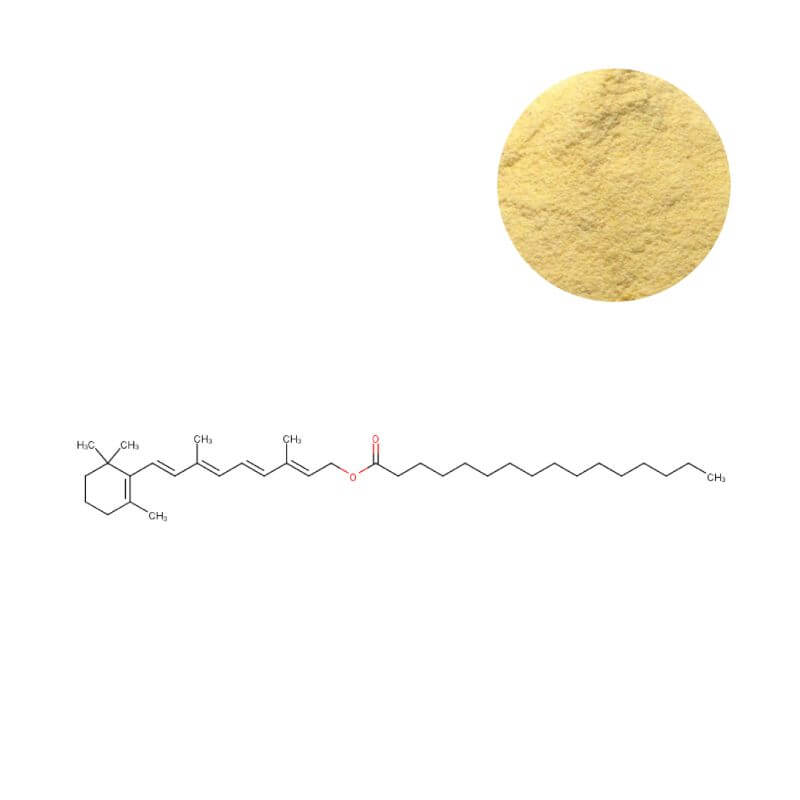
Vitamin A Palmitate Powder
| Product Name | Vitamin A Palmitate Powder |
| CAS Number | 79-81-2 |
| Appearance | Pale yellow to yellow, free-flowing powder or beadlets |
| Purity | 250,000 IU/g min. / 500,000 IU/g min. |
| Packaging | 1 kg/aluminum foil bag, 25 kg/paper drum |
| MOQ | 1 kg |
Vitamin A Palmitate Powder (250,000 IU/g & 500,000 IU/g): Enabling Stable, Compliant & Market-Ready Fortification Strategies
In the crowded landscape of nutritional fortification, simply adding a vitamin label claim no longer differentiates a brand. The real formulation challenge lies in preserving bioactive stability from blending through shelf life, while navigating divergent global compliance frameworks. For formulators and procurement leaders seeking to de‑risk product development, the choice of a vitamin A source—its physical form, carrier system, and documented consistency—has become a strategic lever, not just a specification. Premium Vitamin A Palmitate Powder (available in 250,000 IU/g and 500,000 IU/g CWS grades) addresses these pain points through microencapsulation technology that delivers oxidative resilience and batch‑to‑batch reproducibility, backed by complete COA traceability. For brand owners, selecting a powder with dual potency options directly supports portfolio scalability—from niche supplement lines to high-volume food fortification—without requalifying suppliers at each stage.
Quality Benchmarks: Beyond Purity – What Defines a Premium Vitamin A Palmitate Supplier
For brands sourcing bulk Vitamin A Palmitate, the conventional focus on “potency” alone overlooks the real drivers of finished product performance. A truly premium Vitamin A Palmitate supplier distinguishes itself through three verifiable quality pillars:
- Carrier system & particle engineering: Cold‑water dispersible (CWS) powders use microencapsulation to protect the active from oxidation. Recent research on carbohydrate core–shell microcapsules confirms that interactions between retinyl palmitate and hydrolyzed casein significantly enhance oxidative stability (doi: 10.3390/pharmaceutics15112633). For procurement teams, this directly translates to longer shelf life and reduced batch rejection risk.
- Full‑panel COA with USP/EP/FCC compliance: A credible COA includes heavy metals (Pb ≤2.0 ppm, As ≤1.0 ppm), residual solvents (USP <467>), and microbiological limits (TAMC ≤1000 CFU/g). Insist on batch‑specific data, not generic spec sheets.
- Two‑potency flexibility: 250,000 IU/g enables fine dose adjustments for small‑batch R&D; 500,000 IU/g reduces excipient mass for high‑throughput production. Both grades meet identical quality standards.
From a strategic formulation perspective, these benchmarks directly reduce your compliance burden: a reliable COA package allows you to skip redundant third‑party testing and accelerate market entry in both the US (GRAS affirmed) and EU (permitted under Directive 2002/46/EC).
Formulation in Practice: Stability, Synergy & Delivery Solutions
Even the purest Vitamin A Palmitate Powder will degrade if formulation basics are ignored. An effective formulation requires controlling three critical factors: moisture, oxygen, and light exposure. Here are actionable guidelines for two common finished product forms:
| Formulation Type | Recommended Practice | Critical Checkpoint |
|---|---|---|
| Powdered drink mixes / instant beverages | Pre‑blend Vitamin A Palmitate with a portion of maltodextrin or other carrier before final mixing. Use desiccated environments (≤45% RH). | Avoid high‑shear blending that can rupture microcapsules. Target ≤5.0% loss on drying in final blend. |
| Tablets / capsules (direct compression) | Dry blend with excipients like microcrystalline cellulose. Add antioxidants (e.g., natural mixed tocopherols) as a stabilizer. | Monitor compression force – excessive pressure may degrade the CWS coating. Conduct blending uniformity study at low inclusion rates (e.g., 0.1–1.0%). |
Synergy with other lipophilic nutrients is particularly valuable. Combining Vitamin A Palmitate with natural vitamin E (as α‑tocopherol) provides a built‑in antioxidant shield, while pairing with vitamin D3 supports bone and immune health claims—a common demand in senior nutrition and pediatric formulas. It's worth noting that acidic formulations (pH <4.5) accelerate degradation; a citrate buffer or additional encapsulation layer may be required. For high‑acid beverages like fruit juices, pre‑neutralization of the blend to pH 5.0–6.0 before adding the vitamin A powder can preserve >90% of initial activity over 12 months. For procurement teams, this directly translates to lower stability testing costs and fewer post‑launch complaints. Moreover, the documented synergy with vitamin E and D3 allows brands to file combined structure‑function claims, reducing the need for multiple ingredient qualifications. Practically, this means formulators can achieve a cleaner label by reducing antioxidant overages, directly improving consumer perception.
Supply Chain Resilience & Total Cost of Ownership
Price per kilogram is a deceptive metric when sourcing Vitamin A Palmitate. A low upfront cost often hides hidden expenses: batch‑to‑batch variability leading to reformulation, delayed shipments disrupting production schedules, or incomplete documentation triggering regulatory holds. Experienced buyers evaluate the total cost of ownership (TCO) across five dimensions:
- Consistency of potency (CV ≤5% across batches)
- Availability of both 250K and 500K IU/g grades from the same partner
- Lead time transparency and safety stock options
- Free sample (10–20 g) for pre‑qualification
- Technical support within 24 working hours for COA or regulatory queries
For brands looking to buy Vitamin A Palmitate wholesale, a partner that offers dual potencies and flexible MOQs (starting at 1 kg) significantly reduces inventory risk. Additionally, having both 250K and 500K IU/g from one supplier allows seamless scale‑up from pilot batches to full production without requalifying a new vendor — a hidden cost saver that experienced procurement leaders prioritize. A recent study on encapsulated powder demonstrated that optimized microencapsulation can retain >90% of vitamin A palmitate activity after cooking simulations (doi: 10.1002/fsn3.71237). For formulators targeting fortified foods (bouillon cubes, nutritional bars), this stability data directly translates to higher consumer trust and lower nutrient claim shortfall risk. From a TCO perspective, sourcing both potencies from a single validated partner eliminates duplicate qualification costs and simplifies inventory management—a measurable reduction in indirect procurement overhead. This dual‑grade flexibility also minimizes changeover downtime on high‑speed encapsulation lines.
Mitigating Risk: A Procurement Checklist for Sourcing Vitamin A Palmitate
Whether you are an established supplement manufacturer or a startup launching a vision health formula, the same due diligence applies. Use this checklist when evaluating any Vitamin A Palmitate distributor or supplier:
- Documentation readiness: Can they provide a batch‑specific COA within 24 hours? Does it include USP <571> (assay by HPLC), loss on drying, heavy metals (ICP‑MS), and full microbiological panel?
- Physical spec verification: Request the particle size distribution (100% through 40 mesh, ≥90% through 80 mesh) and appearance description (pale yellow free‑flowing powder).
- Stability data: Ask for accelerated stability studies (40°C/75% RH for 6 months) or real‑time 24‑month data under recommended storage (15–25°C, dry, dark).
- Regulatory support: Confirm GRAS status (21 CFR 184.1930) and EU compliance. The supplier should provide a technical dossier for your new product filing.
- Sample policy: A free sample (10–20 g) allows you to test blend uniformity and solubility before committing to bulk quantities.
From a strategic formulation perspective, using this checklist transforms sourcing from a transactional purchase into a partnership that reduces time‑to‑market. Each verified item lowers your legal exposure and strengthens your finished product’s compliance file. A complete risk mitigation strategy demands verifying that the supplier's stability protocol includes real‑time 24‑month data—this eliminates the guesswork around label claim compliance when facing regulatory audits.
Next Steps: Accelerate Your Product Development with Verified Samples & Technical Dossiers
Developing a stable, compliant dietary supplement or functional food with Vitamin A Palmitate Powder does not have to be a guessing game. By partnering with a solution‑oriented supplier that provides dual potencies, full COA traceability, and formulation support, you can move from concept to commercial batch with confidence. A small‑scale stability prescreen on your proprietary blend using a 10 g sample is available — a service that identifies potential degradation risks before you commit to production tooling. Request your complimentary sample (10–20 g) and the complete technical dossier including batch‑specific COA, stability summary, and regulatory declaration for US/EU markets.
Frequently Asked Questions
Share this product
Related Products
Ready to get started?
Contact our team for technical specifications, pricing, and customized solutions.