
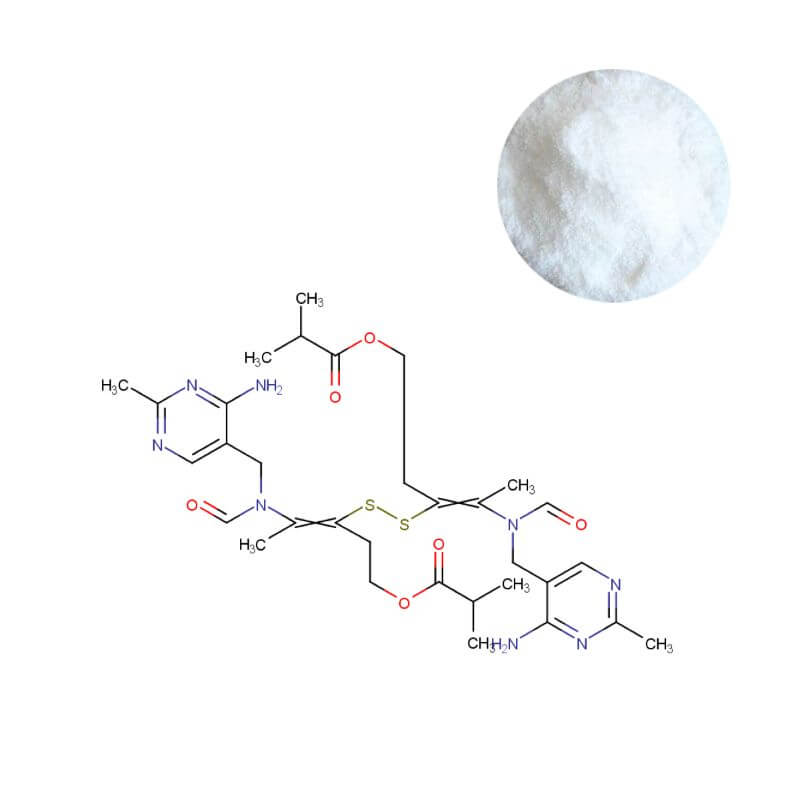
Sulbutiamine Powder
| Product Name | Sulbutiamine Powder |
| CAS Number | 3286-46-2 |
| Appearance | White to off-white crystalline powder |
| Purity | 99.0% min. (by HPLC) |
| Packaging | 1 kg/bag, 5 kg/bag, 25 kg/drum |
| MOQ | 1 kg |
Sulbutiamine Powder: Optimizing Cognitive Energy and Fatigue Management in Specialty Formulations
For brands developing targeted cognitive health or energy support products, the challenge often lies in selecting ingredients with both demonstrable efficacy and formulation flexibility. While standard vitamins provide foundational support, they frequently fall short when addressing nuanced conditions like mental fatigue or suboptimal energy metabolism under stress. Sulbutiamine, a lipid‑soluble derivative of vitamin B1, offers a science‑backed solution. Its enhanced ability to cross the blood‑brain barrier and influence central neurotransmitter systems makes it a distinctive building block for premium nootropic and fatigue‑management blends. This article provides a framework for evaluating, formulating, and positioning sulbutiamine powder in today’s competitive supplement landscape, drawing on peer‑reviewed research and industry best practices. For R&D and procurement leaders, this framework translates into actionable criteria for ingredient selection and product differentiation.
Distinct Mechanism of Action: Beyond Conventional Vitamin B1
For formulators aiming to build synergistic blends with predictable outcomes, understanding these pathways is critical. Sulbutiamine is not merely a different delivery form of thiamine; it exerts unique pharmacological effects that stem from its molecular structure. Synthesized by joining two thiamine moieties through a disulfide bridge, it possesses markedly higher lipophilicity than thiamine itself. This property allows it to traverse biological membranes efficiently, particularly the blood‑brain barrier, leading to elevated concentrations of thiamine triphosphate in the brain—a key metabolite involved in neuronal membrane excitability and acetylcholine synthesis (doi: 10.1155/2020/9349063).
Practically speaking, this translates into several clinically observable benefits:
- Cholinergic modulation: Sulbutiamine increases high‑affinity choline uptake in the hippocampus, supporting memory consolidation processes.
- Dopaminergic regulation: It modulates D1 dopamine receptor density in the prefrontal cortex, which may contribute to improved motivation and mental stamina.
- Antioxidant and anti‑inflammatory actions: Recent work indicates it can upregulate glutathione and inhibit TLR‑4/NF‑κB signaling, reducing oxidative stress in neural tissues.
For a finished‑product brand, this mechanistic depth means sulbutiamine can support credible claims around mental clarity, resistance to daily fatigue, and healthy cognitive aging—claims that are increasingly demanded by educated consumers seeking evidence‑based supplements. Such mechanistic clarity allows brands to communicate benefits with confidence and maintain regulatory alignment.
Critical Quality Parameters for a Reliable Sulbutiamine Supply
For procurement teams, knowing which quality parameters truly matter can mean the difference between a stable supply and recurring production issues. When sourcing bulk sulbutiamine, the consistency of key physicochemical attributes directly impacts both product stability and end‑user efficacy. A premium‑grade material is defined not by a single purity number but by a suite of well‑controlled specifications. Below are the essential parameters that a GMP‑oriented sulbutiamine supplier should document in every batch‑specific Certificate of Analysis (COA).
| Parameter | Specification | Why It Matters |
|---|---|---|
| Purity (HPLC) | ≥ 99.0% | Ensures minimum potency and absence of process‑related impurities that could affect safety or efficacy. |
| Particle Size | ≥ 95% through 80 mesh | Guarantees uniform flow and blendability in direct compression or capsule filling, reducing weight variation. |
| Loss on Drying | ≤ 1.0% | Low moisture content prevents hydrolysis and microbial proliferation during storage. |
| Melting Point | 135‑142°C (typical range) | A sharp melting range confirms crystalline identity and absence of polymorphic changes that could alter dissolution. |
| Heavy Metals (Pb, As, Cd, Hg) | Complies with USP limits | Meets international safety thresholds for dietary ingredients. |
It is worth noting that relying solely on a high purity number can be misleading. For example, two batches both at 99.0% might have different residual solvent profiles or particle size distributions. An experienced supplier provides full disclosure of these values, enabling formulators to anticipate potential challenges in dissolution or tablet hardness. This level of transparency reduces the risk of costly reformulation later in the product development cycle. Therefore, a thorough supplier evaluation should include requests for full disclosure of these parameters, as they directly impact downstream processing costs and time‑to‑market.
Formulation Strategies: Integrating Sulbutiamine into Cognitive Health Products
Formulators seeking to create differentiated products will benefit from understanding how sulbutiamine behaves in real‑world manufacturing environments. Sulbutiamine is compatible with standard oral dosage forms, but successful incorporation requires attention to its physicochemical behavior and synergy with other actives.
- Dosage considerations: Published clinical data and commercial experience point to a daily intake range of 400‑600 mg, often divided into two doses. For fatigue‑related applications, the lower end may suffice; for more pronounced cognitive support, 600 mg/day is common.
- Synergistic combinations: Sulbutiamine is frequently paired with other nootropic ingredients to address multiple pathways. The table below outlines common pairings and their intended benefits.
| Complementary Ingredient | Proposed Synergy | Typical Use Level |
|---|---|---|
| Citicoline (CDP‑Choline) | Supplies choline for acetylcholine synthesis; sulbutiamine enhances choline uptake, together supporting memory and focus. | Citicoline 250‑500 mg |
| Phosphatidylserine (PS) | Modulates cortisol and neuronal membrane fluidity, complementing sulbutiamine's effects on mental energy. | PS 100‑300 mg |
| L‑Theanine | Promotes calm alertness; may balance any over‑stimulation in sensitive individuals. | L‑Theanine 100‑200 mg |
| Bacopa monnieri extract | Supports long‑term memory consolidation; pairs with sulbutiamine's acute cognitive energizing effects. | Bacopa (50% bacosides) 300‑450 mg |
These synergistic combinations not only enhance efficacy but also allow for proprietary blend claims that strengthen brand positioning. From a processing standpoint, sulbutiamine is stable under typical manufacturing conditions (temperatures below 60°C), but it is sensitive to prolonged moisture and light. During blending, keeping the relative humidity below 45% helps maintain flowability and prevents caking. For tablet production, using magnesium stearate as a lubricant is acceptable, but over‑mixing should be avoided to prevent potential softening of the granules. Adhering to these practical guidelines ensures consistent finished product quality and reduces scale‑up surprises, directly contributing to manufacturing efficiency.
Navigating Regulatory Pathways and Market Positioning for Sulbutiamine‑Based Products
For brands planning international expansion, a clear grasp of global regulatory frameworks is non‑negotiable. The regulatory status of sulbutiamine varies globally, and this factor must be central to any market‑entry strategy.
- United States: The FDA has taken the position that sulbutiamine does not meet the statutory definition of a dietary ingredient under the Federal Food, Drug, and Cosmetic Act. It is therefore not permitted in dietary supplements sold in the U.S., though it may be used in research or in products intended for export to jurisdictions where it is allowed.
- European Union: Sulbutiamine is not included in the EU’s list of authorized novel foods or vitamins and minerals, meaning it cannot be used in food supplements without a successful novel food application.
- Other markets: In several Asian and Latin American countries, sulbutiamine is available in pharmaceutical and nutraceutical products under various brand names. Brands targeting these regions should verify local supplement regulations and consider obtaining pre‑market approvals where required.
Proactive regulatory planning can turn a potential compliance hurdle into a competitive advantage, especially in markets where sulbutiamine is already accepted. For companies developing products for permissible markets, the distinct mechanism of sulbutiamine allows for innovative positioning. Instead of a generic “energy” product, consider targeting specific niches:
- High‑performance professionals – formulations aimed at sustaining mental clarity during extended cognitive tasks.
- Healthy aging cognition – blends that combine sulbutiamine with neuroprotective antioxidants to support memory function in older adults.
- Post‑illness recovery formulas – leveraging the anti‑fatigue data (doi: 10.1016/j.msard.2017.05.010) for products designed to help convalescents regain mental and physical energy.
Engaging with a regulatory consultant early in development ensures that any claims and ingredient declarations are aligned with local laws. A responsible sulbutiamine supplier will provide the necessary technical documentation—such as certificates of analysis, stability data, and, where available, regulatory dossiers—to support these efforts. Thus, partnering with a technically equipped supplier can streamline market access and reduce legal risks, ultimately protecting your investment.
Advancing Your Product Development with Premium Sulbutiamine
Incorporating sulbutiamine into your next cognitive health or energy support line offers a scientifically grounded point of differentiation. By prioritizing verified purity, understanding its formulation nuances, and navigating the regulatory landscape with expert guidance, you can deliver a product that resonates with informed consumers. The technical dossier provided by a reliable partner contains the foundational data needed to de‑risk your development process. To accelerate your project, we invite you to request a complimentary sample and complete technical dossier. This package includes batch‑specific COAs, suggested formulation guidelines, and stability data to help you evaluate the ingredient in your own lab.
Frequently Asked Questions
Share this product
Related Products

Ready to get started?
Contact our team for technical specifications, pricing, and customized solutions.